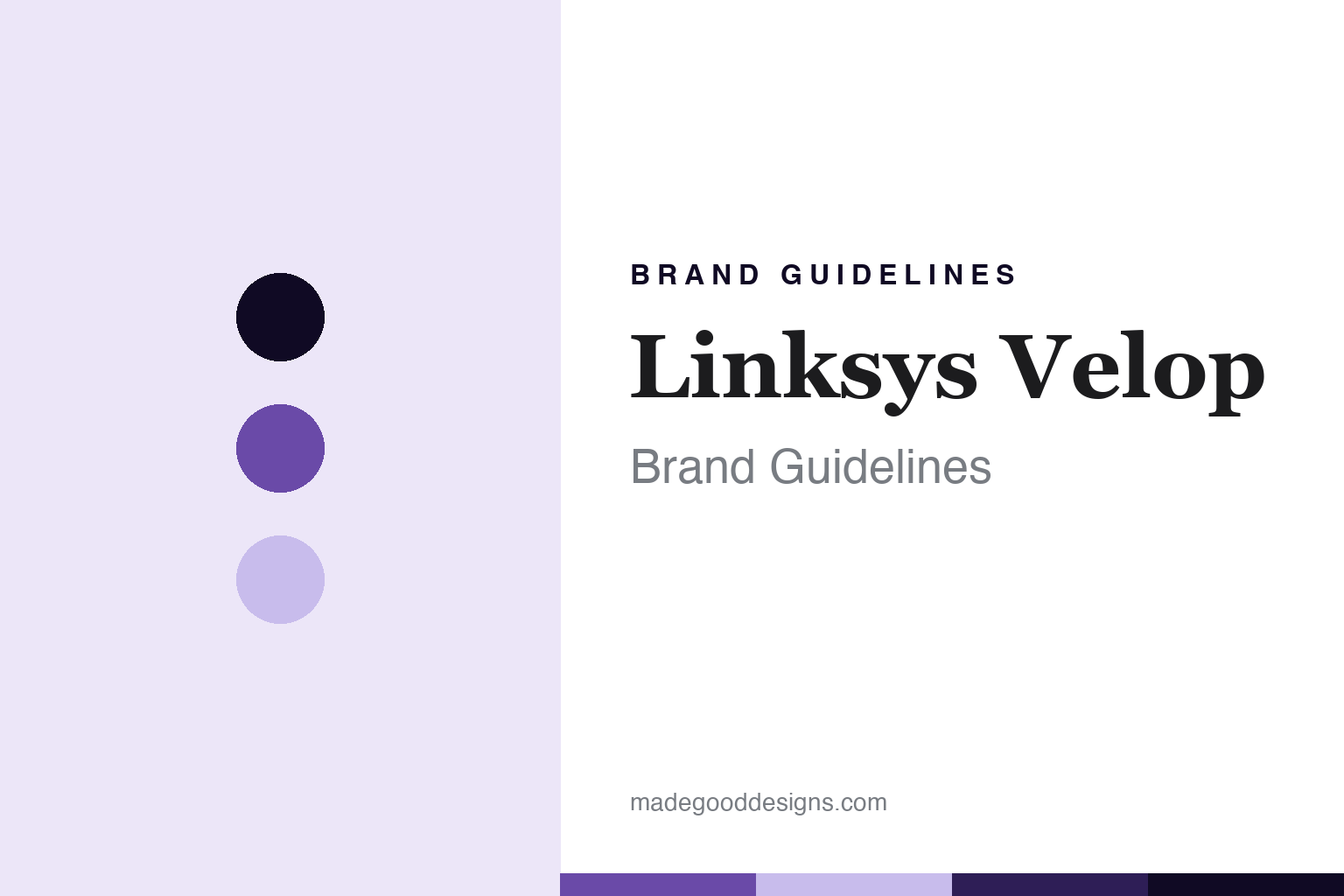
Linksys Velop Brand Guidelines
The heritage mesh, US-owned again.
Aa
Two constants: a velop-violet palette and a velop-serif register. Abstract homage — not a Linksys or Velop product or mark; no router, node or logo is reproduced.
The heritage mesh, US-owned again
Linksys Velop is the mesh line from a heritage router brand that passed through Cisco, Belkin and Foxconn and is now wholly owned by US company Fortinet.
Linksys Velop closes the mesh round as its heritage node — the mesh line from one of the oldest names in home networking, a brand that changed hands repeatedly before landing, in full, with an American cybersecurity company. Its answer to a round about who owns the network and where it is made is a long one: a founder story, a chain of owners across two decades, and a return to US ownership.
Its identity is the heritage mesh, US-owned again. The Linksys heritage, the long ownership chain and the Velop mesh line are the story here. An old name with a new parent. The heritage mesh, US-owned again.
(Honest notes, so the ownership chain is framed accurately and one misconception is prevented. Velop sells mesh as its heroes — the Velop line, launched in 2017 as an “intelligent mesh,” now spanning Wi-Fi 6E and 7 alongside its Atlas and Hydra families; we report its language as the brand’s own. On origin: Linksys was founded in 1988 by the married couple Victor and Janie Tsao in Irvine, California, and became a household name with the WRT54G router in 2002; the corporate entity is described as British-American, registered in England with operations in Irvine. On the ownership chain, in order: Cisco acquired Linksys in 2003; Cisco sold it to Belkin in 2013; Foxconn’s interconnect subsidiary acquired Belkin, including Linksys, in 2018; and the US cybersecurity company Fortinet invested from 2021, reaching majority control, then took full ownership on the last day of January 2025 — so Linksys is now a wholly owned Fortinet subsidiary. We therefore do not describe Linksys as Chinese-owned; the China link is the historical Foxconn parent between 2018 and 2025, not the present. On where it is made: manufacturing is reported to vary by product and region — with country of origin including Vietnam, Taiwan and China depending on the SKU — so we make no blanket claim. On security history, precisely: a 2020 router-hijacking incident exploited weak or reused user credentials rather than a breach of Linksys’s own databases, and a 2024 disclosure found two Velop models transmitted setup credentials in cleartext to a US server, later patched; we report both as documented, and we do not attribute to Linksys the US regulatory router cases that actually involved other brands. Its designs and the Linksys and Velop names are IP we describe but do not reproduce; there is no official brand hex; these tones are an unofficial interpretation.)
Colour
Linksys Velop lives in a velop violet. Click a swatch to copy the hex.
Velop’s identity is heritage, passed-around and US-owned — a velop violet, an ink, a pale velop, a deep violet, and a paper. The palette leans velop violet and pale velop: a considered register that nods to a heritage brand carried through many owners rather than a loud logo colour. It signals the heritage mesh, US-owned again — heritage, passed-around and US-owned. The honest caveat: with no official brand hex, these values are a considered, unofficial interpretation, not first-party colours.
The lesson is a violet signals a heritage identity carried forward. Velop’s world is an old networking name that keeps finding new parents. For designers, it is a reminder that a deep violet and a soft pale can carry a heritage brand — a considered tone held as an accent, not a product shot. Because a mid hue can fail as small text, keep type dark and let the colour live in the accents, palette and band. The takeaways: credit the Linksys heritage and the WRT54G; lay out the ownership chain in order; state that it is now wholly owned by US company Fortinet; correct the Chinese-owned misconception; and make no blanket claim about where each SKU is made.
Typography
The register is a velop serif — heritage, passed-around, US-owned.
Velop’s identity carries a heritage, passed-around, US-owned spirit — an old name carried through many hands, not a new one. A velop serif captures the mood: established, composed and a little worn-in, the register of a brand with a long story. Set in a velop-violet palette, the velop serif feels heritage and considered — exactly the personality Velop carries. It behaves like a made, familiar thing rather than a loud logo, mirroring a coverage ring and a backhaul lattice. (Velop’s real products and the Linksys name are things we describe but do not reproduce, and the exact typeface is not ours to use.) Because it is not ours to use, the honest description is “a velop-serif brand,” shown here in a stand-in. The type behaves like the brand: heritage, passed-around and US-owned.
Aa
A velop-serif brand — heritage and considered. (Specimen set in Playfair Display, a velop-serif STAND-IN; NOT the Linksys or Velop logo or products.)
The mesh node
Linksys Velop stands for the heritage mesh, US-owned again.
Linksys Velop closes the mesh round as its heritage node. A velop-violet palette, a velop serif and a long ownership chain make one thing — the heritage mesh, US-owned again — the whole identity: heritage, passed-around and US-owned. The Velop mesh line is the pitch, and the ownership chain is the story. The point is one of home networking’s oldest names, carried through many parents to a US owner, in a round about who owns the network and where it is made.
Put to work, the identity is the brand told straight, the chain laid out in order and one misconception prevented. A brand in this spirit would credit the Linksys heritage, walk the ownership chain from Cisco to Fortinet, state the present US ownership plainly, and correct the idea that Linksys is Chinese-owned. A reader in this spirit would keep the facts right: Velop sells mesh as its heroes, launched in 2017; Linksys was founded in 1988 by Victor and Janie Tsao in Irvine and made its name with the WRT54G; it went from Cisco in 2003 to Belkin in 2013 to Foxconn’s interconnect arm in 2018, and Fortinet took full ownership on the last day of January 2025, making it a wholly owned US subsidiary; the China link is the historical Foxconn parent, not the present; manufacturing varies by SKU across Vietnam, Taiwan and China, so no blanket claim is made; and its documented security matters — a 2020 credential-stuffing hijack and a 2024 cleartext-credentials disclosure to a US server — are stated precisely, without attributing other brands’ regulatory cases to Linksys. Velop sits after Asus ZenWiFi and closes the round. The honest editorial moves are to credit the heritage, to walk the chain, to state the US ownership, to correct the misconception, and to keep the making SKU-specific.
For designers and brand-builders, Velop closes the mesh node: walk the ownership chain in order — and correct the misconception it invites. The lessons: a heritage brand can pass through many owners, here Cisco, Belkin and Foxconn, before landing with Fortinet; a present owner is stated plainly, a US company as of 2025; a natural misconception — that a brand with a Foxconn chapter is Chinese-owned today — is corrected with the dated facts; a manufacturing base is kept SKU-specific rather than blanketed; and documented security matters are framed precisely, without borrowing other brands’ headlines. It is also a reminder to stay precise: Linksys Velop is the heritage router brand’s mesh line, carried through Cisco, Belkin and Foxconn and now wholly owned by US company Fortinet — with the palette here an unofficial interpretation. The hook is that journey: a garage-founded 1980s networking brand, the maker of a router beloved by tinkerers, handed from giant to giant and finally back into US ownership. Read that way, Velop is less a single product than the heritage mesh, US-owned again: heritage, passed-around, US-owned. The lesson for a brand is that walking the chain and correcting the misconception reinforce each other, and keeping the making SKU-specific keeps the story earned. Velop made the-heritage-mesh-US-owned-again the identity — proof that a well-walked ownership chain can close a round.
Explore & save
Keep Linksys Velop’s identity on hand — save it to a board in the Made Good inspiration library.
Linksys Velop identity set
Pin the velop-violet palette and the velop-serif register to your own board.