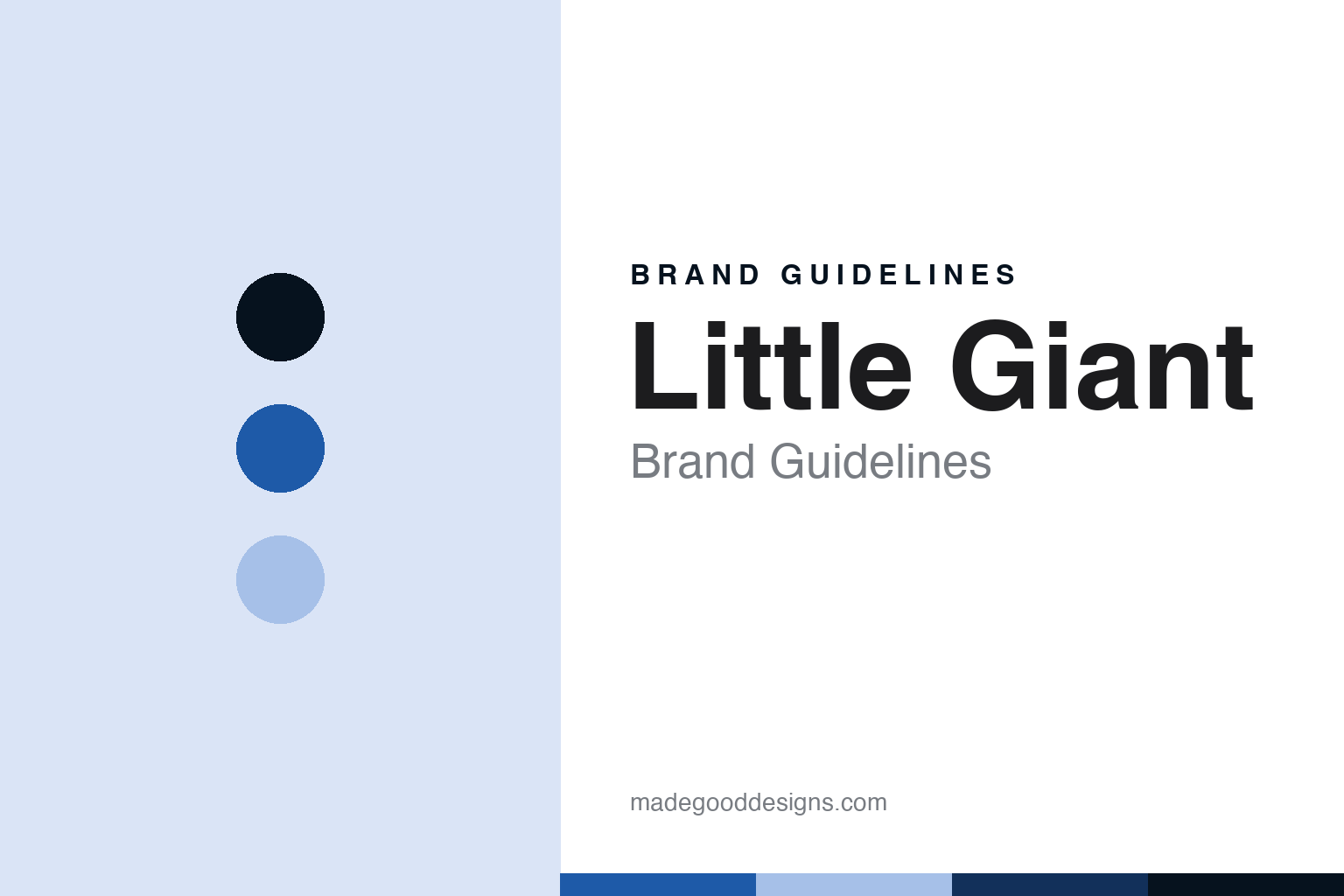
Little Giant Brand Guidelines
The family-run multi-position ladder.
Aa
Two constants: a Little-Giant-blue palette and a multi-position-sans register. Abstract homage — not a Little Giant product or mark; no ladder, rail or logo is reproduced.
The family-run multi-position ladder
Little Giant is the family-run Utah maker whose articulating, multi-position ladders came from a German prototype — and were sold on late-night TV.
Little Giant follows Werner as the round’s family-run node — a Utah maker that turned one clever convertible design into a household name through television. Its answer to a round about who owns and where-makes the ladder is a family firm with a signature format: the family-run multi-position ladder.
Its identity is the family-run multi-position ladder. Wing Enterprises, the German-prototype origin and the multi-position design are the story here. The multi-position ladder. The family-run multi-position ladder.
(Honest notes, so the maker, the origin, the ownership and the making are framed accurately, with a couple of points hedged. Little Giant sells convertible ladders as its heroes; we report its language as the brand’s own. On the maker: Little Giant Ladder Systems is made by Wing Enterprises, Inc., in Springville, Utah. On the origin: the founder Harold Ray, Hal, Wing discovered a ladder prototype in Germany in the 1970s, licensed the design, obtained US patents, and began manufacturing from his home. On ownership: it is family-run, with Wing-family officers and a chief executive, Ryan Moss, from around 2012, though the formal family-owned claim we treat as reported. On the product: multi-position, articulating convertible ladders, marketed with twenty-four position and height permutations, made famous in the as-seen-on-TV era of 2004 to 2005, with current lines including Epic, Velocity, Dark Horse and King Kombo. On the making, nuanced: many models are made in Springville, Utah, and it is designed and engineered in the USA, so it is not accurate to say every Little Giant is US-made. Its designs and the Little Giant name are IP we describe but do not reproduce; there is no official brand hex; these tones are an unofficial interpretation.)
Colour
Little Giant lives in a Little Giant blue. Click a swatch to copy the hex.
Little Giant’s identity is family-run, convertible and US-designed — a Little Giant blue, an ink, a pale blue, a deep navy, and a paper. The palette leans Little Giant blue and deep navy: a clean, practical register that stands in for a family multi-position maker rather than a loud logo colour. It signals the family-run multi-position ladder — family-run, convertible and US-designed. The honest caveat: with no official brand hex, these values are a practical, unofficial interpretation, not first-party colours.
The lesson is a Little Giant blue signals a family-run, convertible identity. Little Giant’s world is the articulating ladder and the infomercial. For designers, it is a reminder that a clean blue and a pale blue can carry a family-run, convertible brand — a practical tone held as an accent, not a product shot. Because a mid hue can fail as small text, keep type dark and let the colour live in the accents, palette and band. The takeaways: name Wing Enterprises and Springville, Utah; trace the German-prototype origin; keep the family-run claim measured; and note that many models, not all, are US-made.
Typography
The register is a multi-position sans — family-run, convertible, US-designed.
Little Giant’s identity carries a family-run, convertible spirit — a maker built on one clever design. A multi-position sans captures the mood: clean, modern and practical, the register of a convertible ladder. Set in a Little Giant-blue palette, the multi-position sans feels dependable and current — exactly the personality Little Giant carries. It behaves like a made, hinged thing rather than a loud logo, mirroring a rail-dot and a rung-line. (Little Giant’s real products and the name are things we describe but do not reproduce, and the exact typeface is not ours to use.) Because it is not ours to use, the honest description is “a multi-position-sans brand,” shown here in a stand-in. The type behaves like the brand: family-run, convertible and US-designed.
Aa
A multi-position-sans brand — clean and practical. (Specimen set in Manrope, a multi-position-sans STAND-IN; NOT the Little Giant logo or products.)
The ladder node
Little Giant stands for the family-run multi-position ladder.
Little Giant sits second in the round as its family-run node. A Little Giant-blue palette, a multi-position sans and Wing Enterprises make one thing — the family-run multi-position ladder — the whole identity: family-run, convertible and US-designed. Wing Enterprises is the maker, the German prototype is the origin, and the multi-position design is the signature. The point is a family firm built on one convertible design, in a round about who owns and where-makes the ladder.
Put to work, the identity is the brand told straight, the origin traced and the making nuanced. A brand in this spirit would name Wing Enterprises and Springville, Utah, trace the German-prototype origin, keep the family-run claim measured, and note that many models are US-made. A reader in this spirit would keep the facts right: Little Giant makes multi-position ladders; Wing Enterprises makes it; it is family-run; and many models are made in Utah. Little Giant sits after Werner and before Louisville Ladder. The honest editorial moves are to name the maker, to trace the origin, to measure the claim, and to nuance the making.
For designers and brand-builders, Little Giant carries the ladder node: a family firm can own a format through one clever design. The lessons: a maker can define a format, here Little Giant and the convertible ladder; a maker is named, Wing Enterprises, Inc., in Springville, Utah; an origin is traced, the founder Hal Wing discovering a prototype in Germany in the 1970s, licensing it and making from his home; an ownership is measured, family-run with Wing-family officers and a chief executive from around 2012, the formal family-owned claim treated as reported; a product is featured, multi-position articulating ladders with twenty-four permutations, the as-seen-on-TV era of 2004 to 2005, and the Epic, Velocity, Dark Horse and King Kombo lines; and a making is nuanced, many models made in Springville, Utah, designed and engineered in the USA, not all US-made. It is also a reminder to nuance a claim: Little Giant is the family-run, convertible ladder, many models US-made — with the palette here an unofficial interpretation. The hook is that format: Little Giant is the family-run multi-position ladder, the family-run Utah maker whose articulating, multi-position ladders came from a German prototype and were sold on late-night TV. Read that way, Little Giant is less a single ladder than the family-run multi-position ladder: family-run, convertible, US-designed. The lesson for a brand is that a family firm can own a format through one clever design, and nuancing the making keeps it honest. Little Giant made the-family-run-multi-position-ladder the identity — proof that a format can carry a node.
Explore & save
Keep Little Giant’s identity on hand — save it to a board in the Made Good inspiration library.
Little Giant identity set
Pin the Little Giant-blue palette and the multi-position-sans register to your own board.