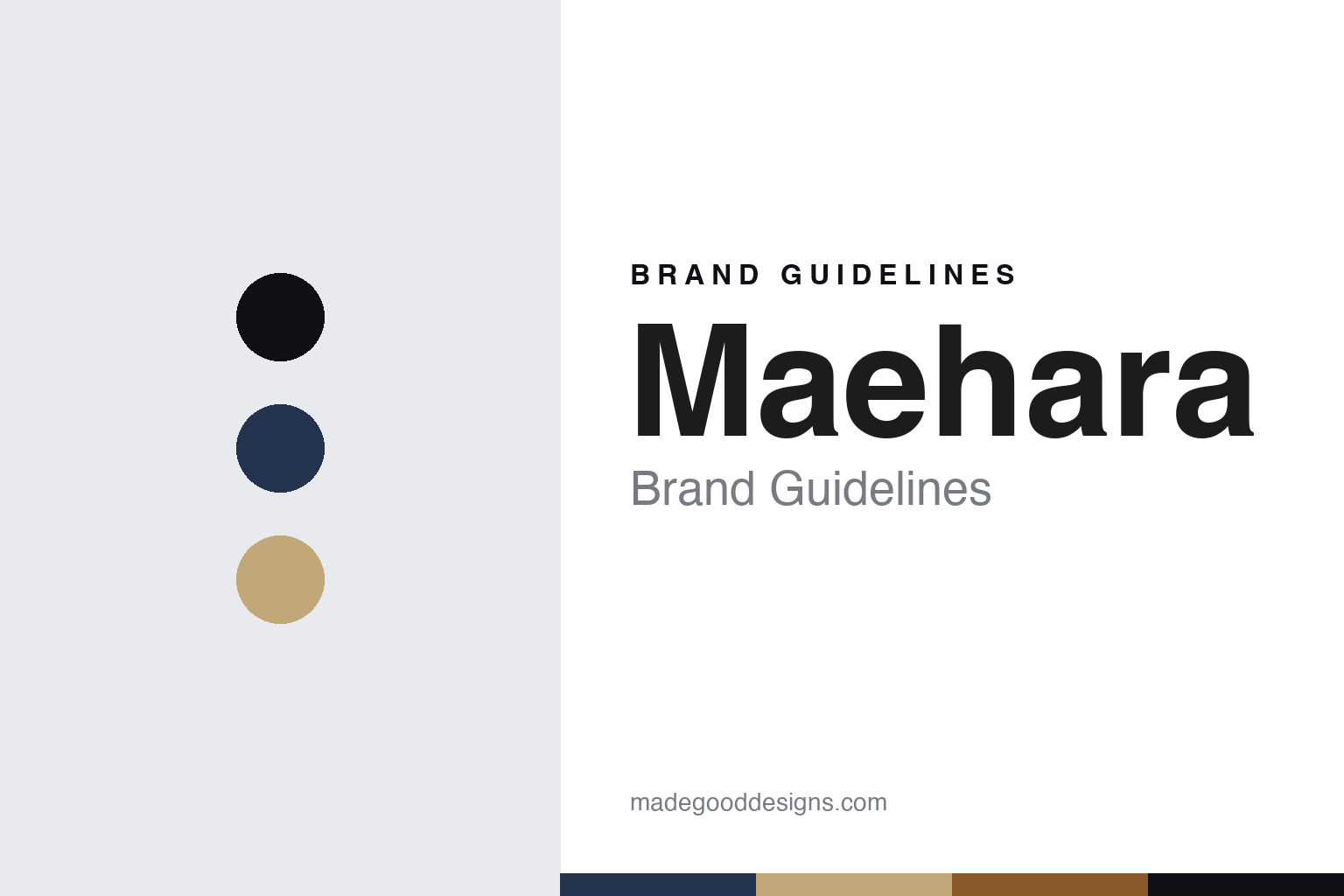
Maehara Brand Guidelines
The Tokyo umbrella.
Aa
Two constants: an ai-indigo palette and a precise sans register. Abstract homage — not a Maehara design, canopy or dragonfly mark.
The Tokyo umbrella
Maehara hand-assembles fine Western-style umbrellas in Tokyo, including its signature 16-rib canopy.
Maehara is a lesson in precision as the identity. A Tokyo house, it hand-assembles fine Western-style umbrellas — yōgasa, not the paper-and-bamboo wagasa — with the exactness of Japanese craft: fabric cut with a knife for clean panels, curved ribs that give a rounded dome, and a signature sixteen-rib canopy that comes close to a true circle. Its answer to how an umbrella is made is a matter of precision. An umbrella, assembled with a craftsman’s exactness.
Its identity is the sixteen-rib Tokyo umbrella. Maehara’s hand-assembly, its made-in-Japan fabric and its rounded canopy are the work it is known for. A precision, made a signature. A Tokyo workshop that turned the Western umbrella into a Japanese craft.
(Honest notes, so the story stays precise. Maehara — 前原光榮商店, trading as Tombo Yōgasa, the “dragonfly Western umbrella” — was founded in 1948 in Asakusa, Tokyo, by Maehara Koei, and remains an independent family maker; it is genuinely made in Japan, with canopy fabric woven in Yamanashi and some lines tailored in Kyoto, across a division of hand-craft roles. Its best-known piece is the sixteen-rib “Tokyo umbrella,” whose extra ribs narrow the panels toward a near-circular canopy, often on lightweight carbon ribs. It makes Western-style umbrellas, distinct from traditional wagasa. Its dragonfly mark and designs are its IP, described but never reproduced, and there is no official brand hex — these tones are an unofficial interpretation. This is design commentary and does not promote any product.)
Colour
Maehara lives in an ai-indigo palette. Click a swatch to copy the hex.
Maehara’s identity is precise, quiet and Japanese — an ai indigo, an ink, a straw, a wood, and a chalk. The palette leans ai indigo and straw: the register of a deep Japanese dye and a natural canopy. It signals craft and precision over show. The honest caveat: with no published brand hex, these values are an original, unofficial interpretation, not first-party colours.
The lesson is an ai-indigo palette signals a precise, Japanese identity. Maehara’s world is a hand-assembled, made-in-Tokyo, rounded-canopy object. For designers, it is a reminder that a deep indigo and a warm straw can carry a brand built on precision — the indigo of a Japanese dye and the straw of a woven canopy. Because these tones can fail as small text, keep type dark and let the colour live in the accents, palette and band. The takeaways: assemble it precisely; make it in Japan; refine one signature; and treat any single hex as unofficial.
Typography
The register is a precise sans — clean, exact, quiet.
Maehara’s identity carries a clean, exact, quiet spirit — a precise object, not a loud one. A precise sans captures the mood: even, controlled and calm, the register of a Tokyo umbrella workshop. Set in an ai-indigo palette, the precise sans feels clean and exact — exactly the personality Maehara carries. It is quiet rather than showy, mirroring a canopy of many careful panels. (Maehara’s real designs and dragonfly mark are things we describe but do not reproduce, and the exact typeface is not ours to use.) Because it is not ours to use, the honest description is “a precise-sans spirit,” shown here in a stand-in. The type behaves like the maker: clean, exact and quiet.
Aa
A precise-sans spirit — clean and exact. (Specimen set in Hind, a precise-sans STAND-IN; NOT the Maehara wordmark or the dragonfly mark.)
How an umbrella is made
Maehara stands for the sixteen-rib Tokyo umbrella.
Maehara is a lesson in making precision the identity. An ai-indigo palette, a precise sans and a rounded canopy make one construction — a knife-cut, sixteen-rib, hand-assembled umbrella — the whole maker: precise, quiet and Japanese. The construction is the differentiator. The differentiator is exactness: extra ribs, narrower panels, cleaner curves, and a canopy that closes toward a true circle.
Put to work, the identity is construction as design. A maker building in this spirit would pursue a single measurable refinement — here, more ribs and truer geometry — keep the making in Japan, and let precision be the whole brand, so the customer buys an object made better, not louder. It would treat the sixteen-rib canopy as its signature. It would keep the Western umbrella a Japanese craft, distinct from wagasa. The lesson Maehara teaches is that precision can build a brand: the exactness gives it distinction, and the Japanese making gives it substance. The construction is the personality, and the sixteen ribs are the proof.
For designers and brand-builders, Maehara offers a clear takeaway in this round about how an umbrella is made: refine one measurable thing until it is your signature. The lessons: assemble it precisely; make it at home; own a single refinement; and never reproduce a protected mark. It is also a reminder to stay precise: Maehara is an independent Tokyo house founded in 1948 by Maehara Koei, hand-assembling fine Western-style umbrellas including the sixteen-rib Tokyo umbrella, made in Japan — with the palette here an unofficial interpretation. Maehara made precision the maker — proof that exactness can be the difference.
Explore & save
Keep Maehara’s identity on hand — save it to a board in the Made Good inspiration library.
Maehara identity set
Pin the ai-indigo palette and the precise-sans register to your own board.