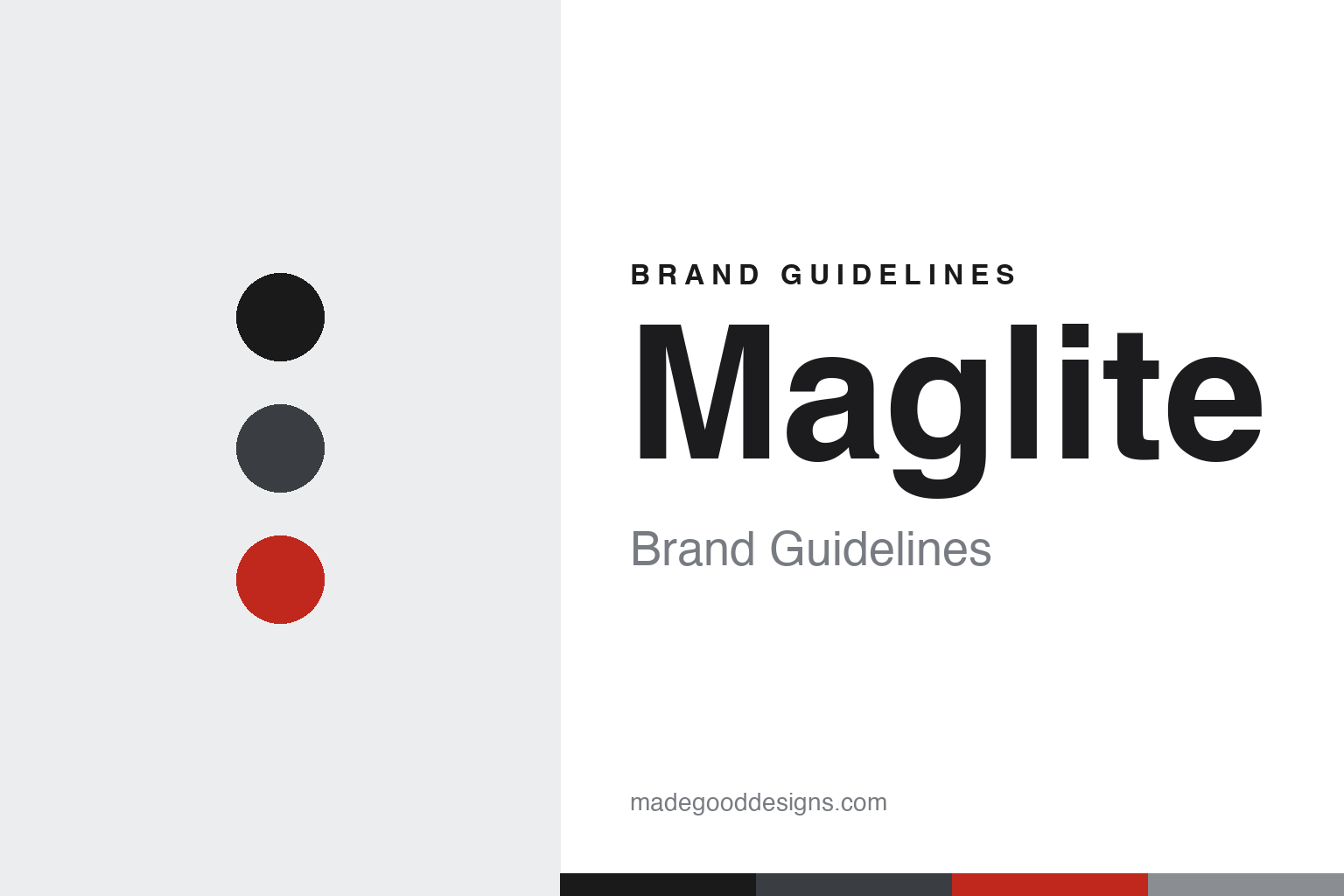
Maglite Brand Guidelines
A machined-aluminum torch with a twist-to-focus beam — American precision engineering you can hold.
Aa
Two constants: a black-and-anodized palette and a machined, technical sans. Abstract homage — not the Maglite wordmark or torch.
Machined aluminum
Maglite made a flashlight into a piece of precision engineering.
Maglite’s identity is precision engineering you can hold. The flashlight is a machined, anodized aluminum body — tough, water-resistant, with a knurled grip — and its signature feature is an adjustable focusing beam: twist the head to go from a tight spot to a wide flood. The full-size C- and D-cell Maglite (1979) and the pocket-size Mini Maglite (1984, running 2×AA) turned a throwaway household item into a serious, machined tool with real heft and quality. That combination of a beautifully machined aluminum body and a genuinely useful focusing mechanism is the whole brand. (Honest caveats: the wordmark is custom/proprietary lettering — and beware a same-named commercial font that is not the brand’s — so don’t name a font; and Maglite publishes no official brand hex.)
The company’s story is one of American machining. Anthony Maglica, a Croatian-American, founded Mag Instrument as a machine shop in 1955 in Southern California, making precision parts for aerospace and industry; he applied that machinist’s precision to flashlights, launching the first Maglite in 1979 and the Mini Maglite in 1984. The company is headquartered and manufactures in Ontario, California. A core brand pillar is American manufacturing: Maglite makes its full line in that single US factory, and Maglica is an outspoken advocate for domestic manufacturing — the fully-defensible phrasing is “designed, engineered and assembled in the USA.”
Maglite earned genuine design recognition: the Mini Maglite is in the Smithsonian’s Cooper Hewitt design museum (and London’s V&A holds a Maglite too), and it was cited by Fortune in 1988 among the products “America makes best,” grouped with the VW Beetle and Levi’s 501s. It also became a law-enforcement standard for decades — the big C/D models doubled as a duty tool (though many departments have since moved to smaller LED lights). The company remains privately held and founder-led: Anthony Maglica, past 90, still runs Mag Instrument and personally inspects new products.
Colour
Maglite lives in black and anodized finishes. Click a swatch to copy the hex.
Maglite’s palette centres on black, alongside the classic anodized aluminum finishes — natural silver, black, red, blue and others that give the machined body its look. The black-and-metal scheme reads as tough, technical and precise, exactly matching a machined-aluminum tool built for reliability and hard use. The anodized colour options let the same precise object come in a range of finishes without changing its engineered character. The honest caveat: Maglite publishes no official public brand hex, so the black and anodized values here are representative approximations rather than a confirmed spec.
The lesson is a technical palette that reflects the material. Maglite’s black-and-anodized identity comes straight from the machined-aluminum product, so it feels engineered and authentic. For designers, it’s a reminder that a tough, technical palette drawn from a product’s real material and finishes can be more convincing than any decorative scheme. The takeaways: let the product’s material and finishes define the palette (machined aluminum, anodized colours); keep it technical and restrained for an engineered tool; and treat specific hexes as approximate when the colour lives in the anodizing rather than a published value.
Typography
The wordmark is a machined, technical sans.
Maglite’s machined, technical sans wordmark matches the precision of the product. Strong, engineered letterforms read as technical, tough and exact — the register of a company that came from a precision machine shop and treats a flashlight as a piece of engineering. Set against the black or anodized aluminum body, the type feels solid and industrial, never decorative, matching a tool built for reliability and duty use. That machined, no-nonsense character is the point: Maglite’s appeal is precision and durability, and the identity signals both. (Honest caveats: the wordmark is custom lettering, and a commercial font that happens to share the “Maglite” name is unrelated to the brand — so the honest description is “a machined, technical sans,” not a named font.) The type behaves like the brand: precise, engineered and tough.
Aa
A machined, technical sans. (Specimen set in Chakra Petch, a technical sans in the spirit of Maglite’s machined identity; the real wordmark is custom — and not the same-named commercial font.)
Precision, made in America
Maglite built a brand on machining and domestic manufacturing.
Maglite is a lesson in a brand built on precision and provenance. Anthony Maglica took a machinist’s obsession with precision and applied it to a mundane object — the flashlight — turning it into a machined-aluminum tool good enough for the Smithsonian and tough enough for police duty. Just as important is the story of where it’s made: Maglite’s commitment to manufacturing in a single US factory, and Maglica’s outspoken advocacy for American manufacturing, became a genuine part of the brand’s meaning. Precision engineering plus proud domestic manufacturing is the whole identity — a quality object, made with integrity, in America.
For designers and brand-builders, Maglite offers a clear takeaway: precision and provenance can define a brand. The lessons: bring real engineering rigour to an ordinary object (machining a flashlight from aluminum) so quality becomes tangible; make provenance part of the brand (designed, engineered and assembled in the USA) where it’s genuine; and let a technical, material-led identity reflect that precision. It’s also a reminder to keep the facts precise — Anthony Maglica founded Mag Instrument as a machine shop in 1955 and launched the Maglite in 1979 and the Mini Maglite in 1984, in Ontario, California; the Mini Maglite is in the Smithsonian’s Cooper Hewitt (not, as sometimes claimed, MoMA); it became a police standard; and the company is privately held and founder-led. Maglite turned a flashlight into precision engineering — proof that craftsmanship and provenance can be a brand.
Explore & save
Keep Maglite’s identity on hand — save it to a board in the Made Good inspiration library.
Maglite identity set
Pin the black-and-anodized palette and the machined-sans spirit to your own board.