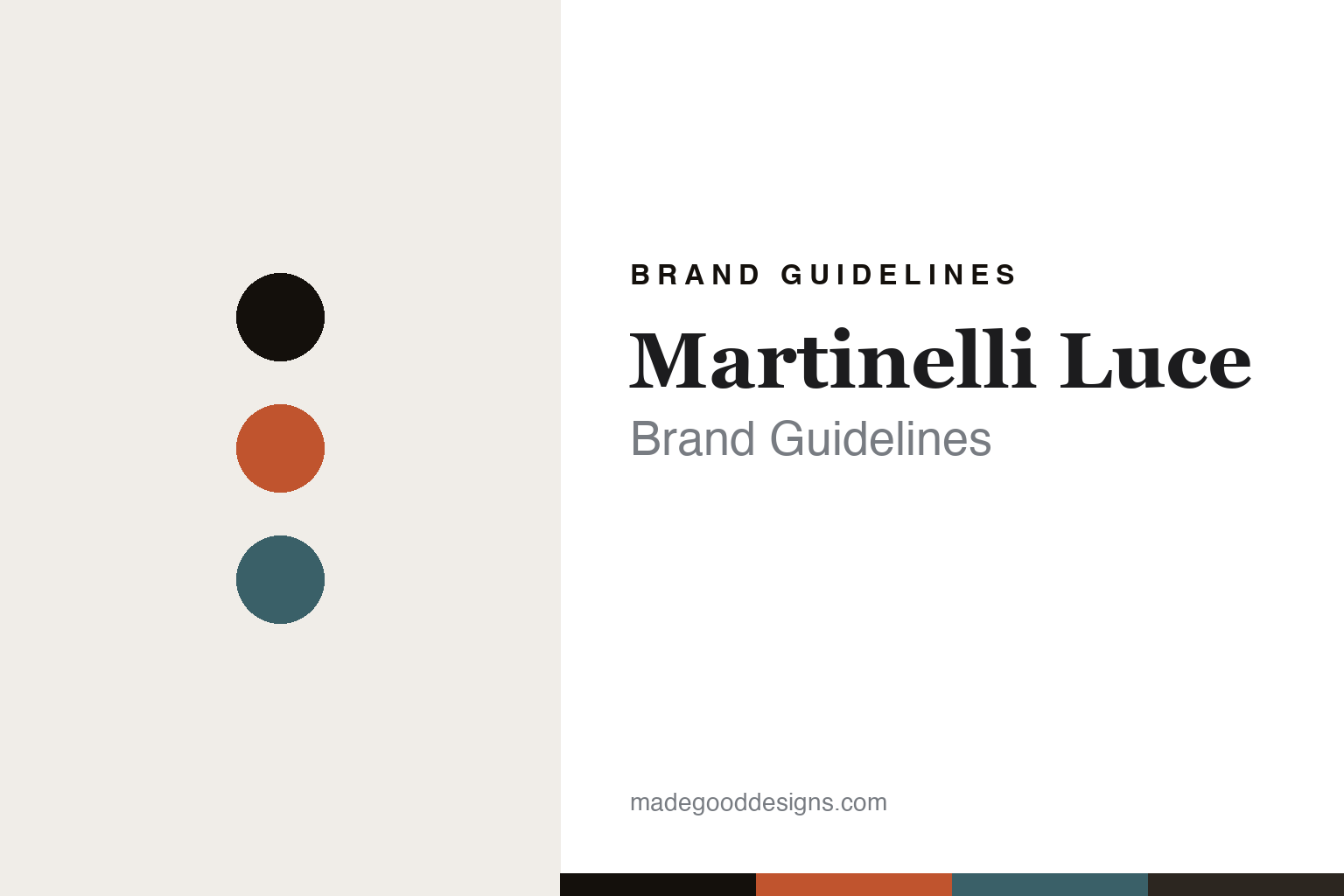
Martinelli Luce Brand Guidelines
Italian light, since the fifties.
Aa
Two constants: an orange-and-teal palette and a retro-modern serif register. Abstract homage — not a Martinelli Luce fixture or wordmark.
Italian light, since the fifties
Martinelli Luce is a Lucca house of space-age Italian lighting, family-run since the 1950s.
Martinelli Luce is a lesson in a modernist lineage as the identity. An Italian lighting house from Lucca, family-run since the 1950s, it built its name on space-age, experimental Italian design — sculptural lamps in new materials — and on producing some of the era’s icons.
Its identity is Italian light, since the fifties. Martinelli Luce’s 1960s and 70s modernist lamps, made in Tuscany and still in production, are the work it is known for. Italian light, kept in the family. A house with a place in design history.
(Honest notes, and one attribution to get exactly right. Martinelli Luce is an Italian brand based in Lucca, Tuscany, founded by Elio Martinelli, who set up his workshop in Lucca in 1950 — so it dates to the 1950s, not 1965 — and it is independent and family-run today, led by his daughter Emiliana Martinelli, its president and art director, with her son Marco Martinelli. Its signature is space-age Italian modernism of the 1960s and 70s, with material experimentation in methacrylate and moulded resin. The critical point: its most famous fixture, the Pipistrello table lamp of 1965 — with its four curved, bat-wing opaline “petals” on a telescopic stem — was designed by the architect Gae Aulenti and is manufactured by Martinelli Luce, so we attribute it to Aulenti and describe the manufacturer’s role separately; the “1965” often quoted is the lamp’s design year, not the company’s founding. The Cobra lamp of 1968, by contrast, was designed by Elio Martinelli himself, and we do not swap the two attributions. On production, it is made in Italy, in the Lucca area, and it is not owned by any lighting group. The Pipistrello is a protected, internationally-collected and heavily-counterfeited design icon, so we describe its form in words and never reproduce its silhouette; the same care applies to Cobra and other signature lamps, and there is no official brand hex — these tones are an unofficial interpretation. This is design commentary and does not promote any product.)
Colour
Martinelli Luce lives in an orange-and-teal palette. Click a swatch to copy the hex.
Martinelli Luce’s identity is space-age, warm and modernist — an orange, an ink, a teal, a graphite, and an opaline off-white. The palette leans orange and teal: the register of 1960s-and-70s Italian optimism and glossy, moulded materials. It signals design history and material play over restraint. The honest caveat: with no published brand hex, these values are an original, unofficial interpretation, not first-party colours.
The lesson is an orange-and-teal palette signals a space-age modernist identity. Martinelli Luce’s world is a space-age, warm, modernist object. For designers, it is a reminder that a palette can evoke an era — that a house rooted in 1960s-and-70s Italian design can use warm orange and cool teal to summon that optimism. Because a mid orange can fail as small text, keep type dark and let the colour live in the accents, palette and band. The takeaways: honour your era; let the palette evoke it; keep the material play alive; and treat any single hex as unofficial.
Typography
The register is a retro-modern serif — warm, characterful, mid-century.
Martinelli Luce’s identity carries a warm, characterful, mid-century spirit — a modernist object with history. A retro-modern serif captures the mood: characterful and a little nostalgic, the register of mid-century Italian design. Set in an orange-and-teal palette, the retro-modern serif feels warm and characterful — exactly the personality Martinelli Luce carries. It is expressive rather than clinical, mirroring a moulded, space-age lamp. (Martinelli Luce’s real fixtures — including designs by named designers — and its wordmark are things we describe but do not reproduce, and the exact typeface is not ours to use.) Because it is not ours to use, the honest description is “a retro-modern-serif spirit,” shown here in a stand-in. The type behaves like the brand: warm, characterful and mid-century.
Aa
A retro-modern-serif spirit — warm and characterful. (Specimen set in Fraunces, a retro-modern-serif STAND-IN; NOT the Martinelli Luce wordmark or any lamp design.)
A lineage as identity
Martinelli Luce stands for Italian light, since the fifties.
Martinelli Luce is a lesson in making a modernist lineage the identity. An orange-and-teal palette, a retro-modern serif and a catalogue of space-age Italian lamps make design history the whole brand — warm, characterful and modernist. The lineage is the differentiator. The differentiator is a real place in the story of Italian design — producing icons of the 1960s and 70s and still making them, family-run, in Lucca.
Put to work, the identity is a heritage as design. A house building in this spirit would honour its history and keep making its classics well, while crediting the designers behind them, so the customer buys into a lineage, not just a lamp. The lesson Martinelli Luce teaches is that a genuine design heritage plus continued, faithful manufacture can build a brand: the icons give it authority, and the family-run making gives it integrity — provided the attributions are exact. The lineage is the personality, and the making is the proof.
For designers and brand-builders, Martinelli Luce offers a clear takeaway: honour your history and credit its authors. The lessons: build on a real lineage; keep making the classics; make them at home; and be exact about the story. It is also a reminder to stay accurate: Martinelli Luce dates to Elio Martinelli’s 1950 Lucca workshop, is family-run and made in Italy, and its most famous lamp, the 1965 Pipistrello, is Gae Aulenti’s design that the house manufactures — the Cobra is Elio Martinelli’s own, the two are not interchangeable, and the palette here is an unofficial interpretation. Martinelli Luce made an Italian modernist lineage the brand — proof that a heritage can be the difference.
Explore & save
Keep Martinelli Luce’s identity on hand — save it to a board in the Made Good inspiration library.
Martinelli Luce identity set
Pin the orange-and-teal palette and the retro-modern-serif register to your own board.


