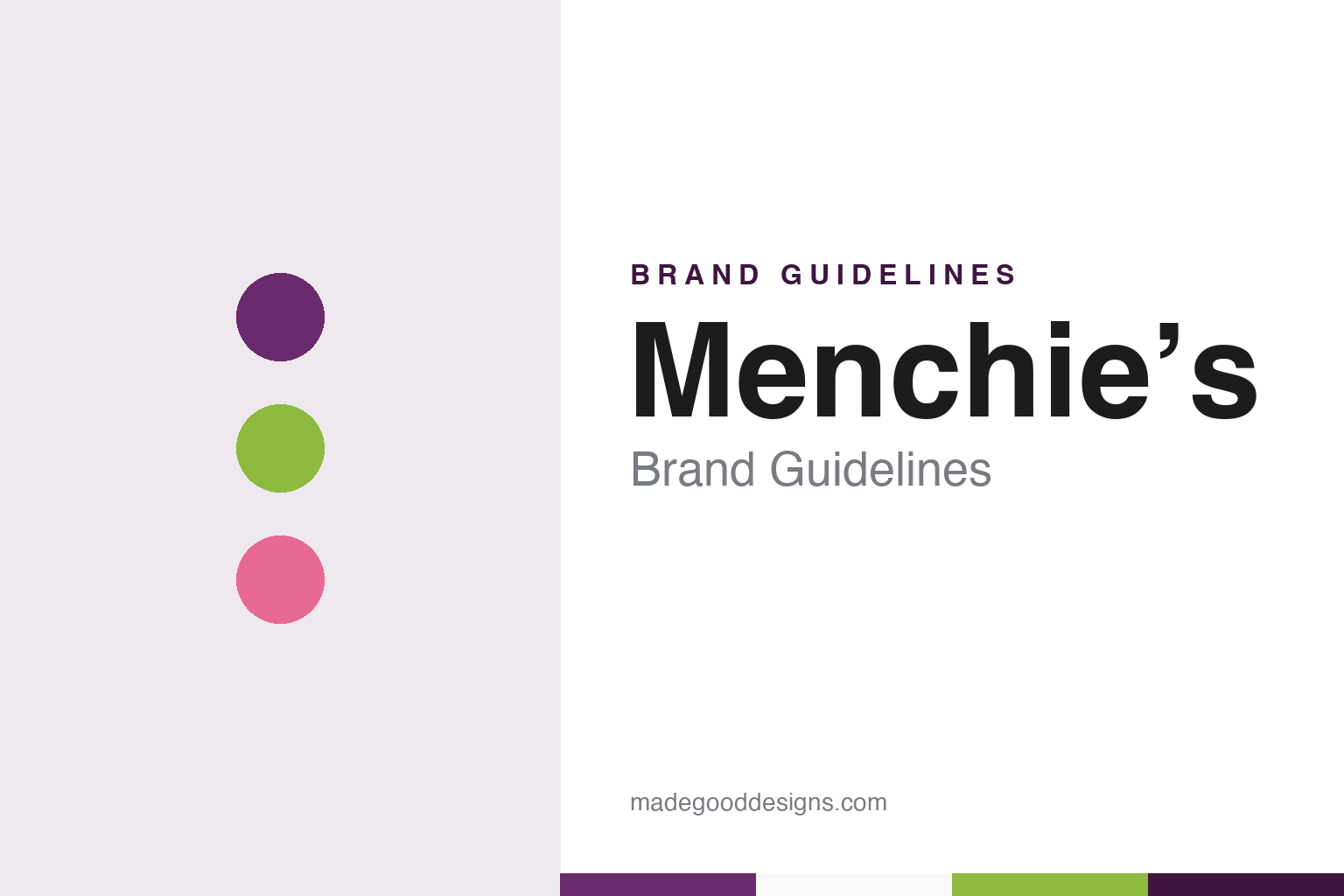
Menchie’s Brand Guidelines
The self-serve froyo chain that puts a smile on the cup.
Aa
Two constants: a grape, kiwi and strawberry palette and a rounded sans register. Abstract homage — not a Menchie’s product or mark; no mascot, logo or cup is reproduced.
One shop in the Valley
A frozen yogurt shop that turned into a franchise within two years.
Menchie’s Frozen Yogurt opened its first shop in 2007. English Wikipedia gives the date as 15 May 2007 and the place as Los Angeles; Fox Business, in a profile published in January 2012, placed the start in Valley Village, in the San Fernando Valley, and named the founding team as Danna and Adam Caldwell. The company’s own history page says the aim from the start was to make people smile and to give families, friends and communities a place to celebrate.
The name and the mascot are the same word. English Wikipedia says “Menchie” came from a nickname used by the founders and is also the name of the company’s mascot, a character who appears on the company’s website today.
Franchising came quickly. Within a year, Fox Business reported, the founders partnered with Amit Kleinberger, who became chief executive, to lead the expansion into franchising. The first franchised shop opened in Woodland Hills, California, in 2009, the same profile said, and Kleinberger told the reporter he had met every franchisee face to face. By January 2012 the chain had 130 stores in 30 states and Canada, according to Fox Business, and was exploring Japan, Australia, Mexico and the United Kingdom. English Wikipedia’s article on frozen yogurt dates Menchie’s entry into Japan to 2012.
The profile also described a training centre the company called Menchie’s University, with an auditorium, a classroom and a working store, where new franchisees followed a 14-day programme focused on leadership in their communities. English Wikipedia notes that Kleinberger appeared in two episodes of the television series Undercover Boss, an appearance the company still mentions on its history page.
Colour
Pull the handle, pick the toppings.
A Menchie’s shop works on self-service. The company describes the routine on its website: a guest takes a cup, fills it from the frozen yogurt machines with any mix of flavours, then moves to a toppings bar of candy, chocolate and fresh fruit, and builds the cup to taste. It promises new flavours every month, and its pages list cakes, açaí bowls, delivery, catering and fundraising alongside the cup itself.
The company makes several claims about the product, and they are given here as its own. It says its frozen yogurt is made with fresh milk from its California dairy, and that its entire line of frozen products is certified kosher, with certification for individual flavours available on request. It also says it rotates vegan, plant-based flavours made with oat, almond and coconut milk, and that its sorbets are dairy-free.
Menchie’s has long sold the visit as an occasion. Kleinberger told Fox Business in 2012 that the business was a “feel good model,” pointing to party rooms, free balloons and temporary tattoos, and said: “our mission is to make you smile.” The company now offers birthday parties in its shops and frozen yogurt cakes for birthdays, weddings and anniversaries, made to order.
The mascot has company. Menchie belongs to a cast the brand calls the Sweet Friends, each tied to a flavour: Chip, described as Menchie’s closest friend, loves peanut butter; Mookie, the performer of the gang, sings about cookies and cream; Sprinkle, with a rainbow, shares cake batter yogurt. The other members of the gang, from Kiwi to Mellow, follow the same pattern, and the website offers colouring sheets, masks and a pumpkin-carving stencil for children to print.
Where the shops go matters to the format. Fox Business reported in 2012 that the company looked for sites near schools and in high-traffic areas, and that it had tightened its site-selection process after two early franchised shops closed. Once a shop opened, the company sent its own trainers to spend four days in the store, and followed up with online classes for franchisees.
Typography
Category.
Ice cream, gelato and frozen-yogurt chains sell something that melts within minutes, so much of their identity sits in the shop itself. The counter, the cabinet of flavours, the cone and the cup are the brand’s most visible surfaces, and the companies’ own pages tend to describe their shops, their kitchens and their ingredients before anything else.
Serving style can become a signature. Amorino, the Paris gelato chain, shapes its gelato into a flower with a spatula, according to French Wikipedia, and in 2012 the business magazine Capital described its shops in tobacco tones rather than the bright white then common among its rivals. The guides in this series look at how each chain describes its own counters, cups and cones, in the words the companies publish.
Names carry a lot of the work. Gelato chains may keep Italian flavour names on their menus, as Capital reported of Amorino, and some chains tie their story to one place. Grom, the Turin gelateria, describes its history through a single founding square, Piazza Paleocapa, and a single central laboratory near the city, and says its shops churn the gelato each day.
Ownership is part of the story too. Some chains grow through franchising, some stay with their founders, and others pass into large groups: Unilever announced its purchase of Grom in 2015, and Grom says it has been part of The Magnum Ice Cream Company since 2025. Each guide in this series sets out who founded the brand, who owns it now and where its products are made, and marks clearly what rests on the company’s own word.
Aa
A rounded sans for a self-serve shop. (Specimen set in Fredoka, a sans STAND-IN; NOT the Menchie’s logo.)
Menchie’s
A smile as the brand promise.
Store counts for Menchie’s vary by source and date. Fox Business gave 130 stores in January 2012. English Wikipedia now gives 540 locations, across the United States, Puerto Rico, Canada, the Bahamas, Kuwait, the United Arab Emirates, Saudi Arabia, Qatar and Bangladesh. The company itself says it has served “tens of millions” of cups over close to two decades, and calls itself “the largest self-serve frozen yogurt brand in the world,” a claim it makes about its own business.
The chain trades in a category that has had its ups and downs. In February 2026 the retail-property association ICSC reported that frozen yogurt chains were expanding again, citing Placer.ai figures: of the 23 months from January 2024, froyo shop traffic grew faster year on year than traffic for the wider dessert category in 15. The analytics firm’s sample of froyo brands included Menchie’s, Yogurtland and Forever Yogurt.
The brand’s language is built on one idea. Its history page returns again and again to smiles: guests are invited to “come smile with us,” stores are described as designed to lift the spirits, and a cup of frozen yogurt is called a “perfect cup of happiness.” The mascot carries that message onto children’s activity sheets, while the shop itself, with its row of machines and its toppings bar, is set up for guests to serve themselves.
For a design guide, Menchie’s shows how a mascot and a single repeated word can hold a franchise together across many countries. Compare Pinkberry, another frozen yogurt chain that began in Los Angeles, and Yogurtland, another self-serve chain founded in Southern California. For this guide we use a grape purple, a kiwi green and a strawberry pink with a sans, an unofficial interpretation; no product or logo is reproduced.
Explore & save
Keep Menchie’s’s identity on hand — save it to a board in the Made Good inspiration library.
Menchie’s identity set
Pin the Menchie’s grape, kiwi and strawberry palette and the rounded sans register to your own board.