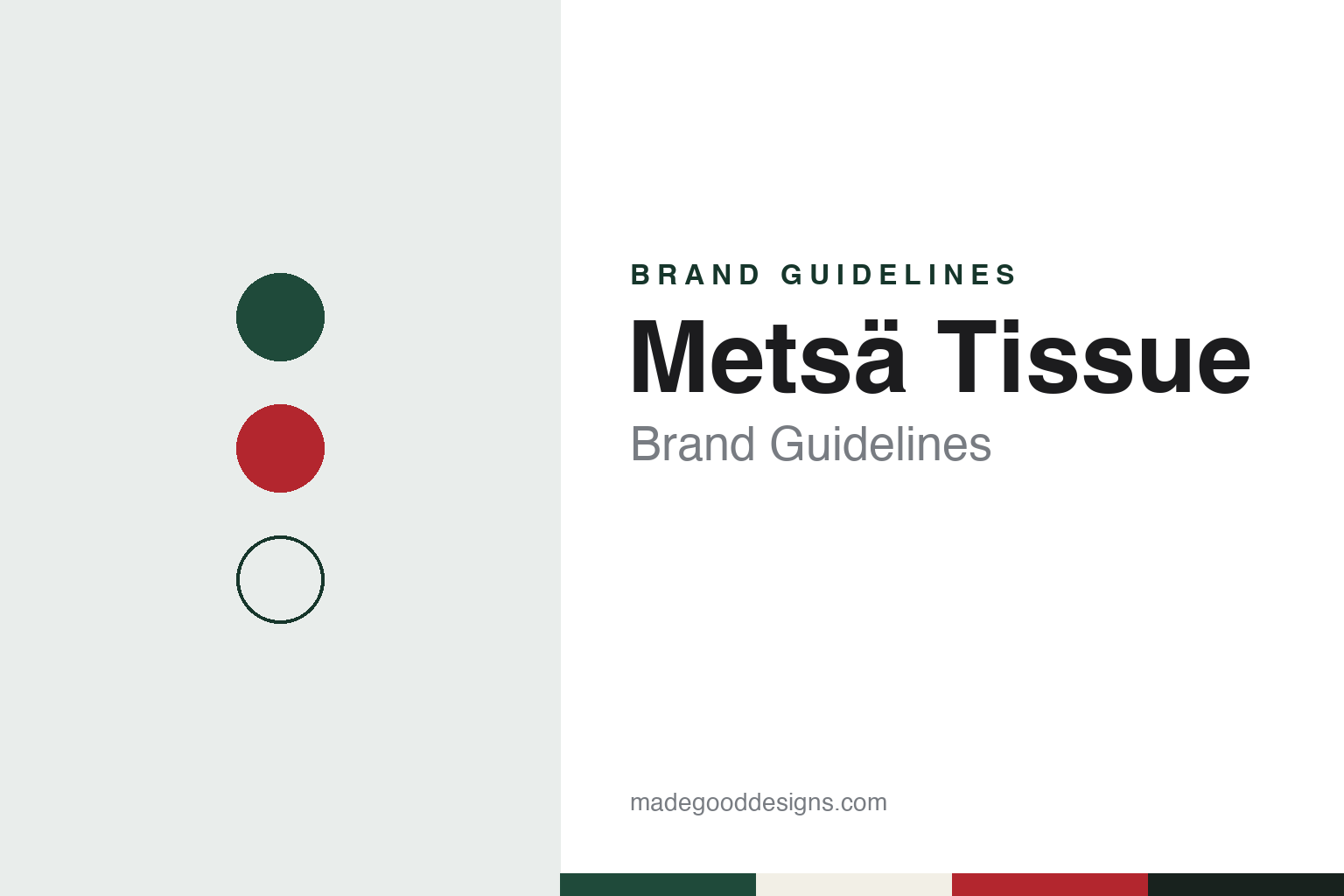
Metsä Tissue Brand Guidelines
A forest-owner cooperative’s tissue maker, from Mänttä to Mariestad.
Aa
Two constants: a spruce green, birch white and red palette and a Nordic sans register. Abstract homage — not a Metsä Tissue product or mark; no pack, dispenser or logo is reproduced.
Owned by forest owners
A cooperative’s tissue arm in Espoo.
Metsä Tissue is the tissue and greaseproof-paper business of Metsä Group, the Finnish forest-industry group, and it is based in Espoo, in the Tapiola district, Finnish Wikipedia says. The same article says Metsä Tissue Oyj is wholly owned by the Metsäliitto Cooperative, whose members are Finnish forest owners, and that commercially and operationally it is part of Metsä Group. English Wikipedia puts the cooperative’s membership at nearly 100,000 forest owners. Metsä Tissue says its results are reported quarterly as part of Metsä Group’s financial information, so it does not publish separate annual accounts in the way a listed company would.
The group’s roots lie in the Finnish cooperative movement of the early twentieth century. English Wikipedia says Metsäliitto Oy was set up in 1934 and began with timber exports, became a cooperative in 1947, moved into sawmilling and then, in the 1950s, into the chemical forest industry. A milestone for the paper side came in 1987, when G. A. Serlachius Oy and Metsäliiton Teollisuus Oy combined to form Metsä-Serla. Today the group is organised into separate businesses for tissue and cooking papers, board, pulp, wood products and forestry services, and Metsä Tissue is the one that reaches supermarket shelves and public washrooms.
The oldest site in the tissue network is the mill at Mänttä in central Finland, which Metsä Tissue dates to 1868. It runs three tissue machines and one greaseproof machine, has a deinking plant for recycled paper and, the company says, was the first mill in Finland to use recycled fibre in tissue. The Swedish mill at Mariestad, known as Katrinefors, is older still: Metsä Tissue says it was established in 1765, when paper was made from textile scraps, and that in the late nineteenth century matchbox labels in blue straw paper made up most of its output. A sulphite factory followed there in 1915.
Both English and Finnish Wikipedia record that the company’s operations in Russia ended in 2015.
Colour
Lambi, Serla and a red washroom brand.
Metsä Tissue sells under six brands of its own, it says, alongside private-label products for European retailers. Lambi and Serla are its consumer names in the Nordic region, which the company describes as the leading consumer tissue brands there. Tento serves the Czech Republic and Slovakia, and Mola is sold in Poland. SAGA covers baking and cooking papers for Finland, the Baltic states and professional kitchens. The consumer ranges run across toilet tissue, household towels, handkerchiefs and facial tissues, and the company says many of them carry environmental labels such as the Nordic Swan, the EU Ecolabel or the German Blue Angel.
The sixth brand, Katrin, is the one with the clearest design story. Metsä Tissue says the name was first used in 1974, which it presents as one of the first professional tissue brands in Europe, and that it comes from the Katrinefors mill. Katrin supplies hand towels, toilet paper, cleaning towels and dispensers for offices, schools, restaurants, factories and other workplaces. The company’s own timeline treats the dispenser as the product: its first range, Sinus, arrived in 1988 in white or a light grey, with the stated aim of giving a washroom “a uniform look.” In 1996 came Katrin Ultimatic, the first Katrin System product, which presented one sheet at a time, and in 1998 the brand adopted “Less is More” as its working motto for dispensers matched to their own towels and rolls.
Later steps in the same timeline are practical rather than decorative. The EasyFlush range of 2004 was made for vacuum toilets on trains, aircraft and ships. The Handy Pack of 2012 reduced packaging size. In 2016 Katrin introduced Inclusive dispensers designed for a broad range of users, which the company says comply with the European Accessibility Act, and since 2019 its black dispensers have been made of recycled plastic, it says.
Colour is the brand’s signature. Katrin’s pages open with the line “Commitment has a colour. Red.”, and a recent brand renewal, presented by the company under the title “Redefining Red,” promised sharper visuals, more direct claims and a signature red “more visible than ever.” For a professional hygiene brand sold through wholesalers and facility-management firms, that single colour does much of the identity work across dispensers, cartons and catalogues.
Typography
Design and documentation.
Tissue and hygiene-paper makers mostly sell under names that are not their own. The corporate group is often a holding name, and shoppers meet it through a portfolio of consumer brands: Essity’s brands page lists TENA, Tork, Libero, Lotus and Zewa, each with a short category label and a link to its own website, while Sofidel puts Regina first and runs separate Regina sites for seven European countries alongside national names such as Sopalin, Le Trèfle and Hakle.
Consumer pack design follows those brand families rather than the parent. Brand names travel across toilet paper, kitchen towels and handkerchiefs, and some identify themselves by a physical detail: Sofidel says its KittenSoft tissue is recognisable by a heart-shaped embossing. Many brands came to their current owners through acquisitions, so a group’s portfolio often mixes a home-grown house brand with bought national names that keep their local identities.
The away-from-home side looks different again. Here the product is often a system for washrooms and other busy places, pairing paper with dispensers. Essity describes Tork as tissue and dispenser systems for professional and high-traffic environments and says more than 30 million Tork dispensers are refilled regularly; Sofidel lists away-from-home products as one of four business lines, next to its consumer brands, private label goods for retailers and parent reels, the large semi-finished reels sold to other converters.
The corporate websites then speak to a different audience: investors, job seekers, suppliers and journalists. Their pages typically set out the brands, the mills and the owners. Sofidel tells its story decade by decade from its first facility in 1966, and Essity explains its business areas and its 2017 origin as a spin-off from SCA. Sustainability sections on forests, water and plastics sit alongside those histories, written in each company’s own words.
Aa
A clean Nordic sans for a forest-group brand family. (Specimen set in Work Sans, a sans STAND-IN; NOT the Metsä Tissue, Lambi, Serla or Katrin logo.)
Metsä Tissue
Nine mills and a doubled Mariestad.
Metsä Tissue makes its products at nine mills in five countries, all in Europe, according to English and Finnish Wikipedia and the company. In Finland there is Mänttä. In Sweden there are Katrinefors in Mariestad, which makes Serla, Lambi and Katrin, and the two Småland mills at Pauliström and Nyboholm, which mainly make Lambi. In Germany there are tissue mills at Kreuzau and Raubach and a greaseproof-paper mill at Düren, run as Metsä Greaseproof Papers. The remaining two are at Krapkowice in Poland and Žilina in Slovakia. The company says it has about 2,400 employees and that its total production in 2025 was 526,000 tonnes; Finnish Wikipedia puts the mills’ annual capacity at about 600,000 tonnes.
The largest recent project is at Mariestad. Metsä Group announced the modernisation and expansion of the mill in February 2023, and English Wikipedia, citing Pulp & Paper News and a report of 24 November 2025, says the work was completed in late 2025 and doubled the site’s annual tissue capacity to 145,000 tonnes. The company says the mill now has a new tissue machine of 77,000 tonnes a year, three new converting lines for rolled and folded tissue and a fully automated warehouse.
The next plan is in England. On 18 September 2025 the BBC reported that East Riding of Yorkshire Council’s planning committee had approved proposals from Metsä Tissue and the developer Wykeland Group for a mill at Goole, in the Humber Freeport, to be built in phases. Metsä said it would be capable of producing 240,000 tonnes of fresh-fibre tissue a year when fully operational and would support up to 400 direct jobs, and it called the project “the UK’s largest tissue paper mill”; the claim is the company’s.
Fresh fibre is the company’s main message. Metsä Tissue says its main raw material comes from Metsä Group’s own wood supply, mainly from northern forests, which it presents as unusual among European tissue suppliers, and that all its mills hold PEFC and FSC chain-of-custody certification. It also says it has received the EcoVadis Platinum rating.
For a design guide, Metsä Tissue shows how one forest-industry owner can run several national consumer names next to a professional brand built on a single colour. Compare Essity, the Swedish hygiene group, and WEPA, a German tissue maker. For this guide we use a spruce green, birch white and a washroom red with a sans, an unofficial interpretation; no product or logo is reproduced.
Explore & save
Keep Metsä Tissue’s identity on hand — save it to a board in the Made Good inspiration library.
Metsä Tissue identity set
Pin the Metsä Tissue spruce green, birch white and red palette and the Nordic sans register to your own board.