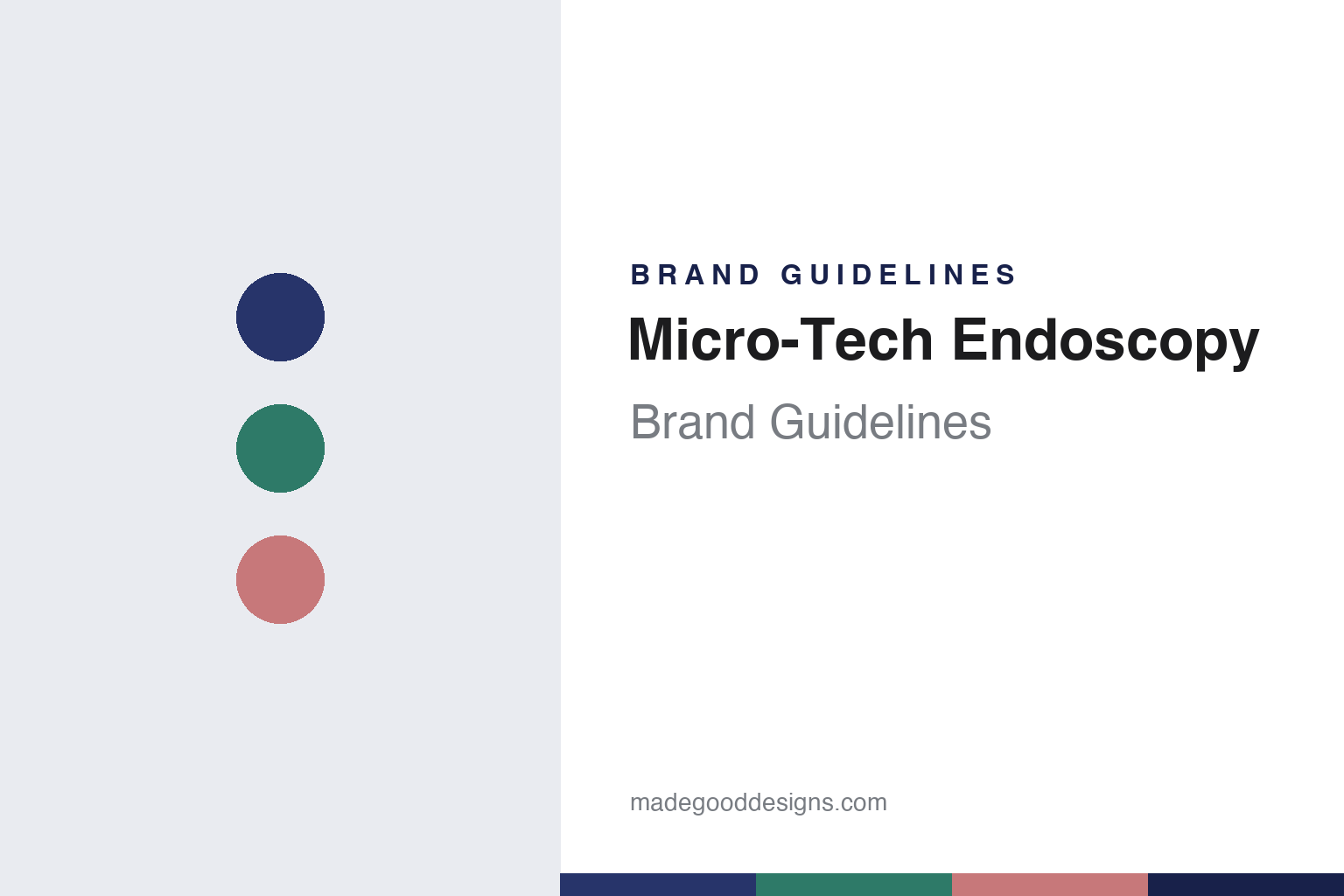
Micro-Tech Endoscopy Brand Guidelines
The Nanjing stent maker that grew into a global endoscopy supplier.
Aa
Two constants: an indigo, jade and rose palette and a Clinical sans register. Abstract homage — not a Micro-Tech product or mark; no device, logo or packaging is reproduced.
Nanjing, 2000
From stents to a family of endoscopy tools.
Micro-Tech was founded in Nanjing, China, in 2000. The Shanghai Stock Exchange’s company snapshot gives its founding date as 10 May 2000 and its full name as Micro-Tech (Nanjing) Co., Ltd., and the company’s Chinese website says it began under an earlier Chinese name and in its first year obtained Chinese registration certificates for oesophageal and biliary stents. Micro-Tech Endoscopy is the name of its American business, Micro-Tech Endoscopy USA, which the company lists among its subsidiaries; its websites write the group name in capitals, as MICRO-TECH.
The company’s own timeline describes a steady build. In 2003, it says, it received outside equity investment and CE certification for its non-vascular stents and for single-use biopsy forceps, a step its English website calls the start of its global expansion. In 2005, the Chinese site says, it became an OEM and ODM supplier to established European and American device companies. A European company followed in 2007: the English site says MICRO-TECH Europe was set up in Germany as its first overseas subsidiary, and both sites say it became wholly owned in 2018.
Investors shaped the middle years. The Chinese timeline says the private-equity firm Actis invested in 2012, when a new management team was formed and new product development was stepped up, and that Actis’s holding passed to other investors in 2016. In 2015 the company set up a subsidiary in the United States and took a controlling stake in Canyon Medical, which the English site says took it into tumour ablation.
Colour
A STAR Market listing and a catalogue of consumables.
The listing came in 2019. On 19 July that year the China business site EqualOcean reported that Micro-Tech would be among the first group of companies to trade on the Shanghai Stock Exchange’s new STAR Market, its board for technology companies, and described it as a biopsy-needle producer from Nanjing. The exchange gives the listing date as 22 July 2019, and the company says it adopted its present Chinese company name the same year.
The exchange’s snapshot describes the business as the research, manufacture and sale of minimally invasive medical devices, grown from non-vascular stents into three platforms: endoscopic diagnostic instruments and consumables, tumour ablation instruments and consumables, and endoscopic optical coherence tomography.
The company’s English catalogue sorts more than forty products by specialty, from gastroenterology and hepatobiliary and pancreatic surgery to pulmonology and interventional radiology, and by type: biopsy forceps, polypectomy snares, sphincterotomes, retrieval baskets, band ligators, ultrasound-guided biopsy needles and metal stents for the gut and airway. Named lines include the SureClip and LOCKADO hemostasis clips, the GoldKnife electrosurgical knife and the eyeMAX cholangioscope. The Chinese timeline dates a single-use cholangioscope to 2021 and the approval of a single-use bronchoscope to 2022.
Micro-Tech also points to state recognition at home. Its Chinese website says research projects on digestive-tract stents, on endoscopic ultrasound and on endoscopic hemostasis won second-class National Science and Technology Progress awards in 2011, 2018 and 2024, and that a microwave ablation project won a second-class National Technological Invention award in 2014.
Typography
Endoscopy and minimally invasive surgery.
Endoscopy and minimally invasive surgery are sold to a small, expert audience: surgeons, gastroenterologists, theatre nurses and the hospital teams who buy and reprocess equipment. The makers’ public image follows from that. A familiar picture in this field is the instrument itself, a slim scope coiled on a white ground or a rigid telescope laid out at full length, shown with little else around it, so that the length, the bend and the tip carry the image.
The second familiar picture is the operating theatre. Here the product is the system rather than the single instrument: a video tower of camera units and light sources beside the table, and a team of surgeons looking up at a screen rather than down at the patient. Some makers go a step further and present the whole room; Karl Storz, for example, showed its OR1 integrated operating room at the Medica trade fair in 1998, the company says. Close by sit macro shots of instrument tips, clips and jaws, where the detail is the subject.
Much of the communication happens face to face. Makers run training and visitor centres where clinicians handle equipment and practise techniques; Karl Storz says it opened a logistics and training centre in Tuttlingen in 1999. Congresses matter as much: Digestive Disease Week (DDW) in the United States, UEG Week in Europe and the annual meeting of the Society of American Gastrointestinal and Endoscopic Surgeons (SAGES) are where new scopes, generators and accessories are shown to the people who will use them.
The makers in this guide range from long-established German firms to younger companies elsewhere, and from full endoscope systems to single devices. This guide sets out what can be checked about each brand: who founded it, who owns it and what it says about where its products are made, and it marks clearly what rests only on the company’s own word.
Aa
A plain clinical sans for a maker of small tools. (Specimen set in Barlow, a sans STAND-IN; NOT the Micro-Tech logo.)
Micro-Tech Endoscopy
Doing our best for life.
Micro-Tech has spent the 2020s building a presence outside China. The company says it added subsidiaries in the Netherlands, the United Kingdom, France and Japan between 2020 and 2023, bought the distributors Endotécnica in Portugal and Medexx Medical in Switzerland, and in 2024 opened a representative office in Sydney. It also says it opened a new production base at its Nanjing headquarters in 2024 and began building a manufacturing centre in Thailand, which it says became operational in 2026. Its English website says it has launched more than 180 products in more than 100 countries and employs more than 2,000 people in more than 20 countries; its Chinese website gives more than 90 countries and lists wholly owned subsidiaries in the United States, Germany, the Netherlands, the United Kingdom, France, Japan, Switzerland, Portugal and Thailand, with the headquarters still in Nanjing.
The largest step abroad was in Europe. In September 2024 the British device company Creo Medical Group agreed to sell 51% of Creo Medical S.L.U., its European subsidiary, which makes and distributes gastroenterology, urology and endoscopy products, to Micro-Tech, the law firm Osborne Clarke announced. On 12 February 2025 Alliance News reported that the sale to Micro-Tech NL International had been completed.
The brand speaks in two registers. The Chinese website carries the English line “Doing our best for life” beside its Chinese equivalent, while the global site opens with “Bringing Health, Hope, and Dignity to Life.” Neither site publishes a typeface or colour values, so the tones in this guide are our own.
For a design guide, Micro-Tech Endoscopy shows how a maker of small single-use tools can build an international brand from a Chinese base, one subsidiary at a time. Compare Boston Scientific, another maker of endoscopic devices, and SonoScape, a Chinese company in ultrasound and endoscopy. For this guide we use an indigo, a jade and a soft rose with clip silver, with a sans, an unofficial interpretation; no product or logo is reproduced.
Explore & save
Keep Micro-Tech Endoscopy’s identity on hand — save it to a board in the Made Good inspiration library.
Micro-Tech Endoscopy identity set
Pin the Micro-Tech Endoscopy indigo, jade and rose palette and the Clinical sans register to your own board.