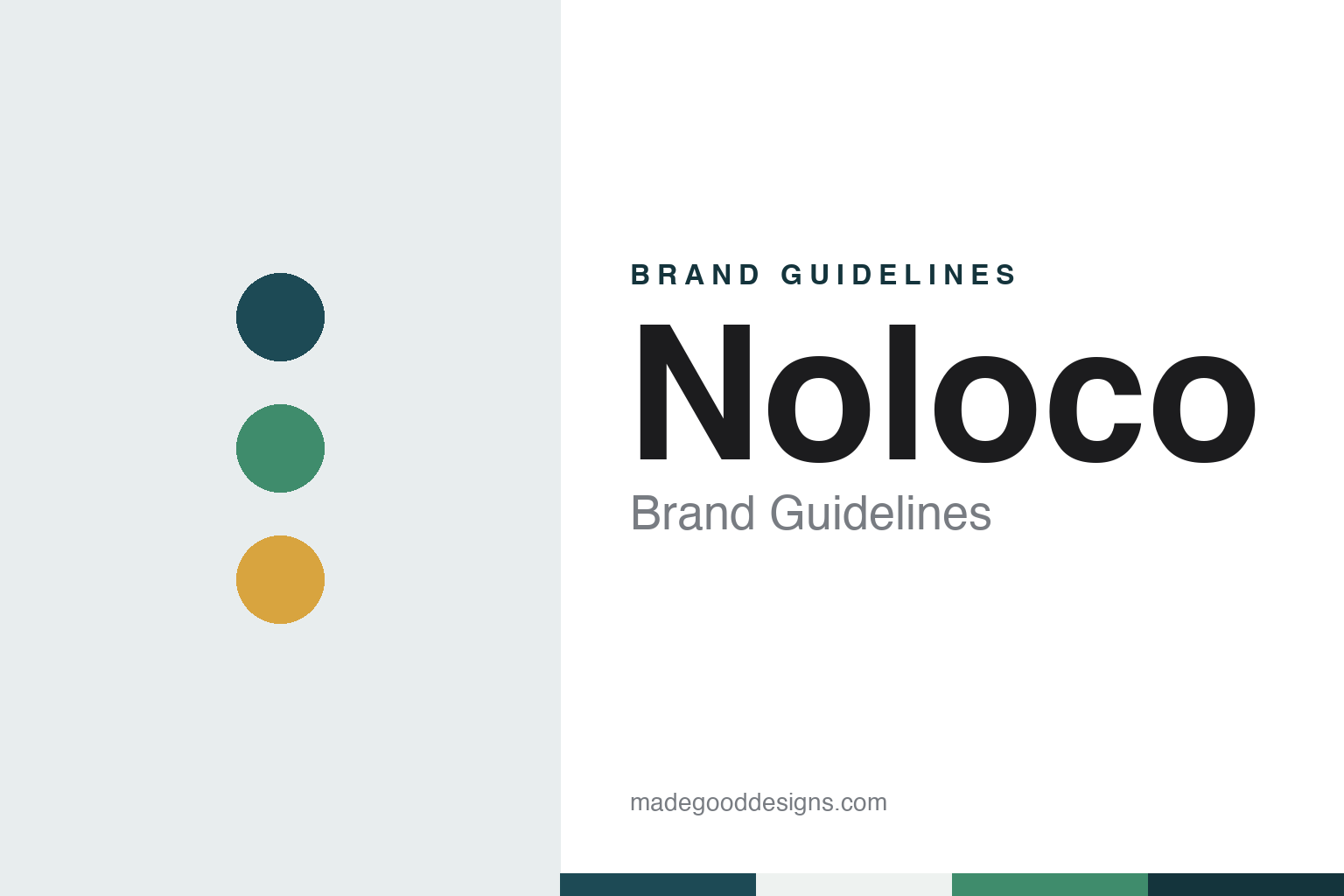
Noloco Brand Guidelines
The Dublin builder that puts a front end on the data a business already has.
Aa
Two constants: a teal, green and amber palette and a rounded geometric sans register. Abstract homage — not a Noloco product or mark; no app screen, logo or interface is reproduced.
Trinity graduates
Two founders, one problem and a Dublin start-up.
Noloco is a Dublin company. It was founded in 2021 by Simon Curran and Darragh Mc Kay, both graduates of Trinity College Dublin, Silicon Republic reported in July 2022. In a June 2023 profile the same publication said the two had first met through the Entrepreneurial Society at Trinity, and that after college Mc Kay, a computer engineering graduate, had worked as a software engineer at HubSpot’s Dublin office and then at Inscribe, a start-up backed by Y Combinator. Curran had been a product owner at Flipdish and Revolut, according to the 2022 report.
The two began meeting on video calls in 2020 to talk through start-up ideas, the 2023 profile said, and kept returning to one problem: how to let non-technical people build their own tools, dashboards and workflows without leaning on developers. Mc Kay told the publication that “all we ever talked about was start-ups, ideas, problems and ways to solve them.”
Noloco joined Y Combinator in its Summer 2021 batch, the accelerator’s company directory shows. Towards the end of 2021 it launched an updated platform that could create a user interface automatically from a business’s data, which teams could then adjust and customise. In July 2022 it announced a seed round with participation from Y Combinator, Anamcara Capital, Zinal Growth and two individual investors, Silicon Republic reported. At that point the company said it had seven staff, and customers in more than ten countries in fields such as real estate, lending, agencies and start-ups.
Colour
Apps built from existing data.
Noloco’s product starts from data a business already has. In its Y Combinator launch post, the company described connecting a source such as PostgreSQL, MySQL, Airtable or Google Sheets, after which Noloco builds an app from the chosen tables, with collection views such as tables and kanban boards, record pages for single entries, and forms for adding new ones. It said most customers could build a first working internal tool within about 20 minutes. The post framed the problem around internal tooling at start-ups and scale-ups: engineering time spent on internal tools, it argued, is time taken from customer-facing products, while teams in operations, support, product and sales rarely have the capacity to get the tools they need. The 2022 Silicon Republic report described the same model: once a data source is connected, Noloco builds a web app within minutes, and companies can share data with their team, customers or partners without giving them direct access to the underlying source.
The company has changed direction more than once. In June 2023 Silicon Republic reported that since going through Y Combinator Noloco had pivoted its focus twice, and that Mc Kay, formerly chief technology officer, now led the company as chief executive. The profile described a remote-first company based in Dublin, with a point-and-click interface for configuring an app’s screens and interactions, and integrations with Airtable, Xano, Google Sheets and SQL databases that sync data to a central database in real time. Y Combinator’s directory now lists Mc Kay as the active founder, based in Dublin, and gives the company’s line as “Flexible Business Apps for Modern Teams.”
An independent snapshot of where Noloco sits came on 10 November 2026, when Dynamic Business published a guide to low-code and no-code app builders. It grouped Noloco with internal-tool builders and described it as a no-code internal-tool and client-portal builder that places a custom front end over Airtable, Google Sheets, HubSpot or SQL databases, with role-based access, field-level permissions, workflow automations and custom domains. The magazine noted that Noloco is meant for internal and portal use and does not publish apps to app stores.
Typography
Design and documentation.
No-code and low-code app builders sell a promise that is easy to state and harder to show: that a working app can be made without writing code, or while writing very little of it. Their websites tend to make the promise visible. Homepages often lead with the editor itself, shown as screens being assembled from ready-made components such as lists, buttons, forms and maps, with a properties panel beside them for colour, type and spacing.
Template and showcase apps do much of the persuading. Builders publish galleries of sample apps sorted by use, such as marketplaces, booking tools, internal dashboards or community apps, and some let visitors open a sample on a phone or copy it into a new project. Customer stories and lists of apps made on the platform play the part that a portfolio plays for a design studio.
Plan and feature naming follows a familiar pattern. Tiers usually climb from a free starter level to team and enterprise levels, and features are named for what they unlock: publishing to the app stores, custom domains, code export, user seats or workflow runs. In recent years several builders have added AI assistants or rebuilt their products around them, and product names now often describe how much of the work the software does, from hands-on visual editing to describing an app in a sentence.
Corporate pages are usually brief. About pages tend to state a mission about widening who can build software, introduce the founders, and name investors or accelerators. Funding rounds, takeovers and, for open-source builders, licence terms are the dated facts that give each company its history, and the guides in this series set them out where a source records them.
Aa
A rounded geometric sans with a calm, practical tone. (Specimen set in Manrope, a sans STAND-IN; NOT the Noloco logo.)
Noloco
From internal tools to client portals.
Noloco’s website now presents it as “the AI portal builder for teams running complex operations.” It introduces Nola, an AI app builder that sits alongside its point-and-click interface builder, and organises the product around use cases such as client portals, a flexible CRM, project management and team intranets. It names the kinds of business it serves, from professional services and agencies to law firms and construction. Its integration list includes Airtable, HubSpot, Google Sheets and Postgres, among others, and the site describes the product as free to start. It also offers ready-made templates, starting with a client portal, along with video tutorials, webinars and a community where customers can hire an expert. Those descriptions are the company’s own.
The homepage leans on permissions rather than decoration. Its headline promise is “one system for your team, your clients, and the AI agents that help run it,” and its sample screens show project boards with status columns, records with owners and due dates, and a “view as” switch that shows the same data through different clients’ eyes, under the line “every client sees only their own work.” The language is plain and operational, written for the people who run a business day to day rather than for developers.
For a design guide, Noloco shows how a no-code company can build its identity as a layer over other systems, presenting spreadsheets and databases as tidy portals for teams and clients. Compare Softr, which Dynamic Business lists for client portals on Airtable data, and Glide, which the magazine groups with builders of data-management apps on existing spreadsheet data. For this guide we use a harbour teal, a soft green and an amber with a sans, an unofficial interpretation; no product or logo is reproduced.
Explore & save
Keep Noloco’s identity on hand — save it to a board in the Made Good inspiration library.
Noloco identity set
Pin the Noloco teal, green and amber palette and the rounded geometric sans register to your own board.