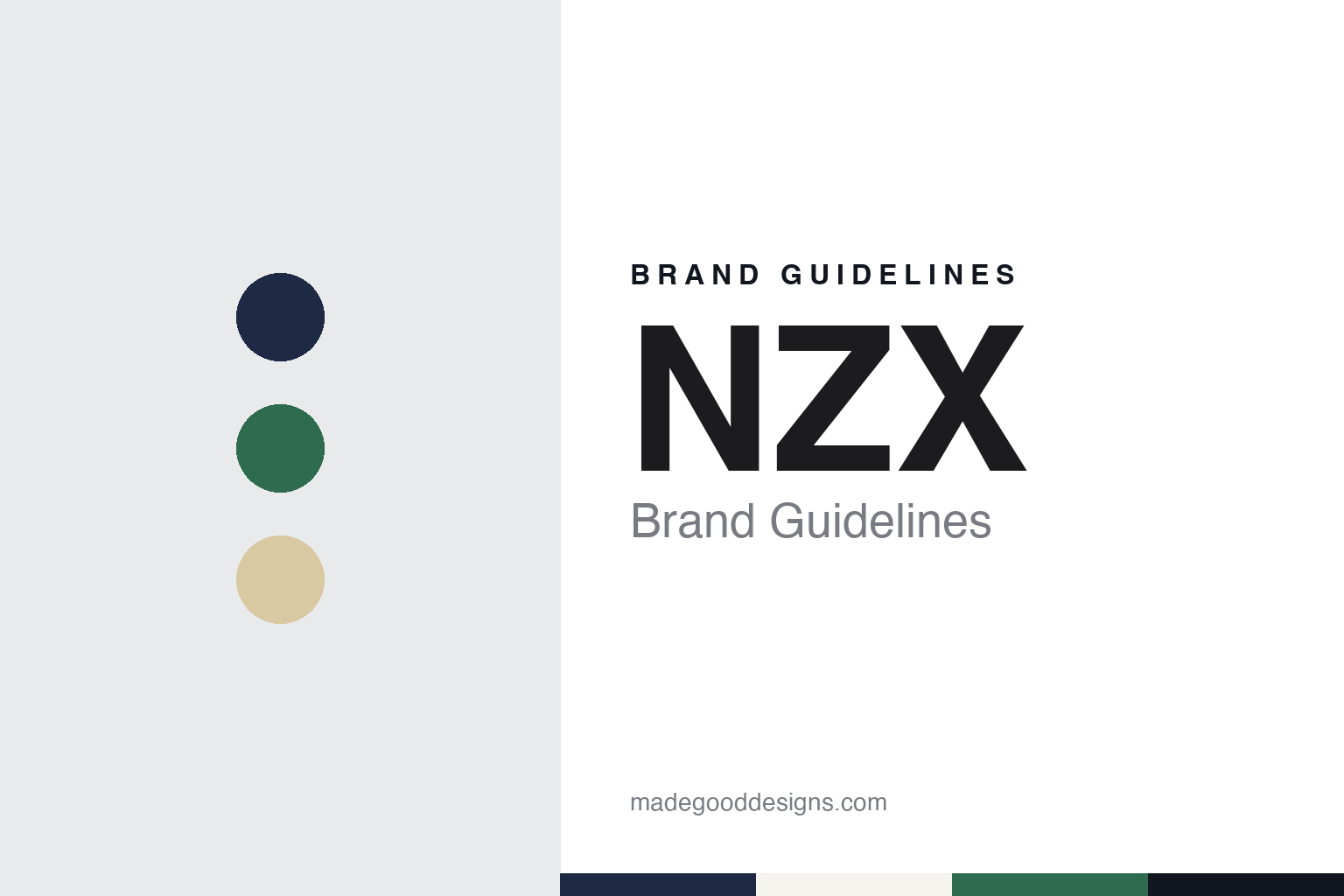
NZX Brand Guidelines
The Wellington exchange that grew from gold-rush brokers’ associations.
Aa
Two constants: an NZX harbour navy, fern green and sand palette and a Plain modern sans register. Abstract homage — not an NZX product or mark; no logo, ticker or index chart is reproduced.
Gold-rush brokers
Regional exchanges, one national market.
NZX is New Zealand’s national stock exchange and, as NZX Limited, a company listed on the market it runs. English Wikipedia traces it to the regional exchanges that grew up during the gold rush of the 1860s: the first brokers’ association started in Dunedin in 1867, and others followed in Auckland in 1872 and Wellington in 1882. The Dunedin association became a stock exchange in 1893, and Christchurch gained an exchange in 1900.
In 1915 the exchanges of Auckland, Christchurch, Dunedin, Thames and Wellington formed the Stock Association of New Zealand; Taranaki joined in 1916, Invercargill in 1920 and Gisborne in 1922, Wikipedia says. The association set up a sub-committee to look at forming a national exchange, and in 1983 the regional exchanges were amalgamated into the New Zealand Stock Exchange, known as the NZSE.
Trading left the floor eight years later. On 24 June 1991, according to Wikipedia, the NZSE brought in a computerised trading system that replaced its open-outcry trading floors. That system gave way to the FASTER trading and settlement system in the late 1990s, and NZX Clearing took over clearing and settlement in 2010.
The exchange then changed its own structure. Its member firms voted for demutualisation on 16 October 2002, and on 31 December 2002 the NZSE became a limited liability company. On 30 May 2003 it changed its name to the New Zealand Exchange Limited, trading as NZX, and on 3 June 2003 it listed its own shares on its main equity market, Wikipedia records.
Colour
Shares, debt, derivatives and dairy.
NZX runs several markets, which its website presents side by side: the NZSX main board for shares, the NZDX debt market, the NZCX for equity derivatives and a set of dairy derivatives, with a link to the Global Dairy Trade auctions. Wikipedia describes NZX as the only registered securities exchange in New Zealand and an authorised futures exchange, and says it also operates the country’s wholesale electricity market and the Fonterra Shareholders’ Market under contract. Wikipedia gives the main board’s usual hours as 10am to 4:45pm and counted 179 listed securities in February 2025.
Its headline index is the S&P/NZX 50, made up of the 50 largest stocks on the main board by free-float market capitalisation. Wikipedia says it began as the NZSX 50 in March 2003, replacing the NZSE 40 as the headline index, was renamed the NZX 50 in late 2005, and took its present name in 2015, when S&P Dow Jones Indices took over calculating all of NZX’s indices under a partnership.
Derivatives have returned in recent years. On 28 April 2026, RNZ reported, NZX launched S&P/NZX 20 Index Futures, based on an index of 20 large and liquid New Zealand companies; RNZ noted that the country had not had a futures index since the early 1990s. In July 2025 RNZ reported that the chief executive at the time counted NZX Dark, an anonymous mid-point trading venue, and the exchange’s equity futures among his main achievements, while the chair pointed to partnerships with the Singapore Exchange and the European Energy Exchange.
Beyond its markets, the group runs funds businesses. Wikipedia names NZX as the parent of Smartshares, its family of exchange-traded funds, and of Wealth Technologies, and says it bought the superannuation and KiwiSaver provider SuperLife in 2015. RNZ’s reports in 2025 and 2026 refer to the wealth business as Smart, alongside NZX Wealth Technologies.
Typography
How exchanges present themselves.
Stock exchanges sell trust before they sell anything else, and their identities tend to show it. Many lean on a short set of letters rather than a full name, set in a sober sans or serif, and on a narrow, conservative palette: navies, deep reds and golds recur across exchange wordmarks, chosen to read as steady rather than fashionable. Few exchanges publish full brand guidelines, so most of what a designer can study is what they put on their own websites and in their own reports.
Photography does much of the work. Exchanges publish pictures of the places and rituals of a market: trading floors, where they still exist or once did, and listing ceremonies such as bell ringings and gong strikes, when a newly listed company’s executives mark its first day of trading. Where trading floors have closed and dealing has moved to screens, those ceremonies and the buildings themselves carry more of the visual story.
The websites follow a common pattern. A home page usually leads with an index ticker or chart and the day’s gainers and decliners; behind it sit listing pages that explain to companies how to raise capital, market-data pages, announcements, and rulebook or regulation pages that set out how the market is run. NZX in Wellington, for example, shows a chart of its headline index, upcoming listings and a section of rules and guidance on its own site.
Exchanges also speak to investors and shareholders. Many run investor-education pages, courses, videos or podcasts aimed at first-time savers, and an exchange that is itself a listed company publishes annual reports and investor news like any other issuer. This guide sets out what can be checked about each exchange: where it began, how it changed its structure, which markets and indices it runs, and how it presents itself today.
Aa
A plain modern sans — “New Zealand’s Exchange.” (Specimen set in Inter Tight, a sans STAND-IN; NOT the NZX logo.)
NZX
New Zealand’s Exchange.
NZX’s website calls it “New Zealand’s Exchange” and pairs the name with a line in te reo Māori, “Te Paehoko O Aotearoa.” Its home page leads with a chart of the S&P/NZX 50, the main board’s gainers and decliners, upcoming listings and company announcements, and it runs a Learning Centre, a section of NZX Rules and Guidance and pages on listing. Its video and audio series include NZX Spotlight, NZX Direct and the Opening Bell podcast. A separate group website carries investor news, governance pages and reports and disclosure.
The exchange is based in Wellington. Its NZX Centre occupies a building put up in 1907 for the C&A Odlin Timber Company, which Wikipedia describes as one of the few surviving Edwardian industrial buildings in the city.
Its systems have been tested. From 25 August 2020, Wikipedia says, online distributed denial-of-service attacks disrupted trading for five days. On 27 August, Bloomberg News, in a report carried by the Bangkok Post, said trading had been halted for a third straight day, that NZX attributed the outages to “volumetric distributed denial of service attacks from offshore,” and that it was working with its internet provider, Spark New Zealand; the Financial Markets Authority, which regulates NZX, had been in touch with the exchange. Wikipedia adds that NZX ruled out paying the attackers’ demand.
Its leadership has also changed. Mark Peterson, chief executive since 2017, announced in July 2025 that he would step down, RNZ reported. Graham Law acted in the role from May 2026, and in August 2026 the board appointed Hishaam Mirza, formerly of NZ Super, who was due to take over on 14 September, according to RNZ. RNZ wrote that NZX had been struggling to grow the number of listed companies over the past decade, and in September 2026 it described the solar company Lodestone’s offer as the exchange’s first major float since 2021.
For a design guide, NZX shows how an exchange can present a national market through a short three-letter name, a bilingual line and an index chart. Compare ASX, the Australian exchange across the Tasman, and Bursa Malaysia, another exchange in the region that began as a brokers’ group. For this guide we use a harbour navy, a fern green and a tussock sand with a sans, an unofficial interpretation; no product or logo is reproduced.
Explore & save
Keep NZX’s identity on hand — save it to a board in the Made Good inspiration library.
NZX identity set
Pin the NZX harbour navy, fern green and sand palette and the Plain modern sans register to your own board.