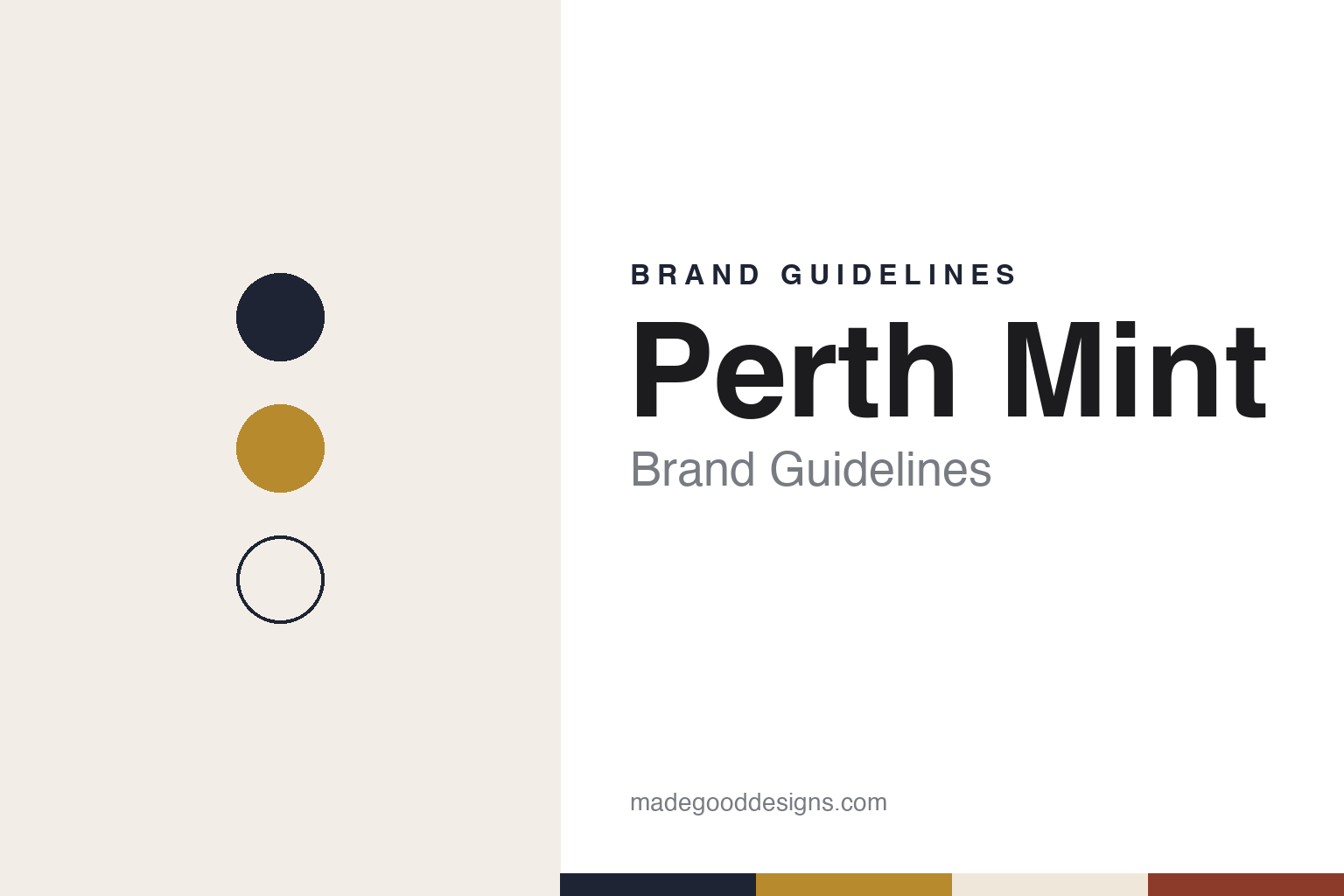
Perth Mint Brand Guidelines
A colonial mint that became a state-owned gold business.
Aa
Two constants: an ink blue, gold and limestone palette and a mint serif register. Abstract homage — not a Perth Mint product or mark; no coin, logo or design is reproduced.
A branch of the Royal Mint
Gold rushes, sovereigns and a limestone building.
The Perth Mint was born of Western Australia’s gold rushes. English Wikipedia says the colony’s population climbed steeply in the 1890s after rich finds at Coolgardie, Kalgoorlie and the Murchison, and that the new mint had two jobs: to strike coins for local circulation, which had been in short supply, and to buy the gold dug by prospectors and mining companies. The mint’s own history credits John Forrest, the colony’s first premier, with persuading the British government to open a branch of the Royal Mint in Perth.
Forrest laid the foundation stone in 1896, and the building opened on 20 June 1899, two years before the Australian colonies federated. English Wikipedia calls it the last of three colonial branches of the Royal Mint, after Sydney and Melbourne. The mint says the building was designed by the architect George Temple Poole and that it holds the National Trust’s highest classification.
Its early output was gold coin for the Empire. Between 1899 and 1931 the mint struck more than 106 million gold sovereigns and nearly 735,000 half sovereigns, according to both the company and English Wikipedia. Sovereign production stopped in 1931, when Britain left the gold standard, and the refinery turned to fine gold bars. From 1940 the mint struck copper pennies and halfpennies for the Commonwealth, with a kangaroo design, until 1964, the company says; after decimal currency arrived in 1966 it struck, by its own count, some 829 million two-cent coins and 26 million one-cent coins by 1973, and English Wikipedia says it made much of Australia’s lower-denomination coinage until the end of 1983.
Federation did not change its ownership. The mint stayed under British control until 1 July 1970, when it passed to the government of Western Australia as a statutory authority under the Perth Mint Act 1970, English Wikipedia says.
Colour
Gold Corporation and the bullion coins.
The modern business dates from 1987. The company says Gold Corporation was created by an act of the Western Australian parliament that year to take over the mint’s operations and launch Australia’s official bullion coin programme; its corporate page gives the date of incorporation as 18 December 1987 and lists two trading names, The Perth Mint and The Perth Mint Refinery. The launch product was the Australian Nugget gold coin, launched at a ceremony in Sydney on 23 April 1987, the company says. The Nugget later became the Australian Kangaroo series, and the mint’s bullion programmes now include the Australian Kookaburra, the Australian Koala and the Australian Lunar coins.
Refining moved out of the city centre as the business grew. The company says a new refinery near Perth airport began operating in 1990, and that an 8,400-square-metre manufacturing building opened beside the original limestone mint, which English Wikipedia dates to 2003. The mint also tells a refining story from 1957, when two of its staff produced a proof plate of nearly pure gold that was assayed by the Worshipful Company of Goldsmiths in London; the company says the Royal Mint asked to keep part of it.
Its heaviest product is a single coin. Guinness World Records lists the “1 Tonne Australian Kangaroo” as the largest coin with legal-tender status: 1,012 kilograms of 99.99 per cent gold, 80 centimetres across and 13 centimetres thick, introduced by the Perth Mint on 9 February 2012. The mint says it was cast in 2011 and is now on show at its original premises.
The mint has also tried digital products. English Wikipedia says it launched the GoldPass app in 2018, for buying and selling certificates backed by metal held at the mint, and that a separate firm, Trovio, offered a Perth Mint Gold Token under licence from 2019 until it was discontinued in late 2023.
Typography
Bars, coins and the language of assay.
Bullion dealers, refiners and mints sell goods that are deliberately standardised: a one-ounce coin or a kilo bar is defined by its metal, weight and purity before any design choice is made. So their identities live in a narrow set of places — the way products are photographed, the marks struck into the metal, the shop interface and the pages that explain who owns whom.
Product photography in this category is usually plain and repetitive by design. Companies tend to show each coin or bar on its own against a light or neutral background, often obverse and reverse side by side, sometimes still in a sealed card or capsule, so that the buyer can read the design, the weight and the fineness at a glance. Special editions are told apart by small details, such as the privy marks that mints add to coins for a particular dealer or occasion.
On the metal itself, the hallmark does the branding. A refiner’s bar typically carries its maker’s mark, its weight, its fineness and a serial number, and minted bars are often sold in an assay card that repeats those details. Accreditation is part of the same language: English Wikipedia, for example, lists the Swiss refiner MKS PAMP on the London Bullion Market Association and London Platinum and Palladium Market Good Delivery lists.
Online, the price chart sits close to the logo. Gold.com, the owner of JM Bullion, runs a strip of gold, silver, platinum and palladium prices across the top of its corporate site, and JM Bullion has kept separate sites named for gold and silver prices. Corporate pages carry the rest of the story: Gold.com publishes a year-by-year timeline of its acquisitions, and Bullion International Group, the owner of APMEX, signs its site “An MKS PAMP GROUP Company,” linking a retail name to a refinery.
Aa
A classical serif with a coin-inscription feel. (Specimen set in Cormorant Garamond, a serif STAND-IN; NOT the Perth Mint logo.)
The Perth Mint
Wildlife reverses and a colonial facade.
Today the Perth Mint is owned by the government of Western Australia, through Gold Corporation, and describes itself as “Australia’s largest fully integrated” precious-metals enterprise, working across refining, manufacturing, investment and storage. Its corporate page names the Auditor General for Western Australia as its external auditor and lists an exchange-traded product on the Australian Securities Exchange under the code PMGOLD.
The brand leans on two visual assets. The first is the building: the mint says its original premises in East Perth remain a visitor attraction with a shop, an exhibition on the gold industry, a live gold pour and the one-tonne coin. The second is Australian wildlife. Kangaroos, kookaburras and koalas give the bullion series their names, and the company describes its proof collector coins as featuring “original Australian designs” of native animals, alongside commemorative and cultural themes, finished with techniques such as colour and gilding.
History is part of the product line as well. On 20 June 2024, 125 years after the first gold was processed and coins struck in East Perth, the mint released a 125th Anniversary Sovereign gold proof coin, which it describes as a reinterpretation of the classic design of the original sovereigns.
For a design guide, the Perth Mint shows how a state-owned refiner can build a consumer identity from its own history and from national wildlife. Compare PAMP, a Swiss refiner known for its bars, and Metalor. For this guide we use ink blue, a sovereign gold and a pale limestone with a serif, an unofficial interpretation; no product or logo is reproduced.
Explore & save
Keep Perth Mint’s identity on hand — save it to a board in the Made Good inspiration library.
Perth Mint identity set
Pin the Perth Mint ink blue, gold and limestone palette and the mint serif register to your own board.