Piganiol Brand Guidelines
The Aurillac umbrella.
Aa
Two constants: an Auvergne-green palette and a French sans register. Abstract homage — not a Piganiol design, canopy or wordmark.
The Aurillac umbrella
Piganiol makes umbrellas in Aurillac, the historic capital of French umbrella-making.
Piganiol is a lesson in a place as the identity. A French house in Aurillac, in the Auvergne — the town that for two centuries made most of France’s umbrellas — it answers how an umbrella is made with a whole region’s craft: cutting the canopy, sewing the panels, mounting them on the frame, and hand-assembling and finishing on site. An umbrella, made in the umbrella capital.
Its identity is the Aurillac umbrella. Piganiol’s French making, its umbrella-town heritage and its state Living-Heritage label are the work it is known for. A place, made a signature. A house that kept making where French umbrellas were born.
(Honest notes, so the story stays precise. Piganiol was founded in Aurillac in 1884 — by Jean-Baptiste Poignet; the Piganiol name entered by succession around 1928–31, so we say it has been in the Piganiol family for five generations, currently under Matthieu Piganiol. It is genuinely made in France, in Aurillac, and holds the state Entreprise du Patrimoine Vivant (Living Heritage Company) label, awarded in 2009. One honest, standard-for-the-trade note: the metal frame hardware is likely sourced abroad, as it is for nearly all surviving French makers — the French craft is the canopy cutting, sewing, assembly and finishing. Its designs, canopy prints and model names are its IP, described but never reproduced, and there is no official brand hex — these tones are an unofficial interpretation. This is design commentary and does not promote any product.)
Colour
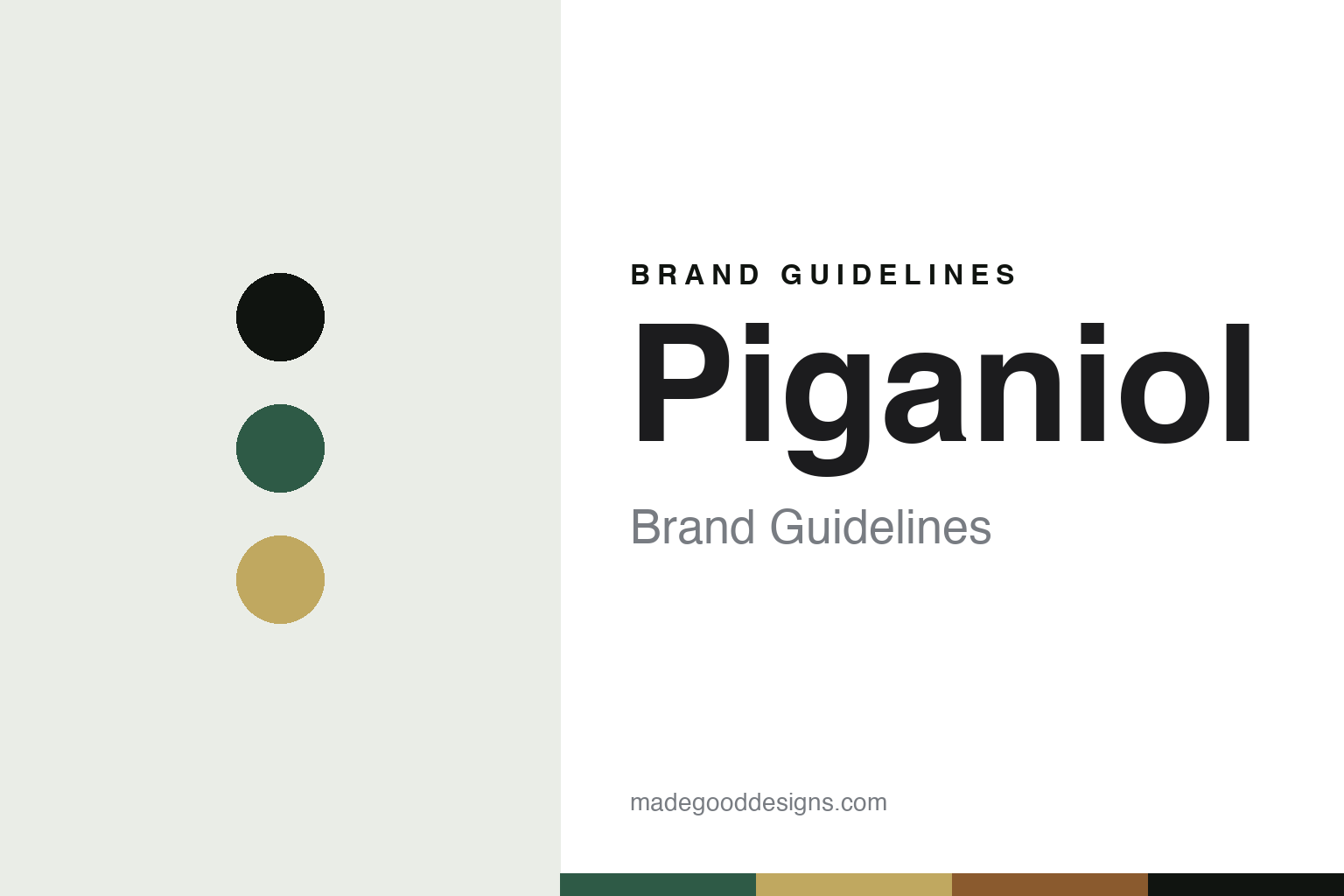
Piganiol lives in an Auvergne-green palette. Click a swatch to copy the hex.
Piganiol’s identity is regional, warm and French — an Auvergne green, an ink, a straw gold, a bark, and a chalk. The palette leans Auvergne green and straw: the register of a highland umbrella town and a canopy in the fields’ colours. It signals heritage and place over show. The honest caveat: with no published brand hex, these values are an original, unofficial interpretation, not first-party colours.
The lesson is an Auvergne-green palette signals a place-rooted, French identity. Piganiol’s world is an Aurillac-made, semi-artisanal object. For designers, it is a reminder that a highland green and a straw gold can carry a brand built on a place — the green of the Auvergne and the straw of a woven canopy. Because these tones can fail as small text, keep type dark and let the colour live in the accents, palette and band. The takeaways: root it in a place; make it there; earn the label; and treat any single hex as unofficial.
Typography
The register is a French sans — clean, warm, contemporary.
Piganiol’s identity carries a clean, warm, contemporary spirit — a heritage-yet-modern object, not a loud one. A French sans captures the mood: even, humane and current, the register of a heritage house making for today. Set in an Auvergne-green palette, the French sans feels clean and warm — exactly the personality Piganiol carries. It is contemporary rather than nostalgic, mirroring a house two centuries into a regional craft. (Piganiol’s real designs and canopy prints are things we describe but do not reproduce, and the exact typeface is not ours to use.) Because it is not ours to use, the honest description is “a French-sans spirit,” shown here in a stand-in. The type behaves like the maker: clean, warm and contemporary.
Aa
A French-sans spirit — clean and warm. (Specimen set in Fraunces, used as a French-serif/sans STAND-IN; NOT the Piganiol wordmark or any canopy design.)
How an umbrella is made
Piganiol stands for the Aurillac umbrella.
Piganiol is a lesson in making a place the identity. An Auvergne-green palette, a French register and Aurillac-made umbrellas make one place — France’s umbrella capital — the whole maker: regional, warm and French. The place is the differentiator. The differentiator is continuity in a town: a house that kept cutting, sewing and assembling umbrellas in Aurillac while the trade shrank around it, and earned a state Living-Heritage label for it.
Put to work, the identity is place as design. A maker building in this spirit would root itself in a genuine craft region, keep the identity-defining work at home, and be honest that some hardware is sourced while the craft stays local, so the customer buys into a real place. It would treat the Aurillac heritage as its foundation. It would earn its label rather than claim it. The lesson Piganiol teaches is that a place can build a brand: the town gives it authenticity, and the French making gives it substance. The place is the personality, and the Aurillac workshop is the proof.
For designers and brand-builders, Piganiol offers a clear takeaway in this round about how an umbrella is made: make the place part of the making. The lessons: root it in a craft town; keep the core work at home; be honest about sourced parts; and never reproduce a protected print. It is also a reminder to stay precise: Piganiol is an independent, family-run French house founded in 1884, made in Aurillac with the state Living-Heritage label (2009) — with the palette here an unofficial interpretation. Piganiol made the umbrella town the maker — proof that a place can be the difference.
Explore & save
Keep Piganiol’s identity on hand — save it to a board in the Made Good inspiration library.
Piganiol identity set
Pin the Auvergne-green palette and the French register to your own board.