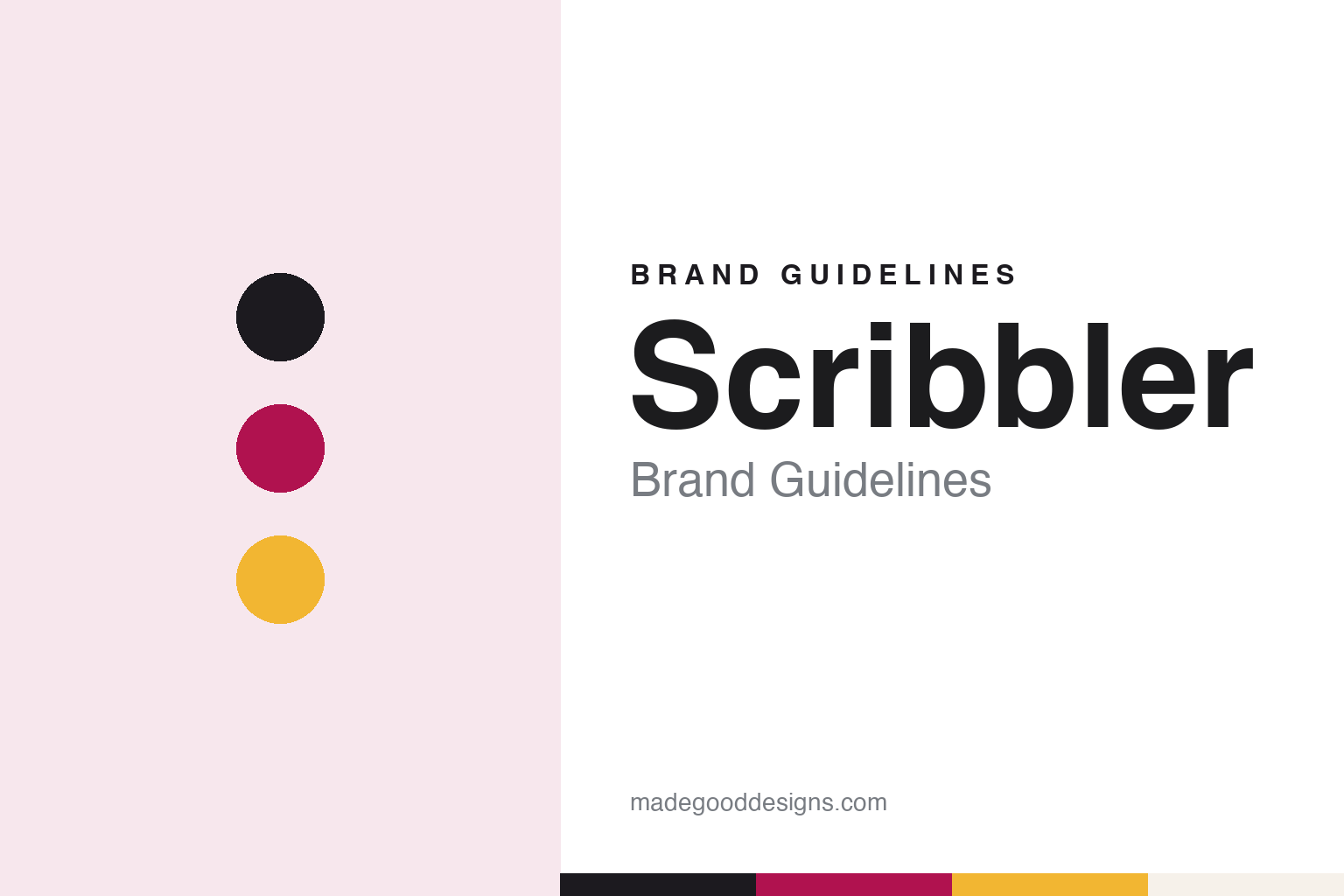
Scribbler Brand Guidelines
The Procters’ cheeky card shops, on the high street since 1981.
Aa
Two constants: an ink black, riot pink and marigold palette and a heavy grotesque sans register. Abstract homage — not a Scribbler product or mark; no card, logo or shop sign is reproduced.
A family card shop
Two founders, one tone of voice and four decades of shops.
Scribbler is a British chain of greeting card and gift shops. It arrived on the high street in 1981, founded by John and Jennie Procter. The Guardian gave the same founding year in January 2012, when it noted that the chain was “still run by the same management team”, and English Wikipedia says the same of it in 2025. The company’s own account says the founders set out to sell bolder, brasher and funnier cards than the high street offered at the time, and its website still headlines that history with the line “Unacceptable since the 80s”.
The company behind the shops is slightly younger than the brand. Companies House lists Scribbler Holdings Limited, incorporated in November 1984 under the name Paraplace Limited and renamed Scribbler Shops Limited a few weeks later. It traded under the name Procter Holdings Limited from 1988 to 1996 before taking its present name. The register names John and Jennifer Procter as the two people with significant control, each holding more than a quarter of the shares, and in 2020 two further companies, Scribbler Brands Ltd and Scribbler On-line Ltd, were registered at the same London office. On that record, Scribbler remains in the hands of its founders more than four decades after the first shop opened.
Its estate has grown steadily rather than quickly. The Guardian counted 23 branches across the UK in 2012. English Wikipedia gives 36 shops as of 2025. In April 2025 the Southampton Daily Echo reported that Scribbler had confirmed a 38th shop, its first in the city, at the Westquay shopping centre, to arrive with a new loyalty scheme. The company’s own website now says it has 38 stores across the UK, alongside a growing online shop.
Colour
Edgy humour, a studio of its own and printing to order.
Scribbler’s identity is built on tone. The company has long described itself as “at the forefront of edgy humour and great design”, a line The Guardian quoted in 2012 when its reporter visited the chain’s branch at Liverpool Street station in London. The paper described a small, brightly lit shop packed with contemporary and retro cards, some of them among the most risqué sold in a mainstream UK store, alongside gentler designs. A sign warned shoppers that some cards and gifts were of an adult nature. The shelves also carried diaries, notebooks, fridge magnets and novelty gifts, and cards from outside makers such as Five Dollar Shake.
Today the company says its cards come from two sources: its in-house designers and hundreds of independent designers, whom it invites to submit work through a “Become A Designer” page. Its website presents thousands of designs and arranges the range by occasion, from birthdays and anniversaries to weddings and Christmas, and by the tone of the joke. The Daily Echo report of 2025 added socks, notepads and gift wrap to the range, a collaboration with the soft-toy maker Jellycat, and party goods from brands such as Talking Tables, sold beside what a spokesperson called Scribbler’s own “studio products”.
Personalisation is the second strand. In 2012 The Guardian noted that Scribbler had recently launched a personalised card website, where buyers could add names, photos and messages, with a same-day dispatch promise. The company now also points customers to Fujifilm instant greeting card kiosks in other locations, where, it says, around 5,000 designs can be chosen, personalised and printed on the spot.
Scribbler also describes how its cards are made. It says it prints all of its own-brand everyday cards in the UK on FSC-certified paper and has dropped cellophane wrapping, so its cards are sold unwrapped; the Daily Echo reported in 2025 that its own-brand cards are produced entirely in the UK and are plastic-free and recyclable. For online orders, the company says cards are printed digitally to order in Guernsey, so that no stock of unsold cards is held, while gifts are sent from its office in Kennington, south London.
Typography
How card brands present themselves.
Greeting card brands sell something small and personal, and the way they present themselves follows from that. Card shops lean on the card wall: rows of designs grouped by occasion, from birthdays and anniversaries to weddings and Christmas, with signage that sets the tone before a shopper reaches the shelves. When The Guardian compared two British card chains on the same London afternoon in January 2012, it judged them on range, pricing, staff and the feel of the shop as much as on the cards themselves.
Online card services present the same product through photographs and screens. Each card appears as the company chooses to photograph it, and the design often matters more than the brand around it. Some services credit the illustrators and photographers behind their cards, and a marketplace such as Thortful builds its whole offer around independent creators, presenting the range by maker as well as by occasion.
Personalisation is the shared interface. Websites, apps and in-store kiosks let buyers add names, photos and messages, choose whether a card goes straight to the recipient or to themselves, and see a posting cut-off for same-day dispatch. Several companies describe these steps plainly on their own sites and app listings, together with how and where cards are printed, which paper they use and whether cards are sold wrapped.
Behind the shop fronts sit corporate pages and public records. Company registers show who owns a card business, when it was incorporated and what it was once called, and they can tell a quieter story than the brand voice: a cheeky high-street name may be a founder-held family company, and a young app may sit on a company formed a year before its public launch. This guide sets out what can be checked about each brand and marks what rests on the company’s own word.
Aa
A loud, heavy sans for a loud brand voice. (Specimen set in Bricolage Grotesque, a sans STAND-IN; NOT the Scribbler logo.)
Scribbler
A family-held chain with a loud voice.
For a designer, Scribbler is a study in how far a single tone of voice can carry a brand. Its website copy is written in the same register as its cards: it jokes about its own age, promises cards “for the Bold, the Brazen, and the Brilliant”, and says that twee messages and bland gifts “can get in the bin”. The adult-humour warning that The Guardian saw in a shop window in 2012 works in the same way, as a piece of signage that tells shoppers what kind of shop they are in before they reach the shelves. The Guardian’s reporter recorded shoppers lingering over the card wall with “plenty of sniggers and howls of laughter”; the cards, rather than a fixed visual motif, carry the identity.
The company’s account of itself pairs that voice with plainly stated production facts: UK printing for own-brand everyday cards, certified paper, no cellophane and print-to-order cards for online customers. It also presents its designers as part of the story, naming both its own studio and the independent illustrators who supply it, while the founders’ names appear in its history rather than on the cards.
For a design guide, Scribbler shows how a small, founder-held chain can build a recognisable brand from tone of voice, a dense card wall and a clear production story. Compare Card Factory, another British card retailer, and Clintons, which The Guardian visited on the same day in 2012. For this guide we use ink black, a riot pink and a marigold yellow with a heavy grotesque sans, an unofficial interpretation; no product or logo is reproduced.
Explore & save
Keep Scribbler’s identity on hand — save it to a board in the Made Good inspiration library.
Scribbler identity set
Pin the Scribbler ink black, riot pink and marigold palette and the heavy grotesque sans register to your own board.