Shipley Do-Nuts Brand Guidelines
The Houston doughnut and kolache chain that grew from a 1936 recipe.
Aa
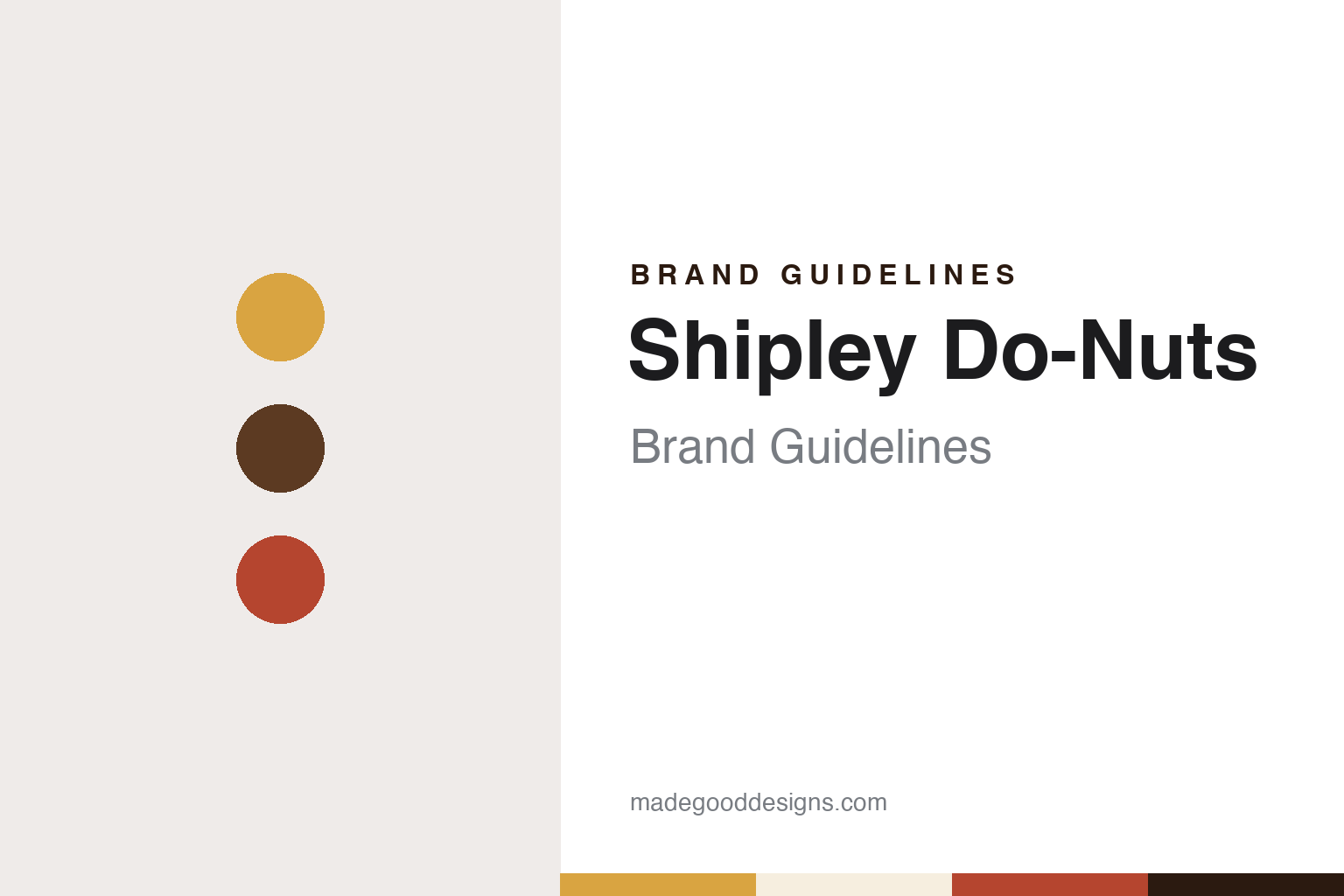
Two constants: a glaze gold, kolache brown and brick red palette and a rounded serif register. Abstract homage — not a Shipley product or mark; no doughnut, logo or sign is reproduced.
Crockett Street
A 1936 recipe and a Houston bakery.
Shipley Do-Nuts traces its start to Houston in 1936. The company’s own history page says Lawrence Shipley Sr. created his recipe that year and first sold his doughnuts on the wholesale market, before opening the first Shipley shop in the city in the mid-1940s. ABC13 Houston, in a 2017 history of the chain, reported that the first doughnuts were baked on Crockett Street in Houston, and that while Lawrence Sr. was out on delivery routes his wife, Lillie, made more doughnuts with their son, Lawrence Jr., on her knee.
The business stayed with the family for three generations. English Wikipedia says Lawrence Shipley Jr. took over and that Lawrence W. Shipley III later became president; ABC13 described the son and grandson carrying on the family trade in 2017. The company still quotes its founder’s view of the product: “When they bite into that hot donut, it will bring them back every time.” The headquarters have stayed in Houston, and English Wikipedia places them on North Main Street, in the city’s Northside.
The menu grew beyond the glazed ring. ABC13 listed three doughnut styles in 2017: yeast-raised, as in the standard glazed; filled, with fillings from apple to Bavarian cream to cherry; and cake doughnuts finished with nuts, glaze, coconut or fruit. The chain also sells kolaches, and the station reported that its “Big Earl” sausage-and-cheese kolache was named for the former Houston Oilers running back Earl Campbell, whose meat-products company partnered with the chain. Today the company says the plain glazed doughnut is still its most popular style, among more than 60 varieties.
Colour
From Houston to more than a dozen states.
For most of its history Shipley was a Texas and Gulf South name. In 2017 ABC13 counted more than 300 stores in eight states, from Alabama to Colorado. English Wikipedia says the chain then began a phase of rapid growth in the late 2010s, opening in Florida, Colorado and Oklahoma in 2018, with its first Florida shop in Bradenton and its first Colorado shop in Aurora, near Denver. A second Colorado shop followed in 2019 in Fountain, near Colorado Springs.
Ownership then moved from the family to private equity. Nation’s Restaurant News reported that the Austin-based firm Peak Rock Capital bought Shipley in 2021. On 28 July 2025 NRN reported that a Peak Rock affiliate had sold the chain to Levine Leichtman Capital Partners, with terms not disclosed. NRN listed Levine Leichtman’s earlier restaurant investments, among them Nothing Bundt Cakes, Tropical Smoothie Café and Wetzel’s Pretzels. At that point NRN described Shipley as a franchisor of doughnut, kolache and coffee shops with more than 375 stores across 14 states, after opening 16 locations in the first half of 2025 and entering North Carolina and Virginia. Levine Leichtman said it had made the purchase in partnership with management, and that the company continues to be run from Houston by the existing team led by chief executive Flynn Dekker.
Growth continued under the new owner. In August 2026 the trade title Fast Casual reported a 15-unit franchise agreement for Metro Detroit, the chain’s Michigan debut, and an earlier three-unit agreement for Ohio, and described Shipley as operating more than 390 franchised and company-owned restaurants across 13 states.
Typography
Rings, boxes and counters.
Doughnut, cookie and cupcake chains sell small things that are eaten quickly, so much of their identity has to work at the counter and in the hand. The box, the bag and the cup travel further than any shop sign in a takeaway trade. Crumbl is a clear case: its own history page calls its long pink box a signature, and Restaurant Business wrote in 2026 that the box makes the cookies look almost as if they are on display.
The product itself is often the second carrier. Glazed rings seen through a window, warm cookies on a counter and cupcakes stacked into towers are the images these companies choose to publish on their own sites and social channels. Some chains add a time or a temperature to the promise: Insomnia Cookies built its name around warm cookies sold late into the night, with shops near college campuses open until 3 a.m., as Restaurant Business reported in 2018.
Flavour naming tends to be plain and descriptive. A cookie or doughnut is usually named after the dessert or ingredient it borrows from, as with the Blueberry Muffin and Dubai Chocolate Brownie that Restaurant Business reported on Crumbl’s menu in 2026, and rotating or seasonal flavours are announced week by week so that the menu itself becomes news. Shops are generally identified by their town, street or campus rather than given names of their own.
Behind the shopfront, corporate pages tell a founder story and, more rarely, an ownership story. Several of the chains in this group began with one person or one family and one shop, then passed through franchising, a larger food company or a private-equity investor. Those changes are dated in trade and business press, and each guide here gives them as dated facts.
Aa
A rounded serif for a round doughnut sign. (Specimen set in Fraunces, a serif STAND-IN; NOT the Shipley logo.)
Shipley
A doughnut-shaped sign, redrawn over time.
Shipley’s mark grew out of its shop sign. English Wikipedia says the current logo is derived from the original store’s sign, a large circular doughnut figure that told passers-by what was sold inside, and that the doughnut-shaped logo has been updated several times while keeping the same theme, with changes to the lettering, brightness, shading and sizing. It adds that an alternate logo tried in the mid-2010s was short-lived.
The name has two spellings. The hyphenated Shipley Do-Nuts is the form used in the 2025 sale coverage and in Levine Leichtman’s announcement; the company’s own website and its 2026 announcements write Shipley Donuts, and many Houstonians simply say “Shipley’s,” English Wikipedia notes. The chain is also tied closely to its home city: English Wikipedia lists sponsorships with the Houston Astros and the University of Houston, and says that in 2018 the Houston artist Donkee Boy painted a Shipley mural along the Katy Freeway.
Its community programmes follow the same local line. ABC13 reported in 2017 that on National Doughnut Day each June the company gave part of its sales to the Salvation Army, and that it held an annual two-mile, doughnut-themed obstacle course, the Shipley Do-Nut Dash, to raise money for meals for pre-school children in Houston; English Wikipedia dates the Dash to early 2015 and names the beneficiary as the charity Kids’ Meals Houston.
For a design guide, Shipley shows how a family bakery’s round sign and hyphenated name can carry a regional chain through changes of owner. Compare Krispy Kreme, the Winston-Salem doughnut chain, and Voodoo Doughnut, a much younger shop from Portland. For this guide we use a glaze gold, a deep kolache brown and a brick red with a rounded serif, an unofficial interpretation; no product or logo is reproduced.
Explore & save
Keep Shipley Do-Nuts’s identity on hand — save it to a board in the Made Good inspiration library.
Shipley Do-Nuts identity set
Save the Shipley glaze gold, kolache brown and brick red palette and the rounded serif register to your own board.