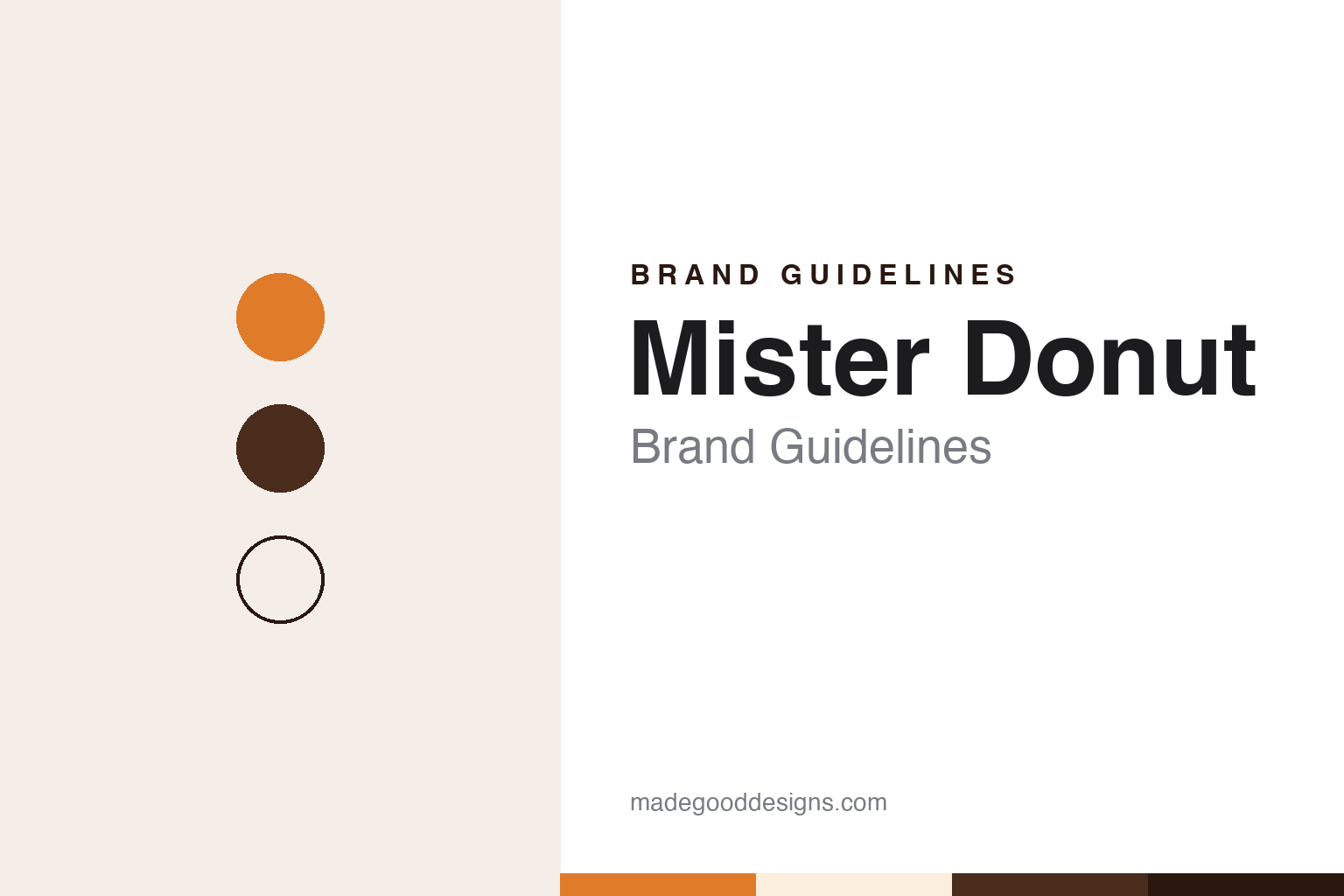
Mister Donut Brand Guidelines
An American doughnut name that found its second home in Japan.
Aa
Two constants: a warm orange, cream and cocoa palette and a rounded sans register. Abstract homage — not a Mister Donut product or mark; no doughnut, character or logo is reproduced.
From Boston to Dunkin’
A breakaway from Dunkin’ that ended up back inside it.
Mister Donut began in the United States in the mid-1950s. English Wikipedia says the chain was founded in 1956 by Harry Winokur; Japanese Wikipedia gives 1955 and places the start in Boston, Massachusetts. Both describe the same background: Winokur had worked with his brother-in-law William Rosenberg, the founder of Dunkin’ Donuts, and left that partnership to set up his own doughnut business, which English Wikipedia says he built with his son-in-law, David Slater. Japanese Wikipedia says the split came from a disagreement over how the business should be run.
The chain grew through franchising. English Wikipedia says it reached 275 stores in the United States and Canada, and that in 1970 the Minneapolis food company International Multifoods acquired Mister Donut and its franchise system from Winokur. By the 1980s, both Wikipedias say, there were about 550 shops across the two countries.
The American story then folded back into Dunkin’. English Wikipedia says the British group Allied-Lyons bought Dunkin’ Donuts in 1989 and that Dunkin’ then acquired Mister Donut from International Multifoods; Japanese Wikipedia dates that purchase to 1990. North American franchisees were offered the option of converting to Dunkin’, and most shops either closed or changed their signs. English Wikipedia says a group of former Mister Donut shops in Pennsylvania and Ohio became Donut Connection in 2006, that the last three Canadian shops, around Toronto, had closed by about June 2006, and that as of 2017 a single Mister Donut remained in the United States, in Godfrey, Illinois.
The name followed Dunkin’ through later sales. English Wikipedia says Dunkin’ Brands, which owned both Dunkin’ and Mister Donut, was sold to three private-equity firms in a deal that closed on 1 March 2006, and became fully independent of them in August 2012. Japanese Wikipedia says Inspire Brands completed its purchase of Dunkin’ Brands on 15 December 2020 and now manages the Mister Donut trademark in North America and other markets.
Colour
Duskin, Minoh and the Pon de Ring.
The chain’s second life began in Japan. Duskin, an Osaka company, was founded in February 1963 by Seiichi Suzuki as Sani-Clean, a franchise business renting dust-control products, and took the name Duskin in June 1964, according to its own history. Japanese Wikipedia says Suzuki travelled to the United States to study franchising, visited Mister Donut of America and met Winokur; Duskin signed a business tie-up in January 1970 and treats 27 January 1970 as the founding day of Mister Donut in Japan.
Duskin’s history says the business opened in April 1971, in alliance with Mister Donut of America, with a first shop in Minoh, Osaka. Japanese Wikipedia says that shop opened on 2 April 1971 as a pilot shop on the site of a Daiei store, and that Japanese shops carry a four-digit number in order of opening, with Minoh as 0001. A training centre followed in October 1971, and the French cruller, a long-running item, arrived in 1973. In 1983, both Wikipedias say, Duskin acquired the Mister Donut trademark and franchise rights for Asia.
The Japanese chain also built its own menu. Japanese Wikipedia says the shops added a dim-sum menu, “Mister Yum Cha,” in 1992, and in 2003 launched the Pon de Ring, a ring of joined dough balls inspired by Brazil’s pão de queijo, together with the lion character Pon de Lion, whose mane is shaped like the doughnut. Duskin’s own pages now describe a meal line, MISDO GOHAN, and two MOSDO shops run with MOS Burger under a tie-up between MOS Food Services and Duskin; its history dates a capital and business alliance with MOS Food Services to February 2008, and a comprehensive capital and business alliance with Mitsui & Co. to September 2004. Duskin says 1,065 Mister Donut shops were trading in Japan as of 31 March 2026, and that its subsidiary Ever Fresh Hakodate mainly manufactures Mister Donut products.
The look was shaped by illustration. Japanese Wikipedia describes the logo as a stylised chef with a moustache and bow tie, drawn as a likeness of Harry Winokur, mainly in orange and white with brown as a secondary colour; some shops use a more abstract mark combining the bow tie and a ring. It says that in the 1970s and early 1980s the Japanese shops took an American, upmarket approach to shop design and advertising, and that packaging and gift illustrations were drawn by the illustrators Peter Sato and Osamu Harada.
Typography
How the category presents itself.
Doughnut, cookie and cupcake chains sell small things that are eaten quickly, so much of their identity has to work at the counter and in the hand. The box, the bag and the cup travel further than any shop sign in a takeaway trade. Crumbl is a clear case: its own history page calls its long pink box a signature, and Restaurant Business wrote in 2026 that the box makes the cookies look almost as if they are on display.
The product itself is often the second carrier. Glazed rings seen through a window, warm cookies on a counter and cupcakes stacked into towers are the images these companies choose to publish on their own sites and social channels. Some chains add a time or a temperature to the promise: Insomnia Cookies built its name around warm cookies sold late into the night, with shops near college campuses open until 3 a.m., as Restaurant Business reported in 2018.
Flavour naming tends to be plain and descriptive. A cookie or doughnut is usually named after the dessert or ingredient it borrows from, as with the Blueberry Muffin and Dubai Chocolate Brownie that Restaurant Business reported on Crumbl’s menu in 2026, and rotating or seasonal flavours are announced week by week so that the menu itself becomes news. Shops are generally identified by their town, street or campus rather than given names of their own.
Behind the shopfront, corporate pages tell a founder story and, more rarely, an ownership story. Several of the chains in this group began with one person or one family and one shop, then passed through franchising, a larger food company or a private-equity investor. Those changes are dated in trade and business press, and each guide here gives them as dated facts.
Aa
A rounded sans for an orange-and-white chef mark. (Specimen set in Nunito, a rounded sans STAND-IN; NOT the Mister Donut logo.)
Across Asia
Master franchises from Bangkok to Hong Kong.
From Japan the chain spread across Asia, through Duskin and through separate franchise holders. English Wikipedia says the first Thai shop opened in Bangkok’s Siam Square in 1978, with Central Restaurants Group managing the business there since 2003, and that the first Philippine shop opened in Manila in 1982, with the Ramcar Group’s Food Fest taking the franchise in 1995. Duskin’s history lists a joint venture with Taiwan’s President Chain Store Corp. in August 2004, which began trading in Taiwan that October; an Indonesian franchise signed in September 2014, with a first shop near Jakarta in May 2015; a Singapore master franchise in November 2022, with a first shop in May 2023; and a Hong Kong master franchise with Dragon Circle Enterprise in April 2024.
Marketing-Interactive reported on 28 October 2024 that the Hong Kong shop had opened in an art shopping mall in Tsim Sha Tsui, with the Pon de Ring presented as its signature doughnut, and described Mister Donut as established in Japan in 1971. English Wikipedia says the chain closed its shops in mainland China in 2019; Duskin’s history records a new master franchise agreement, signed in February 2026 with Shanghai MeiTianTian Brand Management, covering Shanghai and the provinces of Zhejiang, Jiangsu and Shandong. Duskin counts Mister Donut in six overseas markets, Thailand, the Philippines, Taiwan, Indonesia, Singapore and Hong Kong, with 1,287 shops plus 9,717 convenience-store and other sales points as of 31 December 2025, including shops run under master franchise agreements.
For a design guide, Mister Donut shows how an American franchise name can be carried abroad, given new characters and a new signature product by its operator there, while its original home market shrinks to a single shop. Compare Dunkin’, which absorbed the American chain, and Krispy Kreme, another American doughnut chain. For this guide we use a warm orange, cream and a cocoa brown with a rounded sans, an unofficial interpretation; no product or logo is reproduced.
Explore & save
Keep Mister Donut’s identity on hand — save it to a board in the Made Good inspiration library.
Mister Donut identity set
Pin the Mister Donut orange, cream and cocoa palette and the rounded sans register to your own board.