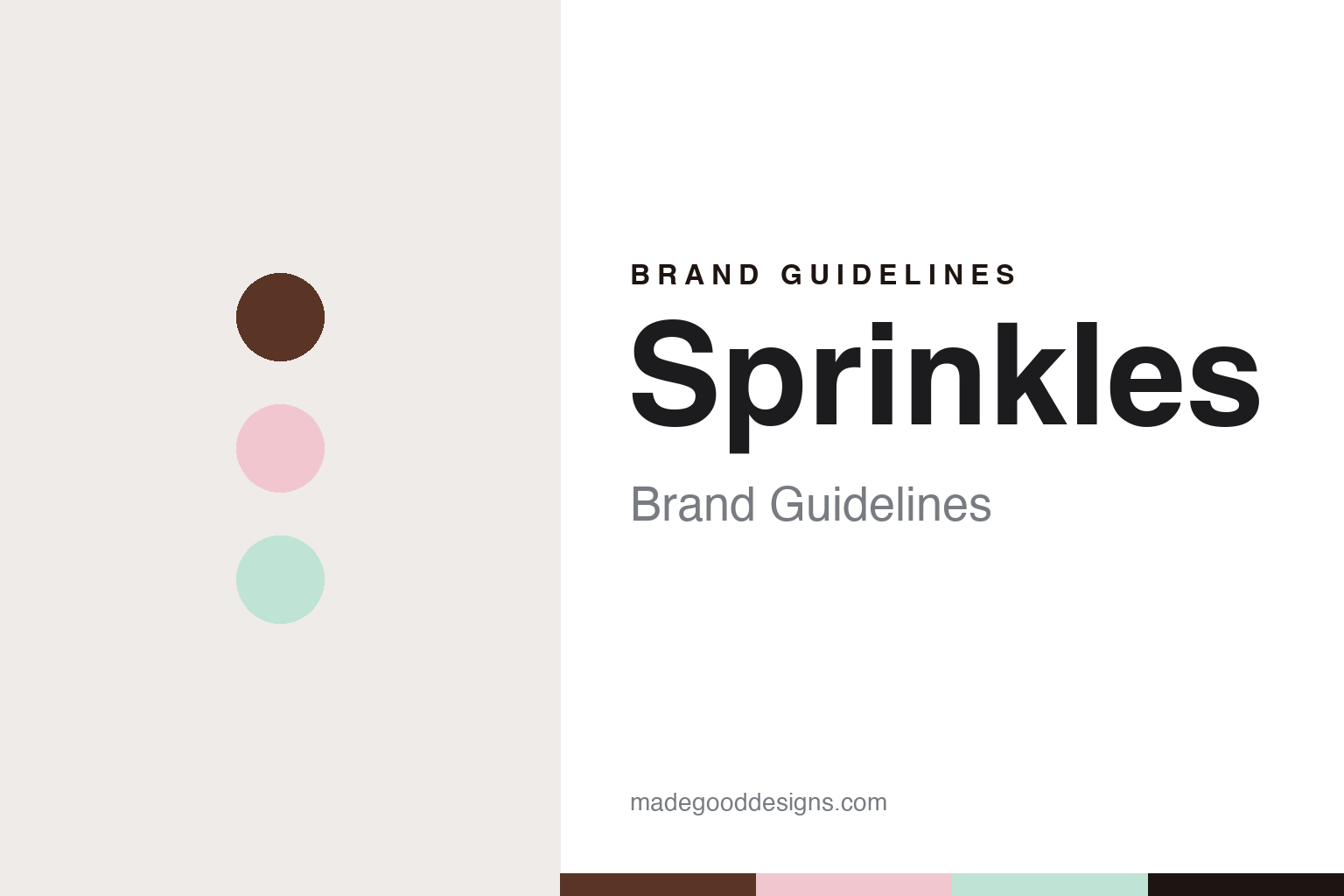
Sprinkles Brand Guidelines
A Beverly Hills cupcake shop with a 24-hour machine.
Aa
Two constants: a cocoa, pink and mint palette and a geometric sans register. Abstract homage — not a Sprinkles product or mark; no cupcake, box or logo is reproduced.
A cupcake-only bakery
Two former bankers and a small shop in Beverly Hills.
Sprinkles was a cupcake bakery chain from Beverly Hills, California. English Wikipedia says its founder, Candace Nelson, was a former investment banker who trained in the pastry programme at Tante Marie’s in San Francisco and then decided to open a bakery devoted only to cupcakes. She and her husband, Charles Nelson, opened the first Sprinkles shop in Beverly Hills on 13 April 2005. English Wikipedia’s article on Candace Nelson says both had worked as investment bankers, that the couple had earlier run a custom cake business from their home in San Francisco, and that the first shop measured about 600 square feet. ABC7 in Los Angeles reported in January 2026 that the shop quickly drew a celebrity clientele.
Design was part of the business from the start. English Wikipedia says the pared-back shop was designed by an architect from Vienna, and that the logo and packaging were created by a former Martha Stewart employee. It names the Sprinkles architect as Andrea Lenardin, who also designed the “Sprinklesmobile,” a travelling shop built on a Mercedes Sprinter van.
The range grew beyond the shop counter. English Wikipedia says Nelson developed a line of cupcake mixes in 2007, sold through the bakeries and through Williams Sonoma stores in the United States and Canada, and that the bakeries also made cupcakes for dogs. Nelson also appeared on television as a judge on the competition series Cupcake Wars, according to the same article, which also says she appeared on Shark Tank as a guest investor; it adds that she later co-founded the pizza restaurant chain Pizzana and wrote The Sprinkles Baking Book.
Colour
A machine that sold cupcakes around the clock.
The company’s signature invention was the Cupcake ATM. English Wikipedia says Sprinkles introduced it in 2012, an idea Nelson had after wanting a cupcake late at night, and that the machines dispensed cupcakes on demand, 24 hours a day. FOX Business, reporting on the chain’s closure, described the cupcake ATMs as the thing Sprinkles was most widely known for, and Entrepreneur reported in January 2026 that the vending machines had gone viral on TikTok.
In 2012 Nelson also sold Sprinkles to private equity. FOX Business and ABC7 name the buyer as KarpReilly, a private-equity firm; FOX Business said the price was not disclosed, and Entrepreneur reported that the chain had 10 locations at the time of the sale. FOX Business reported that Nelson had no operational involvement in the business after 2012.
Under its new owner the chain kept expanding. By the time it closed, English Wikipedia says, it had 21 traditional shops and 25 Cupcake ATMs, with locations in Arizona, California, Florida, Nevada, Texas, Utah and Washington, D.C. FOX Business, citing SFGATE, gave a slightly different picture: more than 20 stores across six states and Washington, D.C., with roughly two dozen cupcake machines. English Wikipedia’s article on Candace Nelson gives a third figure, 22 locations across the United States, including one in New York, without dating it.
The menu stayed close to the original idea. The Sprinkles website, as it stands in November 2026, sorts its range into cupcakes, assorted boxes, layer cakes, birthday and occasion boxes, catering and events, and dog treats it calls Pupcakes, with personalisation offered only at its local bakeries.
Typography
How the category presents itself.
Doughnut, cookie and cupcake chains sell small things that are eaten quickly, so much of their identity has to work at the counter and in the hand. The box, the bag and the cup travel further than any shop sign in a takeaway trade. Crumbl is a clear case: its own history page calls its long pink box a signature, and Restaurant Business wrote in 2026 that the box makes the cookies look almost as if they are on display.
The product itself is often the second carrier. Glazed rings seen through a window, warm cookies on a counter and cupcakes stacked into towers are the images these companies choose to publish on their own sites and social channels. Some chains add a time or a temperature to the promise: Insomnia Cookies built its name around warm cookies sold late into the night, with shops near college campuses open until 3 a.m., as Restaurant Business reported in 2018.
Flavour naming tends to be plain and descriptive. A cookie or doughnut is usually named after the dessert or ingredient it borrows from, as with the Blueberry Muffin and Dubai Chocolate Brownie that Restaurant Business reported on Crumbl’s menu in 2026, and rotating or seasonal flavours are announced week by week so that the menu itself becomes news. Shops are generally identified by their town, street or campus rather than given names of their own.
Behind the shopfront, corporate pages tell a founder story and, more rarely, an ownership story. Several of the chains in this group began with one person or one family and one shop, then passed through franchising, a larger food company or a private-equity investor. Those changes are dated in trade and business press, and each guide here gives them as dated facts.
Aa
A geometric sans for a pared-back cupcake shop. (Specimen set in Josefin Sans, a geometric sans STAND-IN; NOT the Sprinkles logo.)
The last day
A nationwide closure on New Year’s Eve 2025.
The chain closed at the end of 2025. FOX Business reported on 31 December 2025 that Sprinkles was permanently closing all of its stores, and that Nelson, in an Instagram video, called that day the chain’s “final day” of operations; she said she had learned of the decision a few days earlier, and that she had thought Sprinkles “would keep growing and be around forever.” In the caption she thanked the fans, customers and staff, and said she would always be proud of what had been built. A Sprinkles spokesperson told KTLA, as quoted by FOX Business, that the company had made the decision to “transition away from operating company-owned Sprinkles bakeries.” FOX Business also reported that it was unclear what would happen to the cupcake machines.
ABC7 reported on 1 January 2026 that the owner had not given a reason for the closure, and Vending Times reported on 14 January 2026 that the company had removed its products from its website and shut its locations. Coverage of the closure focused on the private-equity ownership: Entrepreneur reported that fans were linking the shutdown to a wider pattern of restaurant brands closing after private-equity purchases.
The name did not vanish entirely. English Wikipedia says two shops in Northern California, in San Ramon and Palo Alto, are still open as independent local stores. In November 2026 the Sprinkles website opens with the line “The next chapter of Sprinkles is coming,” and invites visitors to stay connected for news of new locations, products and opportunities.
For a design guide, Sprinkles shows how a shop interior, a logo and a walk-up machine could carry a single bakery’s look into several states, and how that look outlasted the company-owned shops on a website and two local shops. Compare Crumbl, another American dessert chain, and Krispy Kreme. For this guide we use cocoa, a frosting pink and a pale mint with a geometric sans, an unofficial interpretation; no product or logo is reproduced.
Explore & save
Keep Sprinkles’s identity on hand — save it to a board in the Made Good inspiration library.
Sprinkles identity set
Pin the Sprinkles cocoa, pink and mint palette and the geometric sans register to your own board.