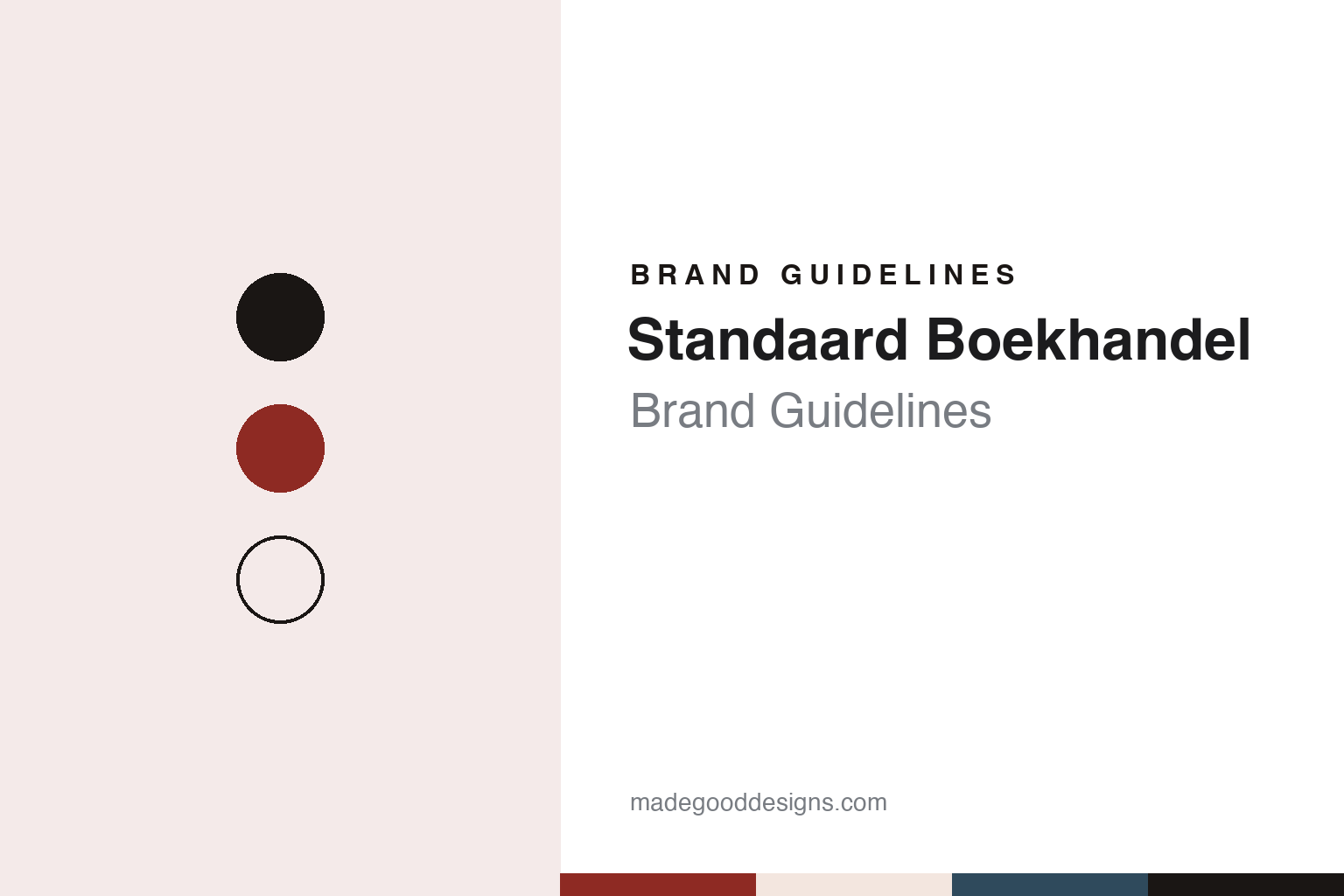
Standaard Boekhandel Brand Guidelines
A 1919 Flemish bookshop chain reunited with its publisher.
Aa
Two constants: a brick red, slate blue and paper palette and a Shopfront sans register. Abstract homage — not a Standaard Boekhandel sign or mark; no logo, shopfront or product is reproduced.
De Standaard
A bookshop born beside a newspaper.
Standaard Boekhandel started in 1919, set up by the same group of Flemish figures who published the daily newspaper De Standaard, Dutch Wikipedia says. The newspaper company itself had been founded in Antwerp on 2 May 1914, when Frans Van Cauwelaert, Alfons Van de Perre and Arnold Hendrix, with 151 shareholders, created both the daily and the publishing company De Standaard N.V.; the outbreak of war delayed the first issue of the paper until 4 December 1918, according to the Dutch Wikipedia article on the newspaper. The paper, a separate business today, is owned by the media group Mediahuis.
At first the bookshops sat inside De Standaard N.V. On 14 July 1924 they became a separate company covering both the bookshops and a publishing house, Dutch Wikipedia says; the trade site MandA, reporting in January 2026, also dates the chain’s independence to 1924. At that point there were two shops, in Antwerp and Brussels. A takeover added Leuven in 1926 and another brought in Ghent in 1933, and the number of shops grew gradually from there. The company also took over the bookshops of the Dutch publisher De Arbeiderspers in the Netherlands, Dutch Wikipedia notes, without giving a year.
The sources used for this guide do not say how the company operated during the occupation of 1940–1944.
The company’s own careers page still opens with the year: it says that “since 1919” its shops have been part of the big and small moments of readers young and old, and describes itself as a group that has guided people through books and paper for more than a century.
Colour
A bankruptcy, a split and a long run of growth.
The break came in 1976, when the parent company De Standaard N.V. went bankrupt. The receiver sold Scriptoria, the company that held the bookshops and the publishing house among other businesses, as a whole to the Dutch printing group Bührmann-Tetterode, Dutch Wikipedia says. The new owners restructured the business in 1984: the Dutch branches were sold and the link between the bookshops and the publisher was cut for good. The publisher continued separately as Standaard Uitgeverij, which later passed through the Dutch group WPG before becoming independent again in 2018, according to Dutch Wikipedia.
The bookshops’ current owner is the Zuidnederlandse Uitgeverij, a Belgian publishing group based in Aartselaar and owned by the Schaltin family, Dutch Wikipedia says. The two Dutch Wikipedia articles differ on the date: the article on the publishing group says it has owned Standaard Boekhandel since 1984, while the article on the chain says since 2002. The group publishes its own books under the Deltas name in Dutch and Chantecler in French.
Growth followed in the 1990s. Dutch Wikipedia counts 59 shops in 1991, 73 ten years later and a hundredth shop opened in 2006. A second attempt at the Dutch market began in 1992 with thirteen shops, which were sold back in 1999. In October 2010 the chain opened a shop in a retail park, at the Bredene Shopping Center on the coast, and by 2011 it counted 129 branches.
Online selling took two attempts. In 2001 the company bought the existing book website azur.be, then announced on 28 November 2002 that the project was ending; it has sold online again since 2011, Dutch Wikipedia says. For years its shops were also where readers redeemed Artis-Historia savings points, until Artis-Historia went bankrupt and stopped trading in September 2004.
Typography
Signs, formats and owners.
Europe’s bookshop chains introduce themselves first through the sign over the door. Many carry a founder’s or family surname. Bruna takes its name from Albert Willem Bruna, who took over a book, paper and music shop in Haarlem in 1868 before the business moved to Utrecht in 1890, according to Dutch Wikipedia. Decitre carries the surname of Henri Decitre, who founded the Lyon bookseller with Marius Bassereau in 1907. Orell Füssli keeps the name of a Zurich printing house far older than its bookshops. Logos and shop signs change over time, and each guide in this series describes the current sign only as the company shows it.
Store formats in Switzerland, the Netherlands, Belgium, France and Finland are described here as each company publishes them: city-centre houses on several floors, branches in shopping centres and stations, franchise shops, and online shops and apps. Branch and country counts in these guides are given only with their source and date, because networks grow and shrink through takeovers and closures, and a chain that has closed is described as closed.
Ownership takes several forms. Some chains belong to larger groups: Finnish Wikipedia says Suomalainen Kirjakauppa was owned by Rautakirja from 1924, and Finland’s competition authority described the chain in 2016 as part of the Otava group. Others are cross-border joint ventures, such as Orell Füssli Thalia in Switzerland, which began trading on 1 October 2013. Others again are networks of independent shops under one name: Libris is a co-operation of independent booksellers run within the retail service group EK, rather than a chain whose shops one company owns.
Chains also name their own formats and services, and these guides name them only as the companies do. Corporate pages and company histories describe founders and owners, and each guide sets out what can be checked against dated, independent sources, with any gap in the record stated plainly.
Aa
A plain shopfront sans for a high-street chain. (Specimen set in Archivo, a sans STAND-IN; NOT the Standaard Boekhandel logo.)
Standaard Boekhandel
From Club to a reunion with Standaard Uitgeverij.
On 2 April 2014 Standaard Boekhandel counted 145 bookshops and announced that it was taking over the Club book and stationery shops, Dutch Wikipedia says. Today the company’s careers page names two head offices, Sint-Niklaas for Standaard Boekhandel and Drogenbos for Librairie Club, with a distribution centre at Temse, and invites applicants to run one of the shops themselves as independent operators. Its website listed 140 shops in November 2026. MandA, in January 2026, gave a wider figure of around 180 stores across Belgium and some 500 staff.
The shops sell more than books. Dutch Wikipedia lists music, films, newspapers and magazines, comics, maps and travel guides, greeting cards, board games and office supplies, and the website adds puzzles, gift boxes and e-readers under the Vivlio name.
In January 2026 the chain bought back the publisher it had been split from. MandA reported on 15 January 2026, citing the financial daily De Tijd, that Standaard Boekhandel had acquired Standaard Uitgeverij, the Antwerp comics and books publisher, reuniting two companies whose histories go back more than a century. No financial details were disclosed, and the companies said in a joint statement that both would continue to operate independently, with their identities, services and existing partnerships in the book trade unchanged. Standaard Uitgeverij, which publishes comic series including Suske en Wiske, De Kiekeboes and Nero, had about 50 employees at the time, according to MandA.
For a design guide, Standaard Boekhandel shows how a shop name can outlast the newspaper group it came from: the word “Standaard” now belongs to a newspaper, a publisher and a bookshop chain with different histories, two of them now under one owner again. Compare Libris, a Dutch network of independent bookshops, and Bruna, another Low Countries bookshop name. For this guide we use brick red, slate blue and paper with a sans, an unofficial interpretation; no product or logo is reproduced.
Explore & save
Keep Standaard Boekhandel’s identity on hand — save it to a board in the Made Good inspiration library.
Standaard Boekhandel identity set
Save the Standaard Boekhandel brick red, slate blue and paper palette and the Shopfront sans register to your own board.
Source & notes
Frequently Asked Questions
What font can I use to match the Standaard Boekhandel look?
This guide describes Standaard Boekhandel’s type as “A plain shopfront sans for a high-street chain”. Its type specimen is set in Archivo from Google Fonts as a stand-in; Archivo is not Standaard Boekhandel’s own lettering.
What colours are in the Standaard Boekhandel palette?
This guide’s Standaard Boekhandel palette is Brick red #8E2A23, Ink #1A1614, Shelf blush #F3E6DF, Slate blue #2F4A5C and Paper #FAF7F4. The tones are the guide’s own unofficial interpretation, not official Standaard Boekhandel hex codes.
When was Standaard Boekhandel founded?
Standaard Boekhandel was founded in 1919, in Flanders, Belgium. This guide lists Zuidnederlandse Uitgeverij as its owner.
Who owns Standaard Boekhandel?
Standaard Boekhandel is owned by Zuidnederlandse Uitgeverij. This guide dates Standaard Boekhandel to 1919, in Flanders, Belgium.