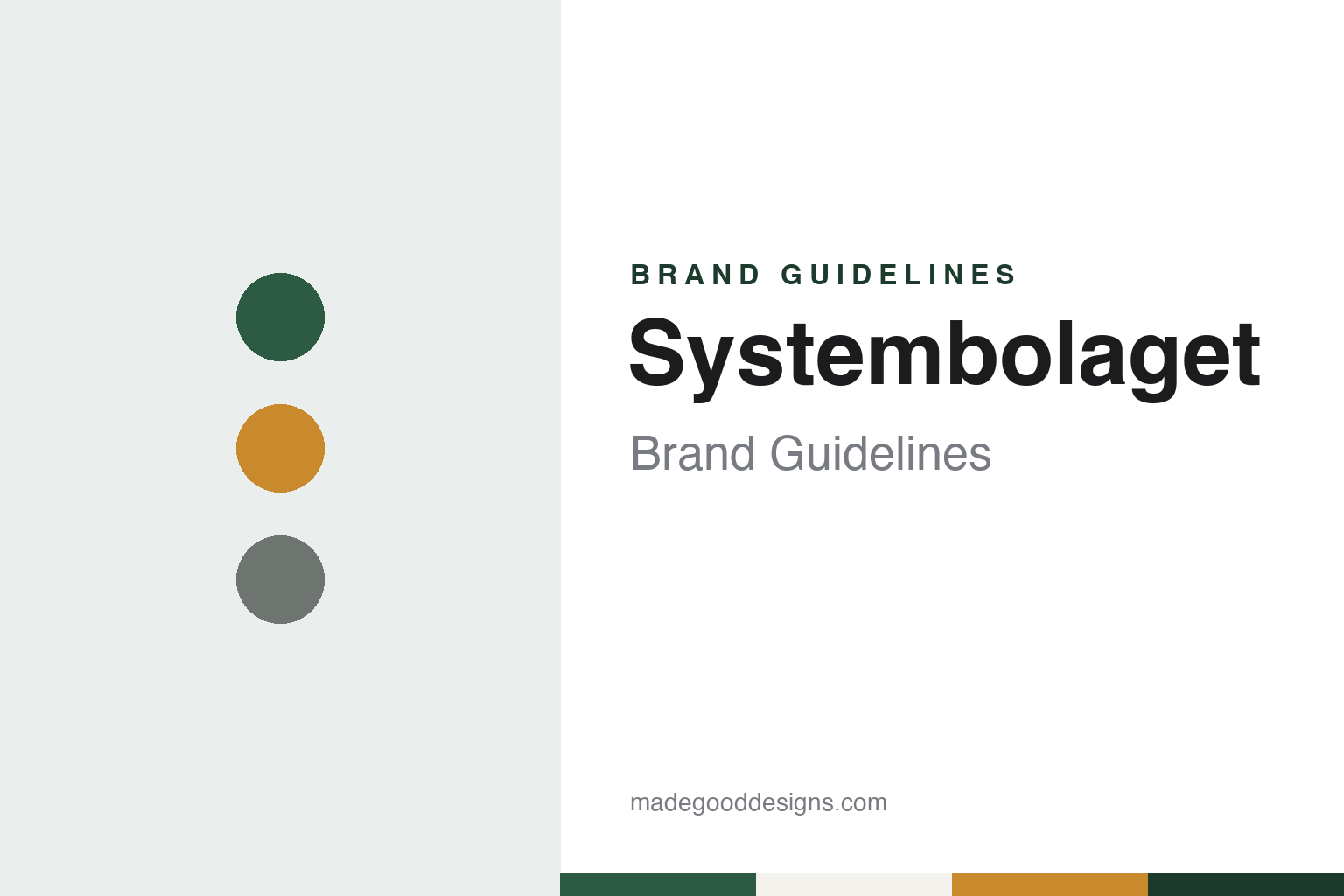
Systembolaget Brand Guidelines
A 1955 state retailer told through shops, shelves and bags.
Aa
Two constants: a spruce green, granite and amber palette and a plain grotesque sans register. Abstract homage — not a Systembolaget product or mark; no logo, symbol or bag design is reproduced.
One company from forty-one
A national monopoly formed in 1955.
Systembolaget is the Swedish state-owned company that holds the statutory monopoly on retail sales of spirits, wine and beer above 3.5 per cent alcohol by volume, Swedish Wikipedia says. Its national form dates from 1 October 1955. According to Systembolaget’s history site, written by the Centre for Business History (Centrum för Näringslivshistoria), on that day 41 local companies with 247 shops in 147 places were merged into a single national company, first called Nya Systemaktiebolaget; the household ration book, the motbok, was abolished the same autumn.
The local companies were older. Swedish Wikipedia traces the model to a company formed in Falun in the middle of the nineteenth century to run all spirits sales in the town, followed by a state-regulated serving house in Gothenburg; in 1870, it says, it was decided that the profits should go to the state. In 1917 Aktiebolaget Spritcentralen was set up to take over wholesale distribution, and from 1919 the motbok was in use nationwide until 1955. The name, according to Systembolaget and the Centre for Business History as cited by Swedish Wikipedia, comes from turning the serving trade into companies and putting spirits sales into a system.
The monopoly’s legal position was tested after Sweden joined the European Union in 1995. Swedish Wikipedia says the European Commission stated in 1993 that Systembolaget could remain if Sweden joined. In a judgment of 23 October 1997 in Case C-189/95, the European Court of Justice ruled that the EC Treaty did not preclude a national monopoly on the retail sale of alcoholic beverages, while ruling against Swedish rules that limited import rights to holders of production or wholesale licences. Swedish Wikipedia says the result ended Systembolaget’s monopoly on sales to restaurants and Vin & Sprit’s import monopoly, while the retail monopoly remained.
Colour
From the counter to the shelf.
The shops changed more than the legal framework did. The history site says the old outlets often stood on side streets, with their windows rented out to advertise other goods such as suits and shirts, and that every sale was made over the counter. In 1984 Systembolaget opened a specialist wine shop in the Marmorhallarna building in Stockholm, staffed by employees with extra training. In 1991 it opened a trial self-service store in Filipstad; Swedish Wikipedia says 418 of 421 stores were self-service by 2013, and the last full-range counter store, in Högdalen in southern Stockholm, was converted in October 2014.
Opening hours and ordering followed. The history site says the Riksdag voted in 1982 to close the shops on Saturdays and that Saturday opening returned in 2001, and that in 1999 parliament allowed longer weekday hours, card payments and internet orders. Home delivery was tried in a few places from November 2012 and became available across Sweden in October 2021, Swedish Wikipedia says. The same autumn the company tested self-checkout tills at Torsplan in Stockholm and Kungsgatan in Örebro; after a trial that also included a store in Uppsala, around twenty stores received them in 2024, the history site says. Swedish Wikipedia counts a chain of more than 440 stores and around 500 agents, known as ombud, serving smaller towns and rural areas.
The range has been shaped by court cases too. English Wikipedia says Systembolaget began selling bag-in-box wine in September 1996, after the European Court of Justice found in favour of the Swedish drinks company Spendrups, which had complained that the earlier refusal to stock boxed wine broke free-trade rules. In 2010 Systembolaget sold Lagena, the subsidiary formed in 1994 to run its warehouses and deliveries to stores, to JF Hillebrand, Swedish Wikipedia says. The shelves also carry alcohol-free drinks, and English Wikipedia says the company represented about 1,200 suppliers in 2023, selling products from more than 5,000 producers.
Typography
Merchants and monopolies.
Wine merchants and alcohol retailers sell a product that shoppers cannot always taste before they pay, so their identities lean on words, place and guidance more than on packaging of their own. A shop name, a fascia and a few lines of handwriting on a card next to a bottle carry much of the work. For a designer, the useful material is what these companies show in public: their shop fronts, shelf cards, tasting areas, catalogues and the corporate pages that explain who founded and who owns them.
The physical shop is the first layer. Some chains began in warehouse-style units where wine was stacked in cases, and later refits moved towards shelving and tasting areas, as Decanter reported of one British chain in 2019. Shelf talkers, the small cards that describe a wine’s style and origin, sit beside the bottles and can be written in a personal, conversational voice. Tasting counters and by-the-glass machines turn part of the shop into a place to try before buying.
Mail-order and online merchants work through a different set of objects: printed catalogues, mixed cases, club mailings and order pages. Their own-label wines, sold under invented names rather than the merchant’s own, are part of the range and are presented much like any producer’s bottle. A founder’s story, such as a first trip to a vineyard or a single van, can be retold in these materials.
Corporate pages fill in the rest: founding dates, changes of ownership, parent groups and, for state retailers, the legal basis on which they operate. This guide uses dated, independent sources for those facts and treats the company’s own descriptions as its own words. The palette and type on each page are an unofficial interpretation chosen for the guide, not a copy of any retailer’s signage, labels or logo.
Aa
A plain grotesque sans — the register of shelf labels and wayfinding. (Specimen set in Work Sans, a sans STAND-IN; NOT the Systembolaget logo.)
Systembolaget
Bags, symbols and shelves.
Much of Systembolaget’s design history, as its history site tells it, is carried home in a bag. The site says plastic carrier bags were trialled for two weeks in April 1967 at the two stores in Jönköping, with a strengthened paper bag tested alongside, before the whole chain switched to plastic; over the years the bags came in different colours and carried different messages. A charge for bags arrived in 1997 together with a bag made mostly from recycled plastic. In 2015 the company moved to a bag made from sugarcane-based plastic, in 2021 to bags made entirely of recycled plastic, and in 2023 it stopped producing plastic bags and offered paper bags in its stores again.
In-store wayfinding has its own symbol set. Nyheter24 reported in November 2026 that six new food symbols were introduced in the stores at the start of September, for hamburgers, pizza, pasta, grilled food, salty snacks and drink ingredients, joining the long-standing symbols for fish, poultry and meat, and that the older cheese symbol was redrawn; the symbols also cover alcohol-free drinks. Staff relations make the news as well: in June 2025 Dagens PS reported that the union Unionen and the employers’ organisation Svensk Handel had signed a new collective agreement for Systembolaget staff, calling off a strike that had been notified for 10 June; the agreement runs from May 2025 to April 2027.
For a design guide, Systembolaget shows how a state retailer that does not advertise individual drinks, as Swedish Wikipedia describes its marketing rules, builds an identity from store formats, shelf symbols and the bag customers carry home. Compare it with Vinmonopolet, Norway’s state wine and spirits retailer, and the LCBO in Ontario. For this guide we use spruce green, birch white, granite grey and a warm amber with a sans, an unofficial interpretation; no product or logo is reproduced.
Explore & save
Keep Systembolaget’s identity on hand — save it to a board in the Made Good inspiration library.
Systembolaget identity set
Pin the Systembolaget spruce green, granite and amber palette and the plain grotesque sans register to your own board.
Source & notes
Frequently Asked Questions
What font can I use to match the Systembolaget look?
This guide describes Systembolaget’s type as “A plain grotesque sans — the register of shelf labels and wayfinding”. Its type specimen is set in Work Sans from Google Fonts as a stand-in; Work Sans is not Systembolaget’s own lettering.
What colours are in the Systembolaget palette?
This guide’s Systembolaget palette is Spruce green #2C5A43, Forest ink #1C3B2C, Granite grey #6E7570, Amber #C98A2E and Birch white #F4F2EC. The tones are the guide’s own unofficial interpretation, not official Systembolaget hex codes.
When was Systembolaget founded?
Systembolaget was founded in 1 October 1955, in Sweden. Systembolaget is known for Self-service stores, carrier bags, shelf symbols.
Who owns Systembolaget?
Systembolaget today: Systembolaget AB, owned by the Swedish state. Systembolaget is known for Self-service stores, carrier bags, shelf symbols.


