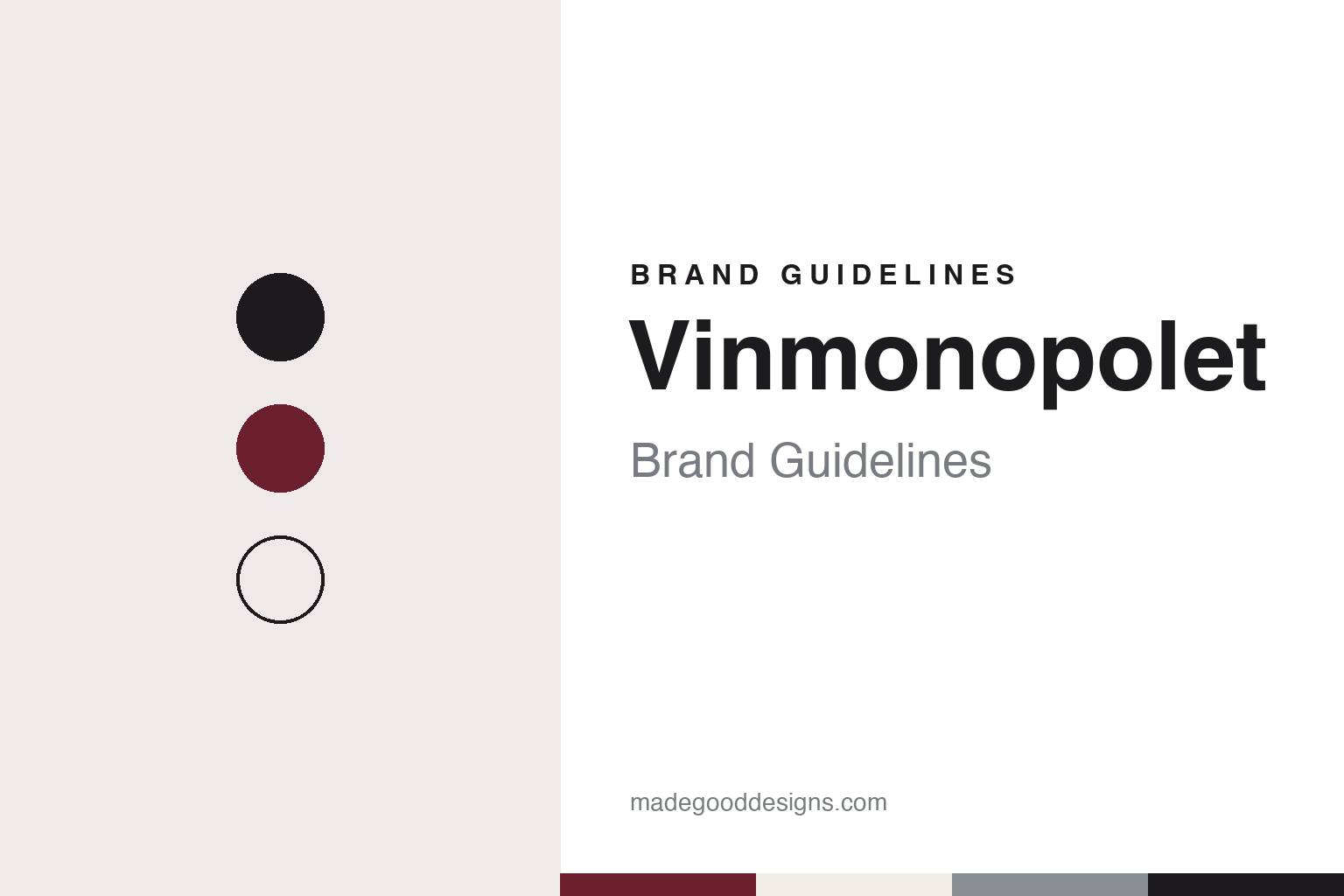
Vinmonopolet Brand Guidelines
Norway’s 1922 wine monopoly, a grey bag and self-service.
Aa
Two constants: a wine red, grey and birch white palette and a bookish serif register. Abstract homage — not a Vinmonopolet product or mark; no logo, bag or sign is reproduced.
Polet
A company named for the only legal drink.
Vinmonopolet, “the wine monopoly,” shortened in everyday Norwegian to Polet, was founded on 30 November 1922 as a private limited company under state control, Norwegian Wikipedia says. Store norske leksikon, the Norwegian encyclopaedia, says its statutes and concession were set by the Storting, Norway’s parliament, with the aim of removing private economic interest from the alcohol trade as far as possible; private investors subscribed the share capital, and their dividend was capped. The name reflects the moment: at the time, wine was the only such drink that could legally be sold in Norway. English Wikipedia ties the founding to trade negotiations with wine-exporting countries, mainly France.
Trading began in 1923 with the import and sale of light wines, Store norske leksikon says. When the ban on fortified wine was lifted in 1923 and the ban on spirits in 1927, the company’s exclusive right was extended to those drinks too. In 1930 shortcomings in its purchasing procedures came to light; Norwegian Wikipedia says the leadership of the time was convicted of mixing private and company interests, and purchasing was reorganised so that individuals had less say. A law on the company followed in 1931, and it was reorganised under that law when the original concession ran out in 1932. In 1938 it took over the assets and liabilities of the local samlag companies, and since 1939 the state has owned all of its shares.
The Second World War brought rationing. Norwegian Wikipedia says imports were sharply limited and goods were rationed; when better stock arrived, queues formed around the block, and in time imported originals were sold only on Thursdays. English Wikipedia says that a stock of Bordeaux left in Norway when the occupation ended in 1945 became the base of a generic Rødvin (“red wine”), sold from January 1946. A new house blend followed in February 1950 and stayed on the shelves for decades, nicknamed “Château Hasle” after the district of the company’s old headquarters, before leaving the standard range in 2014 after 54 vintages.
Colour
From the counter to self-service.
For most of the 20th century a Vinmonopolet shop was a counter. Store norske leksikon says that as late as the mid-1990s every shop was still served over the counter, with only 112 outlets in the whole country and weekend queues common enough to give Norwegian the word “polkø”, the queue at the Polet. The first self-service shop opened in 1999, and such shops quickly replaced the counters; Norwegian Wikipedia says the Grünerløkka shop in Oslo was the last to switch, in 2011. Internet sales began in 2002, English Wikipedia says, and Store norske leksikon adds ordering with delivery by post, to a shop or to the home.
The network then grew. Store norske leksikon counts nearly 210 new shops in the following quarter-century, 348 at the end of 2023 and 351 at the end of 2024, many in places that had never had one; in 2023, it says, 98 per cent of Norwegians lived in a municipality with a shop or within 30 kilometres of one. Norwegian Wikipedia gives 353 shops as of 1 August 2025. In 2012 the shops were sorted into six categories by the previous year’s sales, from about 300 products in the smallest category to about 1,800 in the biggest. The whole range has grown from about 2,000 products to roughly 40,000 at the end of 2024, Store norske leksikon says. Special shops opened in Oslo and Bergen in 2005 and 2006; English Wikipedia says the Oslo flagship moved to Aker Brygge in January 2015 and that these shops hold themed launches six times a year, such as Bordeaux in December and Burgundy in February.
Some things the company no longer does. After the European Economic Area agreement took effect in 1994, its import and wholesale monopoly was found to conflict with EEA rules, and the Storting decided in 1995 to end it from 1996. Production and distribution were split off that year into a new state company, Arcus, which the state sold to the holding company Sucra in 2001 and 2003, Store norske leksikon says. In 1997, Norwegian Wikipedia says, the remaining retail monopoly was found compatible with the EEA agreement. Auctions of second-hand wine became legal from 1 January 2012, and the first was held with the Oslo auction house Blomqvist on 25 November 2013, English Wikipedia says.
Typography
How alcohol retailers present themselves.
Wine merchants and alcohol retailers sell a product that shoppers cannot always taste before they pay, so their identities lean on words, place and guidance more than on packaging of their own. A shop name, a fascia and a few lines of handwriting on a card next to a bottle carry much of the work. For a designer, the useful material is what these companies show in public: their shop fronts, shelf cards, tasting areas, catalogues and the corporate pages that explain who founded and who owns them.
The physical shop is the first layer. Some chains began in warehouse-style units where wine was stacked in cases, and later refits moved towards shelving and tasting areas, as Decanter reported of one British chain in 2019. Shelf talkers, the small cards that describe a wine’s style and origin, sit beside the bottles and can be written in a personal, conversational voice. Tasting counters and by-the-glass machines turn part of the shop into a place to try before buying.
Mail-order and online merchants work through a different set of objects: printed catalogues, mixed cases, club mailings and order pages. Their own-label wines, sold under invented names rather than the merchant’s own, are part of the range and are presented much like any producer’s bottle. A founder’s story, such as a first trip to a vineyard or a single van, can be retold in these materials.
Corporate pages fill in the rest: founding dates, changes of ownership, parent groups and, for state retailers, the legal basis on which they operate. This guide uses dated, independent sources for those facts and treats the company’s own descriptions as its own words. The palette and type on each page are an unofficial interpretation chosen for the guide, not a copy of any retailer’s signage, labels or logo.
Aa
A bookish serif, for a retailer that publishes its own magazine. (Specimen set in Fraunces, a serif STAND-IN; NOT the Vinmonopolet logo.)
Vinmonopolet
A plain bag, a magazine and a centenary book.
One well-documented piece of Vinmonopolet design is its carrier bag. Norwegian Wikipedia says bags were introduced in the 1970s to give customers an anonymous way home: the first was plain grey with no logo, chosen to be as unremarkable as possible, though grey was so unusual for a shopping bag that it stood out in the street. Bags have since mostly been a single colour, with the logo absent or discreet. A new graphic profile in 2006 brought a brown bag with thin black lines, embossed with the logo and web address; in autumn 2009 came pale, translucent bags made from at least half recycled Norwegian plastic, and later black, red and green versions. English Wikipedia notes the circled V, Ⓥ, used as a symbol for the company.
Print carries much of the voice. The company launched the customer magazine Vinbladet in 1988, reviving a name used 60 years earlier for an internal bulletin for staff, English Wikipedia says; from 2016 to the end of 2025 it appeared four times a year, free in the shops and online, and in 2025 the company announced that a redesign was under way, Norwegian Wikipedia says. For its centenary on 30 November 2022 the company marked the date with an illustrated history by the cultural historian Olav Hamran, published by Forlaget Press; the design practice Snøhetta lists the book among its brand and experience design projects.
Governance has been tested in public. In 2005, Store norske leksikon says, both the chief executive and the board chair stepped down after problems with the company’s purchasing routines were uncovered, and Norwegian Wikipedia says six shop managers were dismissed and the ethics rules were changed; after a 2006 change in the law, the chief executive is employed by the board. Ownership has not changed: Vinmonopolet remains a state-owned limited company based in Oslo, with agreements with 810 wholesalers in 2024, Norwegian Wikipedia says.
For a design guide, Vinmonopolet shows how a state retailer can build an identity out of restraint: a plain bag, a serious magazine and shops that moved from counters to open aisles. Compare Systembolaget, its Swedish counterpart, and the LCBO in Ontario. For this guide we use a deep wine red, a slate grey and a birch white with a serif, an unofficial interpretation; no product or logo is reproduced.
Explore & save
Keep Vinmonopolet’s identity on hand — save it to a board in the Made Good inspiration library.
Vinmonopolet identity set
Pin the Vinmonopolet wine red, grey and birch white palette and the bookish serif register to your own board.