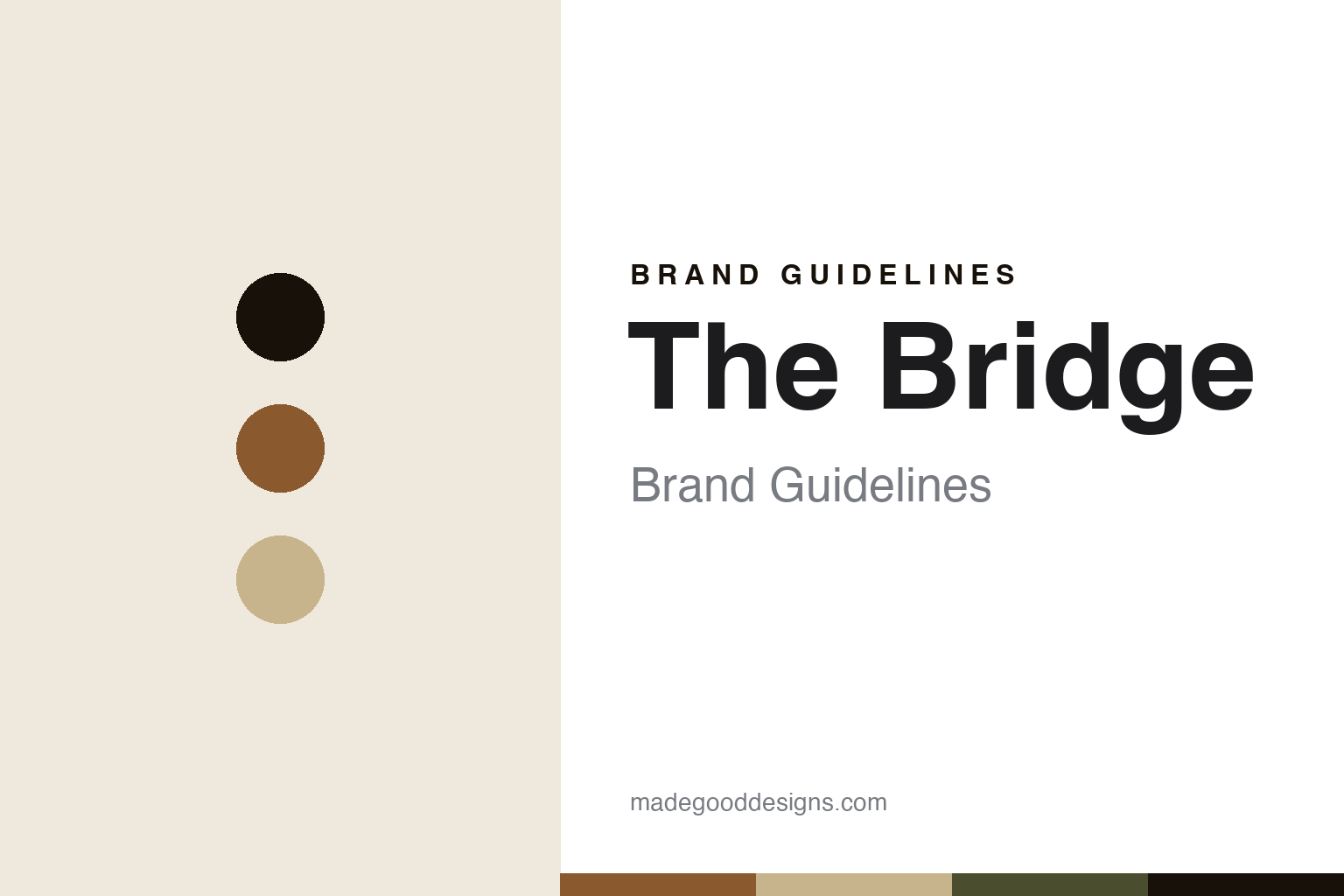
The Bridge Brand Guidelines
Five Florentine craftsmen.
Aa
Two constants: a cognac palette and a Tuscan sans register. Abstract homage — not a The Bridge design or wordmark.
Five Florentine craftsmen
The Bridge began in 1969 when five Florentine craftsmen founded a Tuscan leather workshop.
The Bridge is a lesson in a collective origin as the identity. A Tuscan house near Florence, it began in 1969 when five Florentine craftsmen founded a leather workshop — “Il Ponte Pelletteria,” the little bridge — and later took the English name The Bridge. Its founding story is a group of makers, not a single name, working the vegetable-tanned Tuscan leather that ages to a warm honey and cognac. A workshop, begun by five hands.
Its identity is the Tuscan house of five founders. The Bridge’s vegetable-tanned leather, its Scandicci workshop and its classic Florentine bags are the work it is known for. A collective, made a signature. A house whose name is a bridge between Florence and the wider world.
(Honest notes, so the story stays precise. The Bridge was founded in 1969 in Scandicci, in the Florence area, by five Florentine craftsmen as Il Ponte Pelletteria, adopting the English name The Bridge in 1975 — the anglophone name a deliberate reach beyond Italy. It is not independent today: the Piquadro Group took full ownership by 2022, after buying a majority in 2016. It is genuinely made in Italy, in Tuscany, in vegetable-tanned leather from the region’s tanning tradition, known for a warm patina and lines such as the Story collection. Its designs and its bridge device are its IP, described but never reproduced, and there is no official brand hex; these tones are an unofficial interpretation. This is design commentary and does not promote any product.)
Colour
The Bridge lives in a cognac palette. Click a swatch to copy the hex.
The Bridge’s identity is classic, warm and Tuscan — a cognac, an ink, a honey tan, an olive, and a cream. The palette leans cognac and honey: the register of vegetable-tanned Tuscan leather that darkens with age. It signals craft and heritage over show. The honest caveat: with no published brand hex, these values are an original, unofficial interpretation, not first-party colours.
The lesson is a cognac palette signals a classic, Tuscan identity. The Bridge’s world is a vegetable-tanned, made-in-Tuscany, classic object. For designers, it is a reminder that a warm cognac and a honey tan can carry a brand built on a region’s leather — the cognac of aged Tuscan hide and the honey of a fresh cut. Because these tones can fail as small text, keep type dark and let the colour live in the accents, palette and band. The takeaways: root it in a region; make it there; let the patina speak; and treat any single hex as unofficial.
Typography
The register is a Tuscan sans — warm, even, classic.
The Bridge’s identity carries a warm, even, classic spirit — a considered object, not a loud one. A Tuscan sans captures the mood: humane, legible and grounded, the register of a Florentine leather workshop. Set in a cognac palette, the Tuscan sans feels warm and even — exactly the personality The Bridge carries. It is classic rather than trendy, mirroring a vegetable-tanned bag made to age. (The Bridge’s real designs and bridge device are things we describe but do not reproduce, and the exact typeface is not ours to use.) Because it is not ours to use, the honest description is “a Tuscan-sans spirit,” shown here in a stand-in. The type behaves like the maker: warm, even and classic.
Aa
A Tuscan-sans spirit — warm and even. (Specimen set in Epilogue, a Tuscan-sans STAND-IN; NOT the The Bridge wordmark or any bag design.)
The founding story
The Bridge stands for the Tuscan house of five founders.
The Bridge is a lesson in a collective beginning that lasted. A cognac palette, a Tuscan sans and vegetable-tanned leather make one shared origin the maker — classic, warm and Tuscan. The origin is the differentiator. The differentiator is a group founding: five Florentine craftsmen who built a workshop together and rooted a house in the region’s tanning tradition.
Put to work, the identity is origin as design. A maker building in this spirit would let a genuine, place-rooted founding be the story, keep the making in the region, and be honest that a group can now own what a group once founded, so the customer buys into a real Tuscan craft. It would treat the vegetable-tanning tradition as its foundation. It would say plainly that it is Piquadro-owned while its craft stays Florentine. The lesson The Bridge teaches is that a collective origin can build a brand: the founding gives it authenticity, and the Tuscan making gives it substance. The origin is the personality, and the region is the proof.
For designers and brand-builders, The Bridge belongs to this round about the founding story: a group of makers, rooted in a place, can found a lasting house. The lessons: root it in a region; make it there; be honest about ownership; and never reproduce a protected device. It is also a reminder to stay precise: The Bridge is a Tuscan house founded in 1969 by five Florentine craftsmen, owned by the Piquadro Group and made in Tuscany — with the palette here an unofficial interpretation. The Bridge made its collective origin the maker — proof that a shared founding can be the difference.
Explore & save
Keep The Bridge’s identity on hand — save it to a board in the Made Good inspiration library.
The Bridge identity set
Pin the cognac palette and the Tuscan-sans register to your own board.


