Chapman Made Brand Guidelines
The kitchen-table start.
Aa
Two constants: a field-green palette and a field sans register. Abstract homage — not a Chapman design or wordmark.
The kitchen-table start
Chapman began on a kitchen table in 1984 and still makes waxed-canvas-and-leather bags in Carlisle.
Chapman Made is a lesson in a humble start as the identity. A Carlisle house, it began in 1984 when John Chapman cut and hand-riveted bags on his kitchen table, after Barbour bought the local fishing-bag firm he worked for and moved its production away. Its founding story is a maker who refused to let the craft leave town, and it still makes waxed-canvas-and-bridle-leather field bags in Carlisle. A workshop, begun on a kitchen table.
Its identity is the last Carlisle bag workshop. Chapman’s field bags, its own English factory and its kitchen-table origin are the work it is known for. A humble start, made a signature. A house that kept the making where it began.
(Honest notes, so the story stays precise. Chapman was founded in 1984 by John Chapman as John Chapman Ltd, in Carlisle, Cumbria, after Barbour acquired the Liddesdale fishing-bag business and offshored its production; it now trades as Chapman Made, having rebranded in 2025. It is independent and owner-run, but no longer family-run: ownership passed from John Chapman to Daniel Chamier in 2006 and to Cedric Stonex in 2019. It is genuinely made in England, in its own Carlisle factory, in waxed cotton canvas and bridle leather, with roots in fishing and shooting bags such as the Troutbeck and the Weekender; it also contract-makes for other British brands. One accuracy note: we say military-spec materials and field-sports heritage rather than claim a military contract, which is unverified. Its designs are its IP, described but never reproduced, and there is no official brand hex; these tones are an unofficial interpretation. This is design commentary and does not promote any product.)
Colour
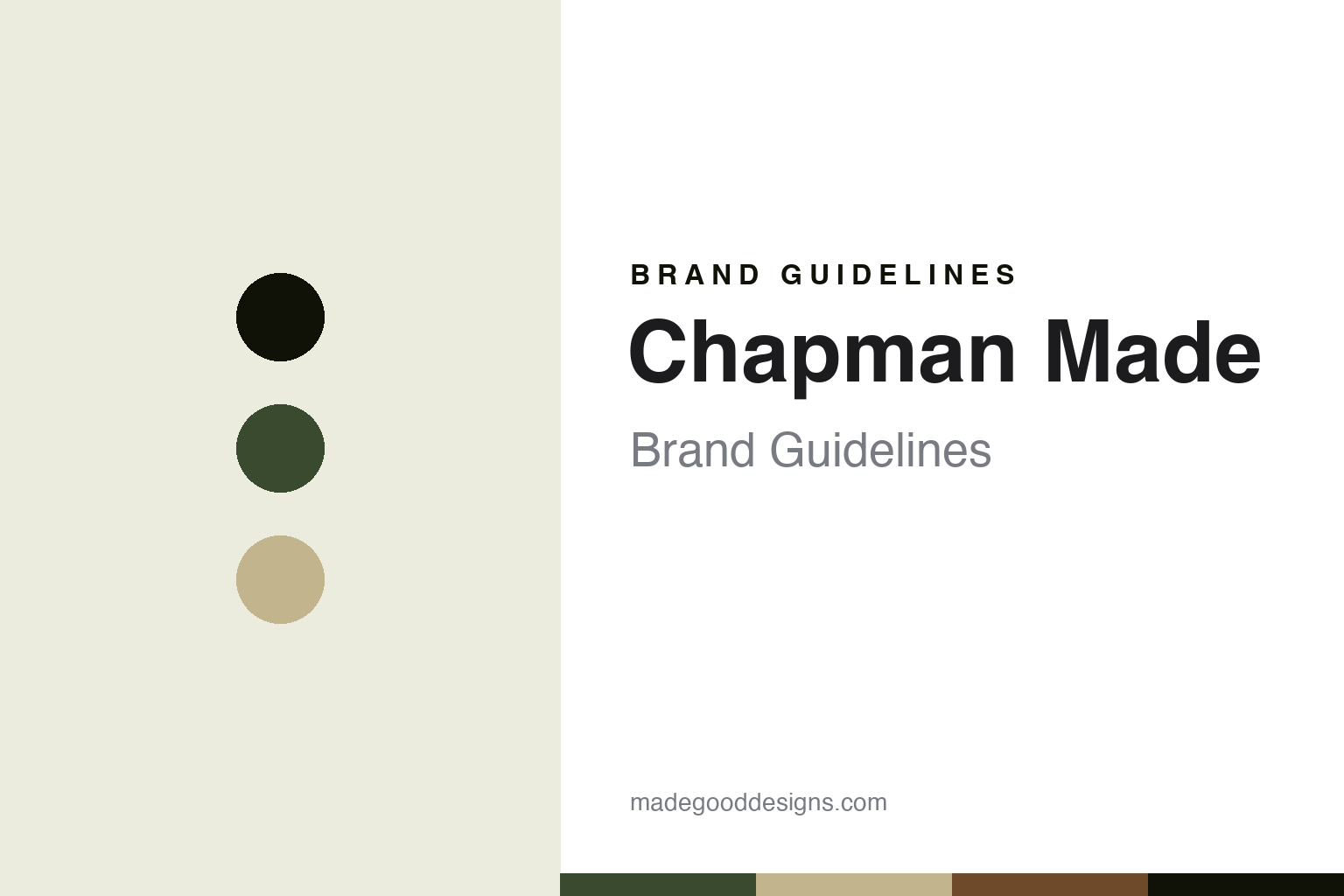
Chapman Made lives in a field-green palette. Click a swatch to copy the hex.
Chapman’s identity is British, rugged and understated — a field green, an ink, a canvas tan, a bridle brown, and a chalk. The palette leans field green and canvas: the register of waxed canvas and bridle leather in a country idiom. It signals craft and utility over show. The honest caveat: with no published brand hex, these values are an original, unofficial interpretation, not first-party colours.
The lesson is a field-green palette signals a British, rugged identity. Chapman’s world is a waxed-canvas-and-leather, made-in-Carlisle, field object. For designers, it is a reminder that a field green and a canvas tan can carry a brand built on a humble start — the green of a shooting field and the tan of a waxed canvas. Because these tones can fail as small text, keep type dark and let the colour live in the accents, palette and band. The takeaways: keep the making at home; own a humble origin; be honest about ownership; and treat any single hex as unofficial.
Typography
The register is a field sans — sturdy, plain, functional.
Chapman’s identity carries a sturdy, plain, functional spirit — a country object, not a loud one. A field sans captures the mood: solid, even and practical, the register of a Carlisle field-bag workshop. Set in a field-green palette, the field sans feels sturdy and plain — exactly the personality Chapman carries. It is functional rather than showy, mirroring a waxed-canvas bag made for the field. (Chapman’s real designs and wordmark are things we describe but do not reproduce, and the exact typeface is not ours to use.) Because it is not ours to use, the honest description is “a field-sans spirit,” shown here in a stand-in. The type behaves like the maker: sturdy, plain and functional.
Aa
A field-sans spirit — sturdy and plain. (Specimen set in Familjen Grotesk, a field-sans STAND-IN; NOT the Chapman wordmark or any bag design.)
The founding story
Chapman Made stands for the last Carlisle bag workshop.
Chapman Made is a lesson in a humble start that kept the craft at home. A field-green palette, a field sans and waxed-canvas-and-leather bags make one kitchen-table origin the maker — British, rugged and understated. The origin is the differentiator. The differentiator is a refusal to leave: a maker who started on his own table when production was offshored, and kept the making in Carlisle.
Put to work, the identity is origin as design. A maker building in this spirit would let a humble, principled beginning be the story, keep the making in its own factory, and be honest that ownership has changed while the workshop stayed, so the customer buys a genuinely local object. It would treat the field-sports heritage as its register. It would state plainly it is owner-run, not family-run. The lesson Chapman teaches is that a humble origin can build a brand: the start gives it character, and the English making gives it substance. The origin is the personality, and the Carlisle factory is the proof.
For designers and brand-builders, Chapman Made belongs to this round about the founding story: a humble beginning, and a refusal to offshore, can be the brand. The lessons: keep the making home; own the humble start; be honest about ownership; and never reproduce a protected design. It is also a reminder to stay precise: Chapman Made is an independent, owner-run English house founded in 1984 by John Chapman, made in its own Carlisle factory — with the palette here an unofficial interpretation. Chapman made the kitchen-table start the maker — proof that a humble origin can be the difference.
Explore & save
Keep Chapman Made’s identity on hand — save it to a board in the Made Good inspiration library.
Chapman Made identity set
Pin the field-green palette and the field-sans register to your own board.