Touax Brand Guidelines
A Seine towing firm of 1853 that now leases railcars, barges and containers.
Aa
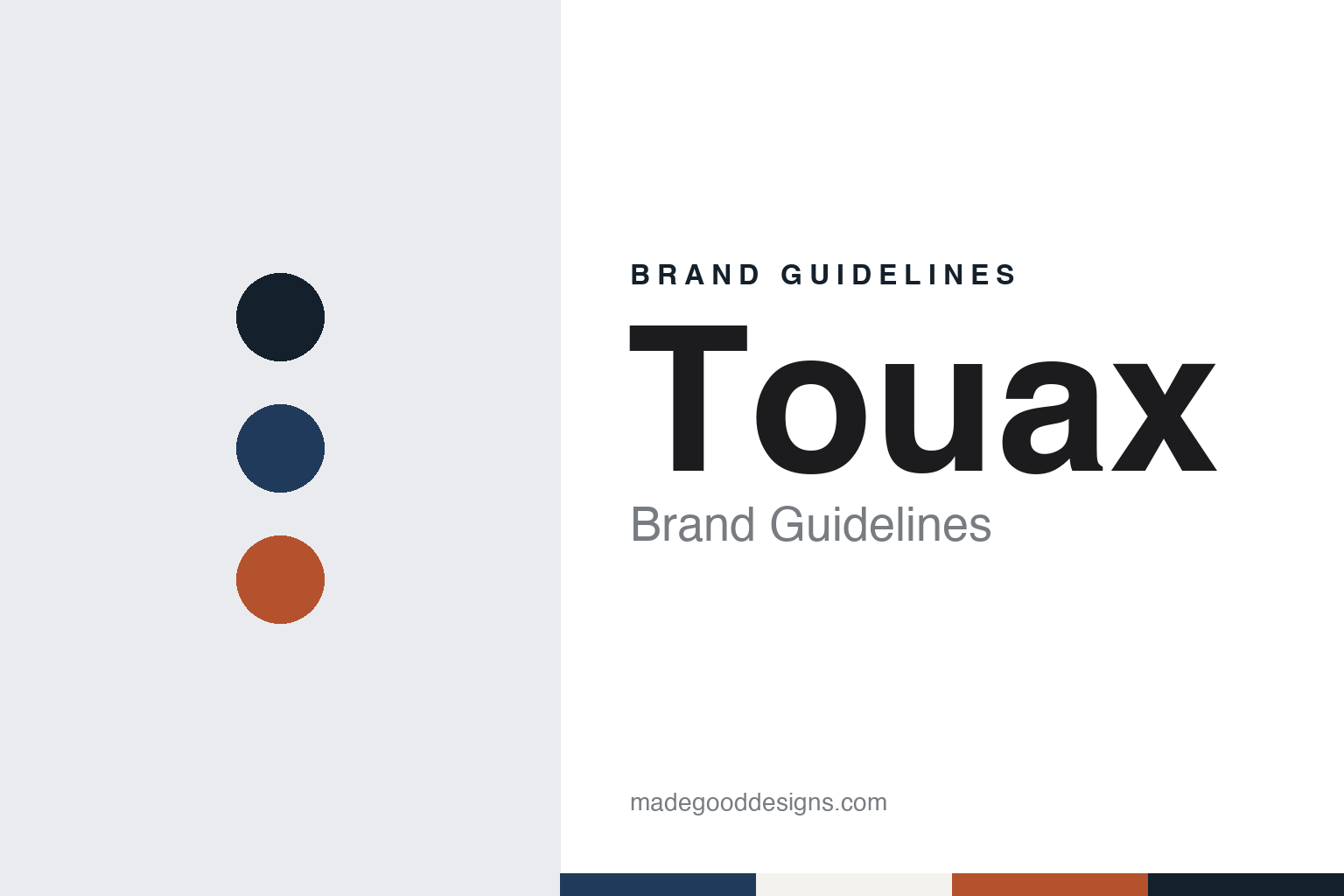
Two constants: a Touax navy, steel and rust palette and an industrial sans register. Abstract homage — not a Touax product or mark; no wagon, barge, logo or nameplate is reproduced.
Towing on the Seine
A river company on two waterways.
Touax began on French rivers. English Wikipedia says the company was formed on 14 July 1853 as the Compagnie de Touage de la Basse Seine et de l’Oise, a towing business on the lower Seine and the Oise, and that imperial decrees signed under Napoleon III and granted to Eugène Godeaux in 1854 and 1855 gave it its statutes. The company’s own history page also dates the launch of its river-barge business to 1853, and calls Touax a family business whose owners are now in their fifth generation.
In 1898 the firm merged with the Société de Touage et de Remorquage de l’Oise and took the name Société Générale de Touage et de Remorquage, which English Wikipedia says it kept until 1994; the company’s own timeline marks 1898 as the creation of Touax. French Wikipedia lists Léon Isidore Molinos as chairman of that company from 1898 to 1912. Its shares were listed on the Paris stock exchange on 7 May 1906, a date that both Wikipedia and the company give, and the group is still listed in Paris.
The sources used for this guide do not say how the company operated during the occupation of 1940–1944.
After the war the river company moved onto rails. English Wikipedia says it ordered its first railcars in 1954, which were then managed by two independent operators; the company and French Wikipedia date the start of its railcar investment to 1955. Modular buildings followed in 1973. Containers arrived through the 1985 acquisition of Gold Container Corporation, a date given by both Wikipedia editions and the company, though English Wikipedia places a first move into shipping containers in 1975. In the 1980s the group set up Touax Corporation in the United States, and in 1994 it took the single name Touax and brought its businesses under one entity, English Wikipedia says.
Colour
Railcars, barges and containers.
Today Touax describes itself as a lessor of tangible assets: freight railcars, river barges and intermodal containers, leased for its own account and on behalf of investors. Each business has its own subsidiary and website. Freight wagons sit with Touax Rail, which the group says handles the leasing, sale and maintenance of railcars; barges sit with TOUAX River Barges; and containers with TOUAX Global Container Solutions, which covers leasing, sale and trading of new and used equipment. A fourth unit, Touax Modular Building Solutions, now works across the African continent from its own manufacturing plant, the company says.
The rail side grew by acquisition. English Wikipedia says Touax took over the European operations of GE Capital Rail Services in 2015. Touax Rail’s site lists box, flat, tank and intermodal wagons among its fleet types, alongside several specialist designs and a separate India range, and describes the unit as the second-largest lessor of intermodal railcars in Europe. It also says Touax Rail was certified as an entity in charge of maintenance (ECM) in December 2011.
Outside investors joined the rail unit in 2020. Railway Technology reported on 11 August 2020 that Touax Rail had agreed a capital increase with DIF Capital Partners to expand long-term leasing of freight wagons in Asia and Europe, leaving DIF with 49 percent through its Core Infrastructure Fund II and Touax SCA with 51 percent. The group’s own timeline lists the capital increase in December 2020.
India is the newest piece. Touax and the Kolkata wagon builder Texmaco Rail & Engineering already ran a joint venture, Touax-Texmaco Railcar Leasing, known as TTRL. In a press release of 3 June 2026, the three partners announced that TrinityRail, a subsidiary of Trinity Industries, was joining TTRL with a 32 percent stake, with Touax continuing to consolidate the venture. The release gives no completion date, so that step is treated here as pending from its June 2026 announcement.
Typography
How wagon lessors present themselves.
Railcar and wagon lessors sell something most people only glimpse from a level crossing: the use of a freight car for a fixed term. Their identities are built for two audiences at once. One is the shipper, railroad or logistics firm signing a lease; the other is everyone who sees the car roll past, because the lessor’s name is often painted on the side of the wagon itself. The car body works as a moving sign for the company that owns it.
Their websites tend to be organised around equipment. Fleet pages are usually split by wagon type, so tank cars for chemicals and mineral oils sit apart from covered hoppers, gondolas, flat cars, boxcars and intermodal wagons, and locomotives often have their own section. Photographs show the cars as the companies publish them, side-on and in yards or on the main line, with the lessor’s name and markings clearly legible.
Service pages carry much of the rest. Lessors describe maintenance workshops and field teams, training on handling wagons, and customer portals where fleets can be managed online. Several now present telematics: sensors and wireless devices that report a car’s location, condition and cargo status in near real time. Sustainability pages make the case for rail freight more broadly, and some describe the conversion or rebuilding of older cars.
Several of these companies are listed or owned by infrastructure investors, so investor pages, quarterly results and fleet counts take up a large share of what they publish. Palettes in this category are often restrained, with blues, reds, greens, greys and black recurring as our interpretation of the sector rather than as any company’s official colours. The guides that follow use tones of our own choosing.
Aa
A plain industrial sans for a capitalised name. (Specimen set in IBM Plex Sans, a sans STAND-IN; NOT the Touax logo.)
Touax
A family-run lessor with a long listing.
Touax’s ownership has stayed steady for a listed company. The group says the Walewski family has held a stable shareholding since the company’s creation and currently holds 32 percent of the capital, and that Fabrice and Raphaël Walewski have jointly managed the group since 1998, a date French Wikipedia also gives. The listed parent is Touax SCA, with the two as its managing partners, and its head office is at Paris-La Défense, the company says.
The company tells the rest of its story through a timeline. It says it began managing equipment on behalf of third-party investors in 1990, while French Wikipedia dates that move to 1995. It sold its modular buildings activity in February 2017, the company says, and its modular unit now presents itself as an African business. It marked 170 years in March 2023, says it received an EcoVadis gold medal for its corporate social responsibility rating in November 2023, and issued its first CSR booklet in 2024.
On screen the group keeps one pattern. It writes its name in capitals, TOUAX, and uses that word as the prefix for every business line: TOUAX Global Rail Services, TOUAX River Barges, TOUAX Global Container Solutions and TOUAX Modular Building Solutions, each with its own web address. The group sums up its work as operational leasing in sustainable transport.
For a design guide, Touax shows how a nineteenth-century river company can carry one capitalised name across barges, wagons and containers without changing the word itself. Compare Ermewa and VTG, two other wagon lessors in this series. For this guide we use river navy, barge steel and container rust with a sans, an unofficial interpretation; no product or logo is reproduced.
Explore & save
Keep Touax’s identity on hand — save it to a board in the Made Good inspiration library.
Touax identity set
Pin the Touax navy, steel and rust palette and the industrial sans register to your own board.