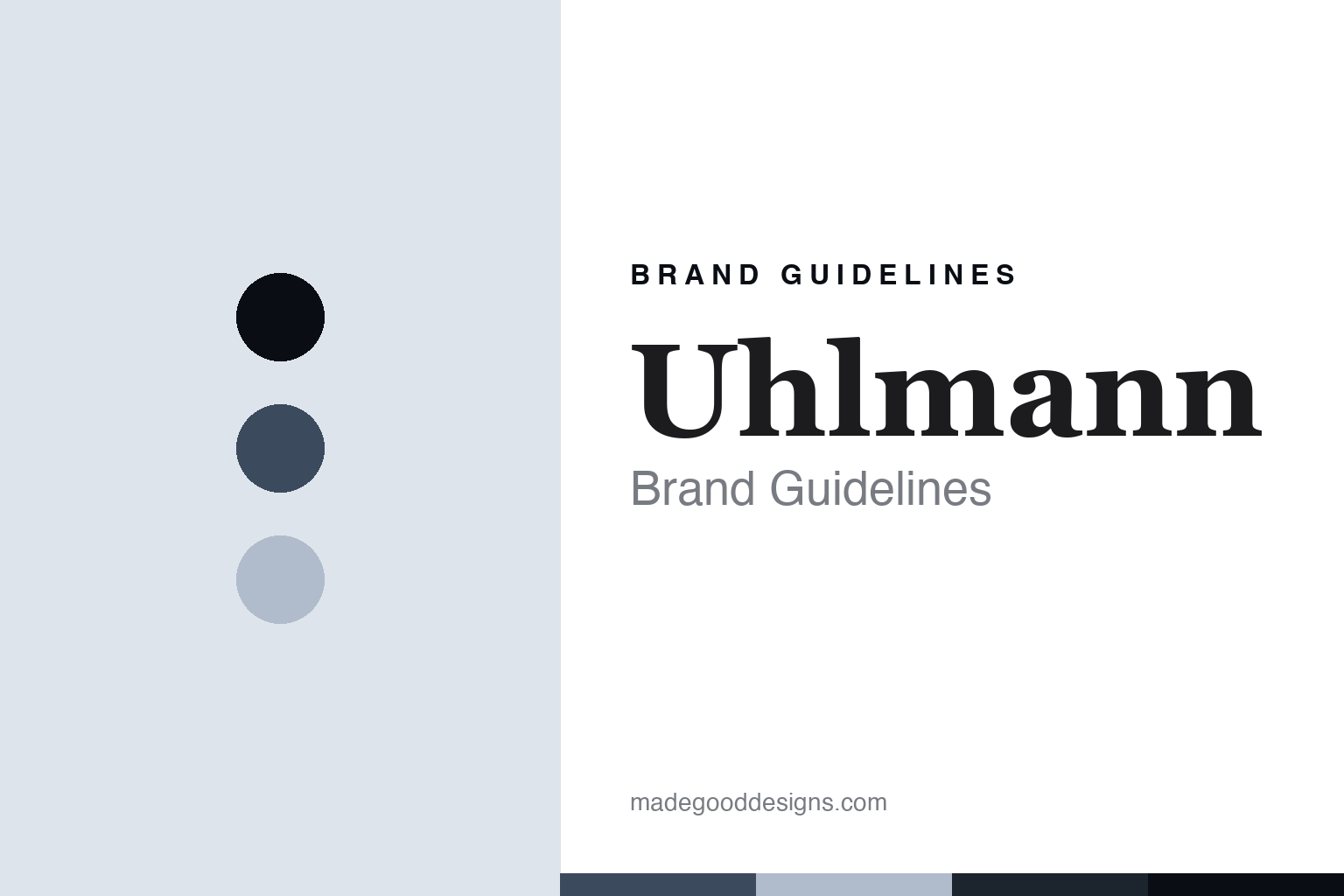
Uhlmann Brand Guidelines
The family kept the machines and sold the swords.
Aa
Two constants: an Uhlmann-graphite palette and a workshop-serif register. Abstract homage — not an Uhlmann product or mark; no weapon, blade, guard or mask is reproduced.
The family kept the machines and sold the swords
Uhlmann makes fencing equipment at Laupheim in Swabia — and the family whose name is above the door left the sport in 1988, keeping a very different business.
Uhlmann follows Leon Paul as the round’s first German house, and it carries the neatest ownership story in the set. The founder built two things: equipment for fencers, and machines. His descendants still run the machine company, which grew into a substantial industrial manufacturer. The fencing business, the one carrying the name most people know, was sold off. Its answer to a round about who owns and where-makes the fencing house is a name that outlived its family’s interest in the sport: the family kept the machines and sold the swords.
Its identity is the family kept the machines and sold the swords. The 1933 start, the Laupheim workshop and a 1988 sale are the story here. The fencing house. The family kept the machines and sold the swords.
(Honest notes, so the founding, the ownership, the making and one common error are framed accurately. On founding: Josef Uhlmann was born at Laupheim in October 1902 and began producing fencing equipment in 1933. His premises at Ulm were destroyed in the war and he returned to Laupheim in 1945, building the factory there in 1954. He died in 1968. A caution for anyone writing about this company: Ulm is where the register court sits, and where the founder was based before 1945 — the company itself is at Laupheim, and giving Ulm as its home is a straightforward error. On ownership, the correction that matters: this is not a family firm in the sense most readers will assume. The founding family sold the fencing division in December 1988 and it has been separately held ever since; the current operating company is a limited partnership with three named managing directors, and its ultimate shareholders are not public. Meanwhile the founder’s machine-building arm became a pharmaceutical-packaging manufacturer that is still in family hands and run by his grandson. On the making: the company manufactures at Laupheim, and its own wording is carefully bounded — it says most of its articles are made in Germany, partly from European input materials, with clothing sewn in its own atelier and weapons, masks and accessories produced in house. Most is not all, and we write it as the company does. On the blades, which is the round’s theme: its own-brand blades are conventional spring steel, while the maraging blades it sells for competition carry other makers’ codes. One dating caution applies to every federation reference in this round: the international federation restructured its supplier registration during 2026, separating supplier registration from product homologation, with the framework still being implemented through that year. Federation statuses here are therefore reported as the published record at their date rather than as live certifications. The approved-blade list we rely on took effect in September 2025. Its marks are IP we describe but do not reproduce, and no registration could be verified; there is no official brand hex.)
Colour
Uhlmann lives in an Uhlmann graphite. Click a swatch to copy the hex.
Uhlmann’s identity is German, independently held and workmanlike — an Uhlmann graphite, an ink, a pale steel, a deep slate, and a paper. The palette leans Uhlmann graphite and deep slate: a workshop register that stands in for a steel-and-cloth house rather than a loud logo colour. It signals the family that kept the machines and sold the swords — German, independently held and workmanlike. The honest caveat: the company does use a blue-grey of its own, and the tones here are an unofficial interpretation for this series rather than that value.
The lesson is a naming system tells you who a brand is talking to. Uhlmann’s product names are compressed technical German — a blade is listed with abbreviations for electric, complete, French grip, pistol grip and maraging, stacked in sequence, with the homologation and the maker’s code appended. Nothing about that is designed to charm a newcomer; it is written for someone who already knows what every abbreviation means and is comparing two nearly identical items on specification. Set that against its stablemate, which sells the same categories under lowercase branding and short alphanumeric codes, and you can see two houses under one managing director making opposite choices about legibility. Neither is wrong. They are aimed at different readers, and the naming is the clearest evidence of it. Because a strong hue can fail as small text, keep type dark and let the colour live in the accents, palette and band. The takeaways: place the company at Laupheim, not Ulm; date the founder’s start to 1933; say the family sold out in 1988; and bound the German-made claim the way the company itself bounds it.
Typography
The register is a workshop serif — German, technical, unshowy.
Uhlmann’s identity carries a German, technical spirit — a supplier that equips an entire hall, from the smallest screw to the piste and the scoring apparatus. A workshop serif captures the mood: sober, precise and traditional, the register of a firm whose catalogue reads like a parts list. Set in an Uhlmann-graphite palette, the workshop serif feels specified rather than styled — exactly the personality Uhlmann carries. It behaves like a forged, ground thing rather than a loud logo, mirroring a blade taper and a mesh weave. (Uhlmann’s real products, its marks and the name itself are things we describe but do not reproduce, and the exact typeface is not ours to use.) Because it is not ours to use, the honest description is “a workshop-serif brand,” shown here in a stand-in. The type behaves like the brand: German, technical and unshowy.
Aa
A workshop-serif brand — sober and precise. (Specimen set in Cormorant Garamond, a workshop-serif STAND-IN; NOT the Uhlmann logo or products.)
The succession node
Uhlmann stands for the family that kept the machines and sold the swords.
Uhlmann holds the round’s succession node. An Uhlmann-graphite palette, a workshop serif and a 1933 start make one thing — the family kept the machines and sold the swords — the whole identity: German, independently held and workmanlike. The founder is the frame, the 1988 sale is the substance, and the surviving family machine business is the twist. The point is a heritage name whose family is still trading successfully under it, in a completely different industry, while the fencing house they sold carries on without them.
Put to work, the identity is the split told straight. A brand in this spirit would date the founder’s start to 1933 and place him at Laupheim, note the wartime destruction at Ulm and the 1945 return, mark the factory in 1954 and the founder’s death in 1968, state plainly that the fencing division was sold in December 1988 and that the company is no longer family-held, and resist the easy assumption that a German firm with a surname above the door is still run by that surname. A reader in this spirit would keep the facts right: Uhlmann makes fencing equipment; it dates to 1933; it is not owned by the Uhlmann family; and it manufactures at Laupheim. Uhlmann follows Leon Paul, before Allstar. The honest editorial moves are to date the founding, to fix the town, to correct the ownership, and to bound the making.
For designers and brand-builders, Uhlmann holds the succession node: a surname on a product is a claim about the past, not the present. The lessons: a category can include a house whose name and whose family have gone separate ways, here a founder whose descendants kept his machine-building business — now a substantial pharmaceutical-packaging manufacturer still run by his grandson — while the fencing company that made the name famous was sold in 1988; a founding is dated to 1933 and placed at Laupheim, with Ulm correctly identified as the register court and the founder’s pre-war base rather than the company’s home; an ownership is described only as far as the record allows, a limited partnership with three named managing directors and undisclosed ultimate shareholders; a making is bounded by the company’s own words, most articles made in Germany, partly from European materials, with clothing sewn in house — most, not all; and a naming system is read for its audience, compressed technical German aimed at a buyer who already knows the abbreviations. The sharpest detail belongs to the round’s theme. Its own-brand blades are conventional spring steel and sit outside the federation’s competition standard, while the homologated maraging blades on its shelves carry other makers’ codes — so the house that equips a hall end to end buys in the one component the rules care most about. That is not a criticism; it is how a category of fifteen-odd approved blade makers works. But it is the clearest possible illustration that who brands a thing and who makes it are different questions. The hook is that divergence: Uhlmann is the family that kept the machines and sold the swords. Read that way, Uhlmann is less a single weapon than a name that outlived its family’s interest in the sport: German, technical, unshowy. The lesson for a brand is that heritage and ownership are separate facts, and only one of them is current. Uhlmann made the-family-kept-the-machines the identity — proof that a surname can outlast the family behind it.
Explore & save
Keep Uhlmann’s identity on hand — save it to a board in the Made Good inspiration library.
Uhlmann identity set
Pin the Uhlmann-graphite palette and the workshop-serif register to your own board.