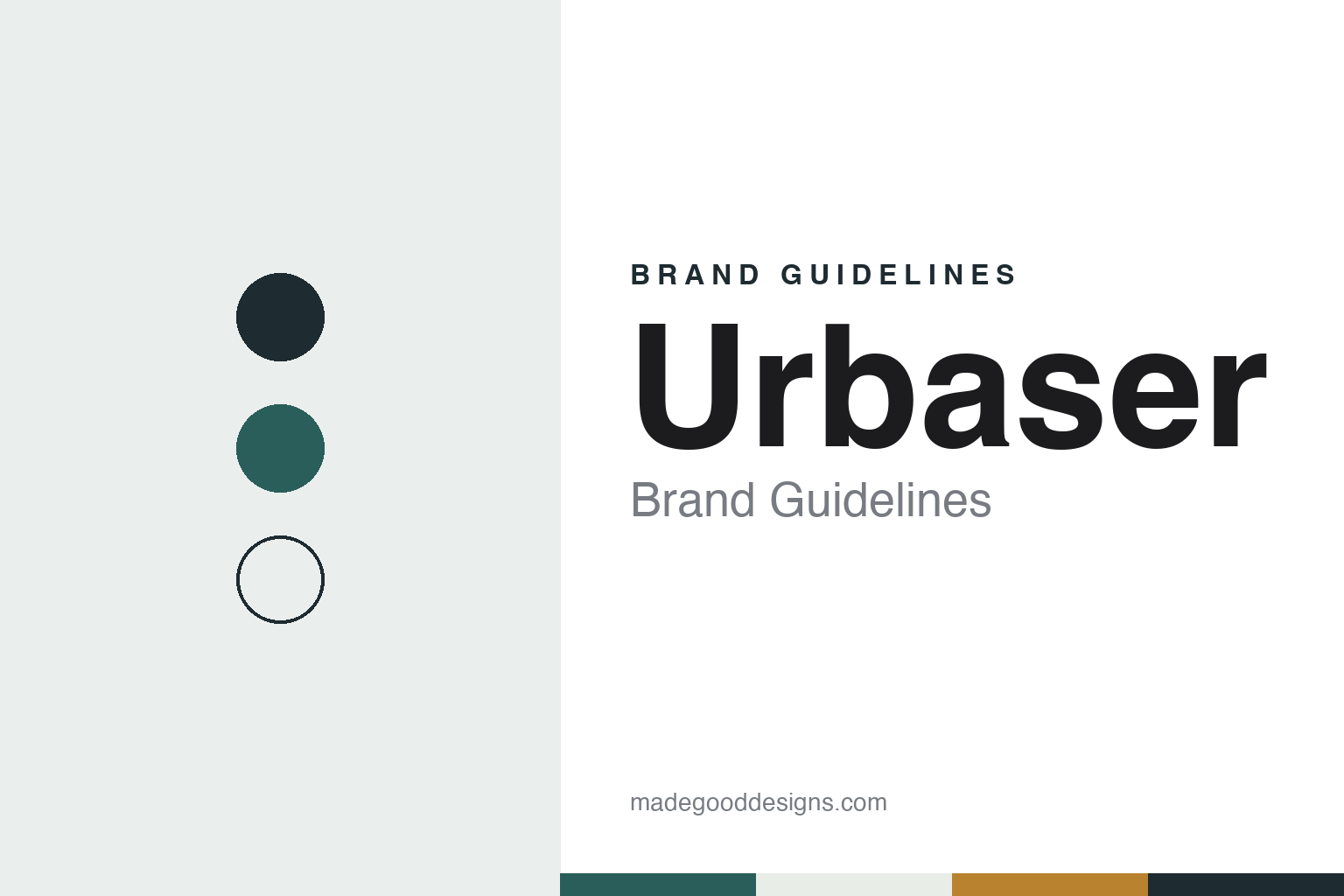
Urbaser Brand Guidelines
The Madrid waste group that grew out of TecMed and Dragados.
Aa
Two constants: a slate, teal and amber palette and a Civic sans register. Abstract homage — not an Urbaser vehicle, product or mark; no logo or livery is reproduced.
TecMed
A services firm with a construction parent.
Urbaser is a waste and environmental services company headquartered in Madrid. It began in 1990 as Técnicas Medioambientales, known as TecMed, a company providing environmental services to town councils and local authorities, Spanish Wikipedia says. During the 2000s it grew by setting up subsidiaries, and in 2004 TecMed merged with the environmental division of the Spanish construction group Dragados and took the name Urbaser S.A.
The construction link shaped its early years. In a February 2025 interview with El Español, the company’s innovation director recalled that when he joined, its main activity was construction and civil-engineering projects, a legacy of Dragados, and that waste management was a newer field in which technical knowledge was still limited. By 2016 Urbaser was a subsidiary of the Spanish construction group ACS, which, Público reported that September, had put it up for sale at the end of 2015.
Its scale is now large. In its company description of September 2026, Urbaser says it serves more than 60 million people through its cleaning and collection services, manages more than 150 treatment plants and has more than 38,000 employees. Spanish Wikipedia says it operates in more than 15 countries.
Its work falls into three segments, as Platinum Equity described them in September 2026: Urban Services, covering waste collection, street cleaning and water management; Municipal Waste Treatment; and Industrial Waste Treatment. Spanish Wikipedia lists ships’ oils, batteries and solvents among the more complex industrial wastes it handles. In the 2025 interview, the innovation director described industry as the newest of the three areas, alongside urban services and waste treatment, and said the three together let the company offer a complete service.
Colour
Three owners in ten years.
Urbaser changed hands three times in a decade. In September 2016 ACS announced the sale of Urbaser to Firion Investment, a company that Público reported was indirectly controlled by the Chinese green fund Huayu, in which Jiangsu Dagang and China Tianying held stakes. Público reported that the sale would help ACS reduce its debt; the final price depended on future conditions that ACS did not detail.
The second change came in October 2021, when the American investment firm Platinum Equity acquired Urbaser from China Tianying Inc., according to Platinum Equity. In its own account of the following five years, published in September 2026, Platinum Equity says it brought in a new executive team, now led by chief executive Fernando Abril-Martorell, invested in the business through capital spending and acquisitions, sold some activities, and moved the portfolio towards treatment and long-term contracts. Those are the investor’s own descriptions of its ownership.
The third change came in 2026. In February 2026 Platinum Equity agreed to sell Urbaser to funds managed by Blackstone and EQT, which were to control it jointly, Spanish Wikipedia says, citing Cinco Días. On 22 September 2026 Platinum Equity announced that the sale had been completed. As part of the deal, Platinum Equity kept Urbaser’s waste business in Argentina, which it says has operated in that country for 30 years, so the Argentine operation now sits outside the group sold to Blackstone and EQT.
Inside the company, Urbaser has built an innovation unit. Its innovation director told El Español in 2025 that the team had grown from essentially one person to sixteen, had worked with about 30 outside organisations, among them the Universidad Autónoma de Madrid, and had moved the year before into new offices in the Edificio Aqua, on Madrid’s Plaza de Castilla. He described projects including the company’s own connected-sensor infrastructure and a biorefinery that turns organic waste into biogas, and said the hardest task had been persuading the whole organisation that innovation was not the job of one department.
Typography
Design and documentation.
Waste and environmental-services companies speak to several audiences at once. A household wants a pickup day and a holiday calendar; a town council wants a collection contract; a hospital wants a compliant route for regulated medical waste; investors want results and a sustainability report. Their websites tend to separate those audiences into service pages: residential and commercial collection, recycling, roll-off containers, landfills and transfer stations, special and hazardous waste, medical waste and document shredding.
The plants are named the way the companies describe them. Waste Connections’ 2026 sustainability report speaks of collecting and treating landfill biogas for “beneficial use” and of a growing network of renewable natural gas facilities; trade coverage such as Waste Dive reports these plants, along with leachate-treatment systems, through quarterly results and project announcements. Where this guide uses terms such as recycling operation, energy-from-waste plant or landfill-gas plant, it follows the wording of the company or of a dated report, and environmental claims are given as the company’s own description.
Much of a waste brand is seen on the street rather than on a screen: on collection trucks, containers and depots, and in the photography of fleets and yards that fills sustainability reports. Mobile apps now carry part of the load, sending collection reminders and service alerts, as Waste Connections says its WasteConnect app does. Greens, blues and ambers recur in this guide’s own palettes for the sector; those palettes are unofficial interpretations, not company colours, and no truck livery, logo or mark is reproduced.
Ownership matters as much as identity. Large groups grow by buying local haulers, and specialist names often survive inside them: Stericycle, the medical-waste company bought by WM in 2024, now forms WM’s Healthcare Solutions business. Each guide sets out who founded a company, who owns it now and what rests only on the company’s own word.
Aa
A civic sans — a name made for trucks, depots and plants. (Specimen set in Inter Tight, a sans STAND-IN; NOT the Urbaser logo.)
Urbaser
Public contracts, public scrutiny.
Urbaser’s record includes legal matters from its TecMed years and later. In May 2023, the news agency EFE reported, two managers admitted before the Audiencia Provincial de Las Palmas that they had paid bribes to officials of the Arrecife council, on Lanzarote, between 2001 and 2004 to win the town’s waste-collection concession. Urbaser dismissed both managers, saying the conduct went against its code of conduct and its anti-corruption policy, EFE reported.
In August 2023 Andalusia’s competition agency, ACREA, fined Urbaser and the French construction group Eiffage for manipulating public road-maintenance contracts between 2020 and the end of 2021, elDiario.es reported. Both matters concern public tendering.
The name has stayed constant through all of this. TecMed became Urbaser in 2004, and the Urbaser name has since passed from Dragados and ACS to Firion, Platinum Equity and now Blackstone and EQT. In its September 2026 description the company names its services as cleaning and collection for cities and the running of treatment plants, alongside industrial waste.
For a design guide, Urbaser shows a municipal-services name that has kept one identity through three changes of owner in ten years. Compare Veolia and Suez, two French groups that also collect and treat waste for cities. For this guide we use a deep slate, a street teal and an amber with a sans, an unofficial interpretation; no product or logo is reproduced.
Explore & save
Keep Urbaser’s identity on hand — save it to a board in the Made Good inspiration library.
Urbaser identity set
Pin the Urbaser slate, teal and amber palette and the Civic sans register to your own board.