Zerodha Brand Guidelines
The Bengaluru broker named for removing barriers.
Aa
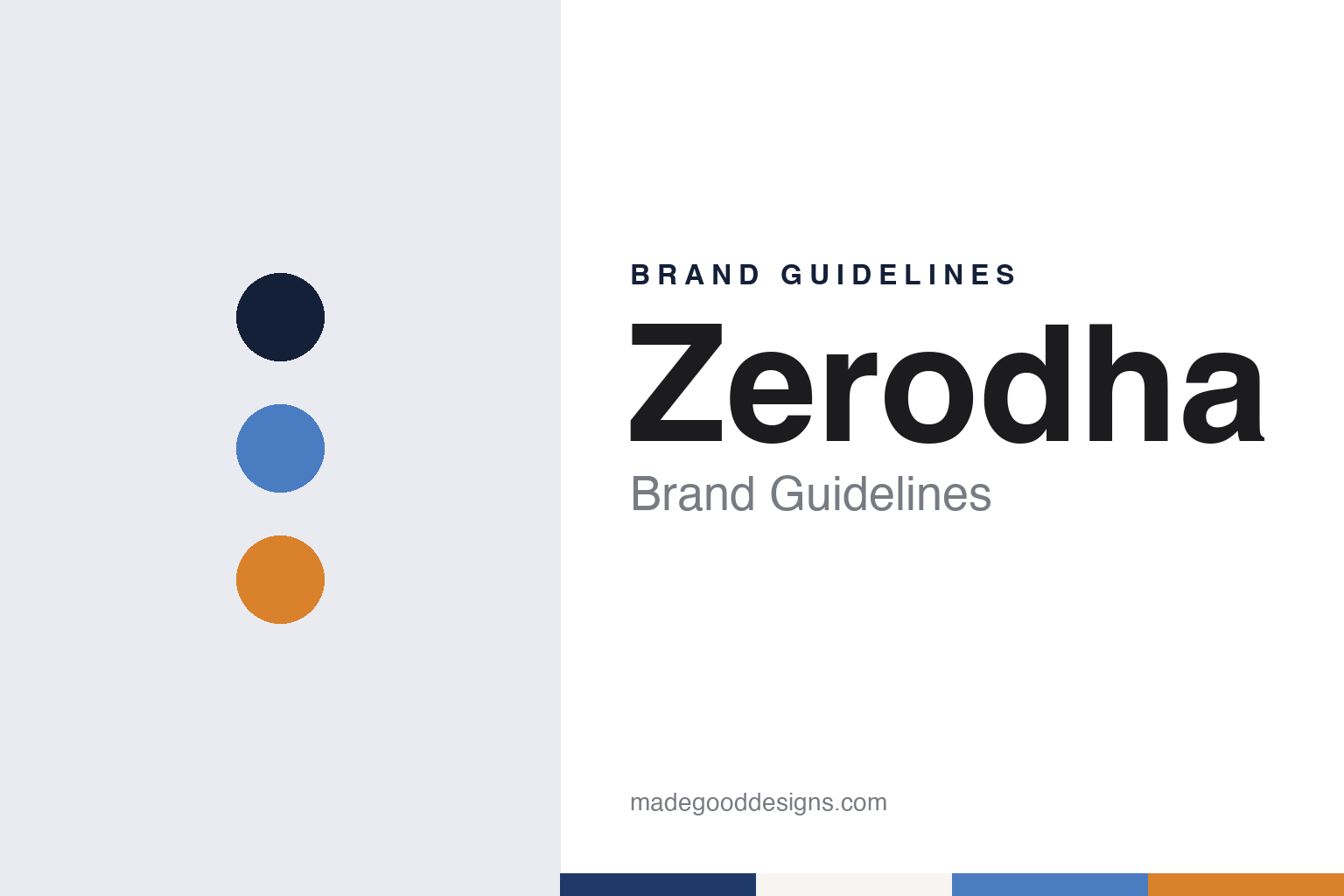
Two constants: a Zerodha indigo, sky and marigold palette and a Technical sans register. Abstract homage — not a Zerodha product or mark; no app screen, logo or wordmark is reproduced.
Zero and rodha
Two brothers and a name built from a Sanskrit word.
Zerodha began in Bengaluru in 2010. The company says it “kick-started operations on the 15th of August, 2010,” and English Wikipedia says it was founded that August by the brothers Nithin Kamath and Nikhil Kamath as a discount brokerage. The company’s about page says Nithin Kamath bootstrapped and founded the business after a decade as a trader; he is its founder and chief executive, and Nikhil Kamath is co-founder and chief financial officer. English Wikipedia says the firm started with six employees.
The name is a statement of intent. Zerodha joins “zero” with “rodha,” the Sanskrit word for barrier, the company says — a reference to the barriers of cost, support and technology that it set out to remove for traders and investors in India. On its about page it says it “pioneered the discount broking model in India”; that is the company’s own description.
Technology became the firm’s core. English Wikipedia says Kailash Nadh joined in 2013 to start the technology team and has been chief technology officer since, building the trading platforms in-house. In 2019, the encyclopedia says, Zerodha became the largest retail stockbroker in India by active client base, overtaking ICICI Securities; as of May 2024 it gave the firm 7.5 million active customers registered with the National Stock Exchange, which it said made Zerodha the second-largest stockbroker in India by that measure. Mint reported in September 2026 that the broker had more than 16 million customers. The operating company is Zerodha Broking Ltd, which its website describes as a member of the NSE, BSE, MCX and MSEI.
Colour
Kite, and the tools around it.
Zerodha’s signature product is Kite, which the company calls its “flagship trading platform,” with streaming market data, advanced charts and apps for Android and iOS. On 6 December 2017 the company announced the beta of Kite 3.0 on its Z-Connect blog, saying its technology team had spent a whole year rebuilding Kite from the backend systems and APIs to the web front end. The post listed a faster login page that users could personalise with a profile photo, browser notifications, a customisable marketwatch, a revamped market-depth view with volume bars and 52-week sparklines on holdings.
Around Kite sit several named tools. Console is the back-office dashboard with reports and visualisations; Coin offers direct mutual funds; Kite Connect provides HTTP and JSON trading APIs for developers and start-ups; and Varsity is a collection of stock-market lessons, which the company says was written by its chief of education, Karthik Rangappa. The products page also points to partner platforms for systematic trading, options analysis, thematic baskets and research.
The group reaches beyond broking. English Wikipedia says Rainmatter, an early-stage fund that the company describes as its fintech fund and incubator, was founded in 2014, with investments including Smallcase and Sensibull; that the alternative investment fund True Beacon started in 2019; and that Zerodha Fund House, an asset manager formed in partnership with Smallcase and focused on index funds with direct plans only, launched in October 2023. On 15 October 2024 Zerodha announced the FLOSS Fund to support free and open-source software projects worldwide, the encyclopedia says, and in November 2025 it invested in Tijori Finance, a Bengaluru market-data and research platform.
In October 2026 Zerodha began offering US stock investing in beta to selected users through Kite, CNBC-TV18 reported on 19 October 2026, routed through BSE-owned India INX Global Access at the International Financial Services Centre in GIFT City; the channel said the underlying US brokerage partner had not been named. English Wikipedia also records reports of glitches and outages on Kite, especially on volatile days and derivatives expiry days, including a login problem in November 2020 that Livemint reported and the company acknowledged.
Typography
How brokers present themselves.
Online brokers and trading platforms sell access to markets through a screen, so the screen does much of the branding. Their websites lead with app views and price charts, and many show the same platform on a phone, a tablet and a desktop. Saxo, for example, presents two platforms by name, SaxoInvestor for simple investing and SaxoTrader for its full range, rather than a single product.
The visual language is often restrained. Interfaces come in dark and light modes, numbers are set in clear sans-serif type, and green and blue accents mark rising prices, buttons and links. Wordmarks tend to be short and confident: a single word, two letters or a name with a number, written to sit comfortably in an app icon as well as on a sponsorship board or the name of an arena.
Regulation is part of the page design. Footers carry licence lines that name the regulated companies behind a brand and their supervisors, such as the Financial Conduct Authority in the UK or the Danish Financial Supervisory Authority, and pages for leveraged products carry risk warnings set near the top. IG’s UK website, for instance, names four separate companies behind the one brand in its footer.
Beyond trading, these brands publish a great deal. Product pages explain shares, ETFs, options and, in some markets, savings or pension accounts; education hubs and market commentary aim at newer investors; and listed or bank-owned groups add annual and investor reports and press releases. This guide looks at how each company’s name, ownership and history sit behind that common pattern.
Aa
A technical sans for a platform built in-house. (Specimen set in IBM Plex Sans, a sans STAND-IN; NOT the Zerodha logo.)
Zerodha
Unlisted, founder-led, and moving into new lines.
Zerodha’s recognition has come mostly from the finance industry. English Wikipedia lists the National Stock Exchange’s “Retail Brokerage of the Year” award for 2018, Outlook Money’s “Retail Broker of the Year” award in 2017 and an EY Young Entrepreneur of the Year (Startup) award in 2017. CNBC-TV18 described Zerodha in October 2026 as one of India’s top unlisted companies, led by the Kamath brothers.
In 2026 the group moved towards investment banking. Its subsidiary Zerodha Corporate Advisors applied to the Securities and Exchange Board of India for a merchant banking licence on 27 April 2026, Mint reported, citing SEBI records. On 2 September 2026 Mint reported that SEBI had approved the application, that the licence was not yet formally registered and the remaining regulatory steps still had to be completed, and that the company planned to start operations over the following couple of months. The licence would allow it to manage initial public offerings and advise companies on fundraising; the company told the paper that investment banking was “a natural extension” of its business.
The brand itself is built from a few plain elements. The company name is a coined word with a stated meaning; the main platform carries a one-word name, Kite, that also appears in its web address, its API product and its blog categories; and the company’s about page gives as much space to its education and community projects, and to the Rainmatter fund, as to trading. Its about page describes those educational and community initiatives as open and online, aimed at retail traders and investors, alongside a blog, Z-Connect, where product launches such as Kite 3.0 are announced.
For a design guide, Zerodha shows how a broker can turn a coined name and a single platform name into a recognisable identity. Compare Groww, another Indian investing platform, and Angel One, another Indian broker. For this guide we use a deep indigo, a sky blue and a marigold with a sans, an unofficial interpretation; no product or logo is reproduced.
Explore & save
Keep Zerodha’s identity on hand — save it to a board in the Made Good inspiration library.
Zerodha identity set
Pin the Zerodha indigo, sky and marigold palette and the Technical sans register to your own board.