Hubbard Brand Guidelines
A New Hampshire family flock that became a broiler breeder run from Brittany.
Aa
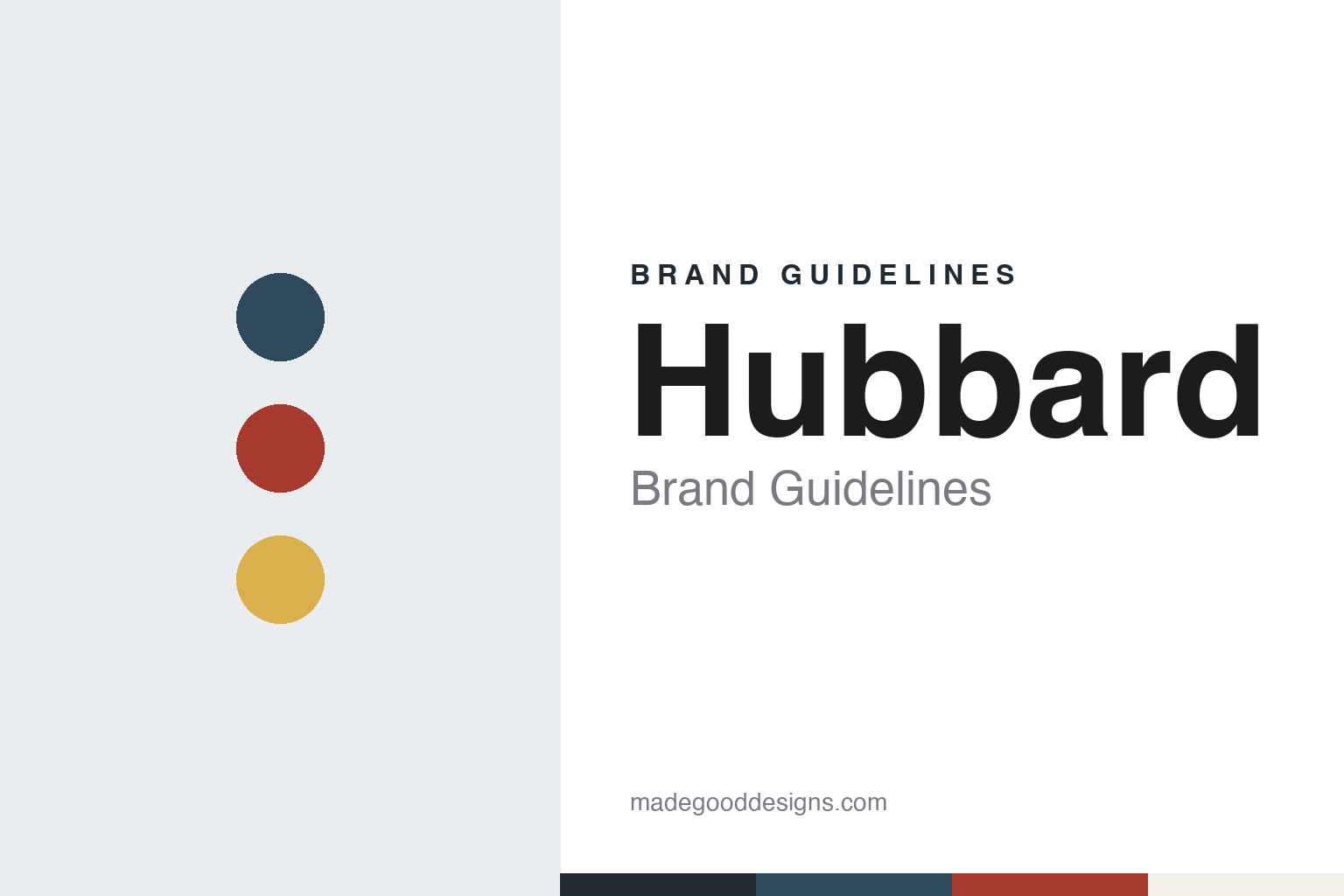
Two constants: a slate blue, wattle red and corn yellow palette and a Steady serif register. Abstract homage — not a Hubbard product or mark; no bird, logo or pack is reproduced.
A New Hampshire flock
A family poultry business that began in 1921.
Hubbard dates its start to 1921, and its website still greets visitors with that year. A company anniversary article published on ThePoultrySite in January 2011 says the business began with a small flock of chickens kept by Ira and Oliver Hubbard, and that Oliver Hubbard’s graduation from the New Hampshire agricultural college in 1921 can be seen as the start of Hubbard in commercial poultry. The same article says Hubbard remained a family company from 1921 until it was bought by the drug company Merck in 1974.
The decades that followed are a story of corporate combinations, set out by Hubbard in its own timeline. It lists the creation of the Canadian breeder Shaver in 1946, Merck’s purchase of Hubbard in 1974, the creation of the French breeder ISA in 1976 and Merck’s purchase of the turkey breeder BUT in 1978. ISA acquired Shaver in 1988. In 1997, the timeline says, the Hubbard and ISA groups merged to form Hubbard ISA, and in mid-2003 a new Hubbard company was created that dealt in broilers only.
Since then the name has stood for meat chickens, or broilers. Its website describes the business as supplying day-old grandparent and parent stock chicks around the world for chicken-meat production.
Colour
Merial, Grimaud and Aviagen.
By the mid-2000s Hubbard belonged to Merial, the animal-health company. ThePoultrySite reported on 4 April 2005 that Groupe Grimaud La Corbière, the French family-owned breeding group, had completed its purchase of Merial’s subsidiary Hubbard on 25 March that year, through a sale of the shares of Hubbard companies in France, the United States and the Netherlands. The report said Hubbard would operate autonomously within the Grimaud group, keep its own identity and continue to trade under the Hubbard name, selling parent and grandparent broiler breeders to producers and integrators worldwide.
The 2011 anniversary article says that, after the Grimaud purchase, Hubbard was again part of a family company, and that it ran selection programmes at research centres in North America and Europe, with its own production sites in North America, Europe and Brazil.
The Grimaud years ended in 2017. On 2 August 2017 Groupe Grimaud announced that it would transfer 100 per cent of Hubbard’s shares to the Aviagen Group, according to the poultry magazine Zootecnica. The announcement said avian-influenza export bans had hit Hubbard’s international sales, especially in Asia and the Middle East, and that Hubbard would stay an independent broiler breeding company, wholly owned by Aviagen, with its headquarters kept in France. Frédéric Grimaud, the group’s chief executive, called the move “the best possible scenario for the future of the company, its customers and employees,” and said it would let Grimaud refocus on other species and on biopharmaceutical work. The same announcement said Hubbard had, under Grimaud, built positions in more than 120 countries through subsidiaries in the United States, Brazil, France and Poland. Le Journal des Entreprises reported on 24 August 2017 that the sale had gone through in early August and placed Hubbard in Quintin, in Brittany’s Côtes-d’Armor department, calling it the world’s third-largest broiler breeder. English Wikipedia says the EW Group, Aviagen’s German family-owned parent, integrated Hubbard into the Aviagen Group in 2018, and Hubbard’s own timeline dates its entry to February 2018.
Hubbard organises its birds into two ranges. The Conventional range is aimed, the company says, at total meat yield at the lowest cost; the Premium range covers what it calls high value-added breeds, and Zootecnica reported in 2017 that Hubbard had developed this offer of slower-growing broilers over the previous five years. A third heading on its website, Hubbard Males, groups its male lines.
Typography
Design and documentation.
Livestock-genetics companies sell something a customer cannot see: the breeding value carried in an animal, a fertile egg or a frozen straw of semen. Their marketing therefore leans on the animals themselves. A prize bull or a breeding sow is photographed side-on, square to the camera, against a barn wall or an open sky, so that frame, legs and topline read clearly; the pose echoes the show ring and the sire catalogue.
Poultry breeders work at a different scale. Their pictures tend to show a day-old chick held in gloved hands, rows of laying hens in clean housing, or a single bird against a plain backdrop, with the brand name and line number set beside it. The gloves signal hygiene, and with breeding farms closed to casual visitors, staged photography often stands in for a site visit.
The laboratory is the third setting. Cattle and pig genetics companies show technicians filling or sorting semen straws, opening liquid-nitrogen tanks wrapped in vapour, or reading genomic data on a screen, to show that selection now runs on DNA testing as well as on pedigree and performance records. Alongside them come farmer portraits: a dairy farmer in the parlour, a pig producer in the barn, a family on the farm, used to make a technical product feel local.
Much of this imagery is made for trade shows. World Dairy Expo in Madison, Wisconsin, EuroTier in Hanover and the International Production & Processing Expo (IPPE) in Atlanta are where breeders put up stands, hand out sire catalogues and parade cattle in the ring. The companies in this guide are set out by what can be checked: who founded them, who owns them and what they breed.
Aa
A steady serif — Hubbard in title case. (Specimen set in Source Serif 4, a serif STAND-IN; NOT the Hubbard logo.)
Hubbard
Breeding stock, not chicken.
Hubbard describes its research as the centre of the business. It says it has two research centres, in France and the United States, runs pedigree programmes in both countries, and supports them with its own great-grandparent and grandparent operations in Europe and the Americas, with subsidiaries in Europe, the United States and Brazil. Among the tools it names are computed tomography scanning, radio-frequency identification with feeding stations that record each bird’s intake, and genomics.
The company states its mission as being “a provider of efficient breeding stock for the worldwide broiler markets,” and lists values including a positive attitude, customer focus, teamwork, continuous improvement, respect, integrity and care. Its offices are split between Hubbard SAS in Quintin, which serves Europe, the Middle East, Africa and Asia, and Hubbard LLC in Pikeville, Tennessee, which serves the Americas.
For a design guide, Hubbard shows how a breeding brand can keep one family name through more than a century and several owners, from a New Hampshire flock to a Breton headquarters inside a German family group. Compare Aviagen, the broiler breeder that now owns it, and Grimaud, the French family group that owned it from 2005 to 2017. For this guide we use slate blue and wattle red with a serif, an unofficial interpretation; no product or logo is reproduced.
Explore & save
Keep Hubbard’s identity on hand — save it to a board in the Made Good inspiration library.
Hubbard identity set
Pin the Hubbard slate blue and wattle red palette and the Steady serif register to your own board.