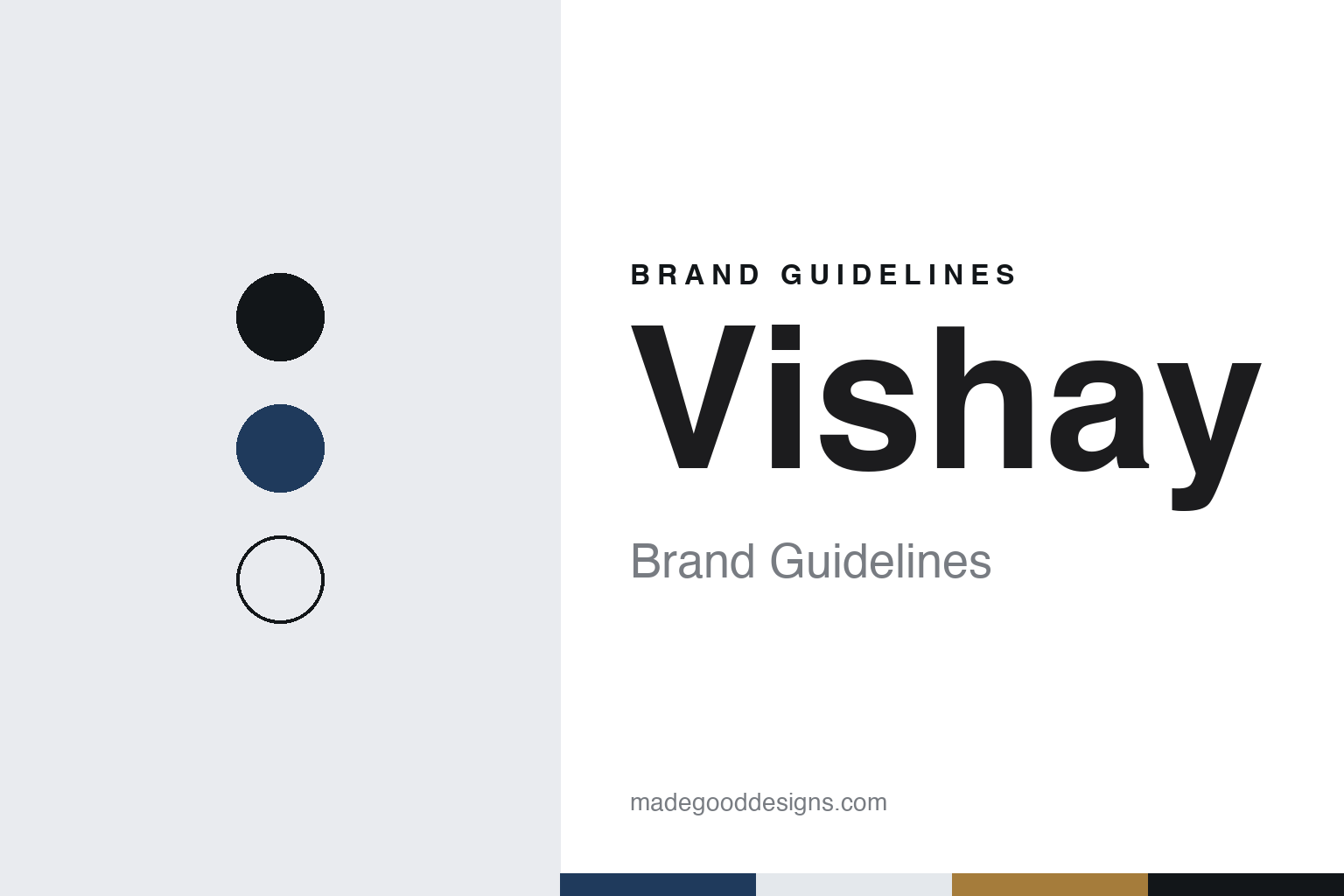
Vishay Brand Guidelines
Felix Zandman’s 1962 foil resistor and a name from a village.
Aa
Two constants: a Vishay foil navy and brass palette and an Engineering serif register. Abstract homage — not a Vishay product or mark; no component, logo or nameplate is reproduced.
Veisiejai
A physicist’s resistor and a village name.
Vishay Intertechnology was founded in 1962 by Felix Zandman, a Polish-born physicist, according to both the company and English Wikipedia. It is based in Malvern, Pennsylvania, and its shares trade on the New York Stock Exchange. The name comes from Veisiejai, Zandman’s ancestral village in present-day Lithuania, English Wikipedia says.
The founder’s route to the company ran through the Second World War. Born in Grodno, then part of Poland, Zandman told that story in his 1995 memoir Never the Last Journey, written with David Chanoff and reviewed by Kirkus Reviews in April that year. The review notes that the book moves from those years to France after the war and then to America and the building of Vishay. English Wikipedia says he studied physics and engineering at Nancy from 1946 to 1949 and took a doctorate in Paris on photoelasticity, the study of stress through polarised light.
He first presented his measuring methods in the United States in 1956, English Wikipedia says, and joined Tatnall Measuring Systems in Philadelphia as director of basic research. In 1960 he and Sidney J. Stein presented a resistor made from a thin metal foil bonded to a ceramic base, so that the foil’s tendency to change resistance with heat is largely cancelled by the restraint of the base; the metal foil resistor was aimed at uses with extreme temperature changes, such as aircraft and spacecraft. His relative Alfred P. Slaner provided the initial funding, and in 1962 the Franklin Institute awarded Zandman its Edward Longstreth Medal, the same source says.
Colour
A broad line built by purchase.
The company says it began with two products, foil resistors and foil strain gauges, and that in 1985 it began “an ongoing series of strategic acquisitions” to become a broad-line maker of electronic components. English Wikipedia lists the purchases year by year: Dale Electronics in 1985, Draloric in 1987, Sfernice in 1988, Sprague Electric in 1992, Roederstein in 1993 and Vitramon in 1994. In 1998 Vishay moved into semiconductors with Siliconix and Telefunken, and in 2001 it added General Semiconductor and the infrared components business of Infineon.
Passive components kept coming. In 2002 Vishay bought BCcomponents, the former passive components businesses of Philips and Beyschlag, the company says; in 2008 it bought the wet tantalum capacitor business of KEMET, and in 2011 the resistor businesses of Huntington Electric, English Wikipedia says. The company now describes its range as discrete semiconductors and passive components — rectifiers, MOSFETs, optoelectronics, resistors, capacitors and inductors among them.
Many of those older names were kept rather than retired. The company’s brands page lists more than two dozen sub-brands in the form “Vishay Dale,” “Vishay Sprague” or “Vishay Siliconix,” so a buyer still meets the acquired maker’s name next to the parent’s. One purchase touched architecture: Spectrol, bought in 2000, owned the British firm once known as Reliance Controls, whose Swindon factory, opened in 1967 and demolished in 1991, was the last design of the practice Team 4, the partnership of Richard Rogers, Norman Foster, Su Brumwell and Wendy Cheesman, English Wikipedia says, citing the Design Museum.
The precision side was later separated. Vishay announced in October 2009 that it would spin off its foil resistor and measurement businesses, and completed the spin-off of Vishay Precision Group in July 2010, English Wikipedia says; the foil resistor that started the company now sits with that separate firm.
Typography
Design and documentation.
Passive components are hard to photograph and harder to brand. A multilayer ceramic capacitor in the smallest sizes is a speck that sits like a grain of sand on a fingertip, and a scatter of chips on a fingertip is one way to show that scale. Resistors, inductors, filters and fuses look little different from one maker to the next, so the presentation leans on the company’s name, its colours and the way it pictures the work behind the part.
The pictures repeat across the trade. Reels of tape-and-reel parts, ready for pick-and-place machines, stand for volume. Through-hole resistors with their coloured bands, cut-away capacitors that open up the layers or the wound film inside, and close-ups of ceramic sheets being stacked stand for the craft. Automated inspection lines, with cameras checking each part, stand for consistency, and pictures of factories and laboratories often stand in for the end products the parts go into.
Trade shows are where these brands meet engineers in person. electronica in Munich and CEATEC in Japan are among the fairs where component makers take large stands, and some use them for showpieces that have little to do with a datasheet: Murata, for one, says it demonstrated its bicycle-riding Murata Boy robot at CEATEC JAPAN 2005.
Many of these companies began with a material rather than a product: ferrite, titanium oxide, barium titanate, tantalum or film. Several have changed hands or merged, so names, marks and owners do not always line up. This guide sets out who founded each brand, who owns it now and where it says its parts are made, and marks clearly what rests only on the company’s own word.
Aa
An engineering serif — a village name on a components company. (Specimen set in IBM Plex Serif, a serif STAND-IN; NOT the Vishay logo.)
Vishay
“The DNA of tech.”
Vishay keeps its founder at the centre of its story. Its “Who we are” page is headed “Honoring our founder, Dr. Felix Zandman,” and says the Vishay journey began with “one man” and “a revolutionary technology.” Its slogan, carried as a registered mark across the site, is “The DNA of tech.”, which the company uses to describe its range as the foundation of modern electronic products, from automotive and industrial to medical, aerospace and telecommunications uses. The Zandman name continues in the business: English Wikipedia lists Marc Zandman as executive chairman and Joel Smejkal as president and chief executive.
Its manufacturing is international. English Wikipedia, drawing on the company’s 2024 annual report, says Vishay has plants in Israel, Asia, Europe and the Americas, and had about 22,700 full-time employees at the end of 2024; the Kirkus review of Zandman’s memoir mentions the pride he took in the Israeli operations.
Its most recent large addition is in Wales. In March 2024 the UK government cleared Vishay’s purchase of the Newport Wafer Fab from Nexperia, the BBC reported on 1 March 2024; the plant, which began as Inmos in 1980 and which the BBC called the UK’s largest manufacturer of semiconductors, had been renamed Newport Vishay, and the company said it wanted to expand the site with an emphasis on research into compound semiconductors.
For a design guide, Vishay shows how a company can grow by buying dozens of makers while keeping their names under one prefix. Compare KEMET, which sold Vishay its wet tantalum business, and Kyocera AVX, another American passive-component maker. For this guide we use a foil navy and a brass with a serif, an unofficial interpretation; no product or logo is reproduced.
Explore & save
Keep Vishay’s identity on hand — save it to a board in the Made Good inspiration library.
Vishay identity set
Pin the Vishay foil navy and brass palette and the Engineering serif register to your own board.