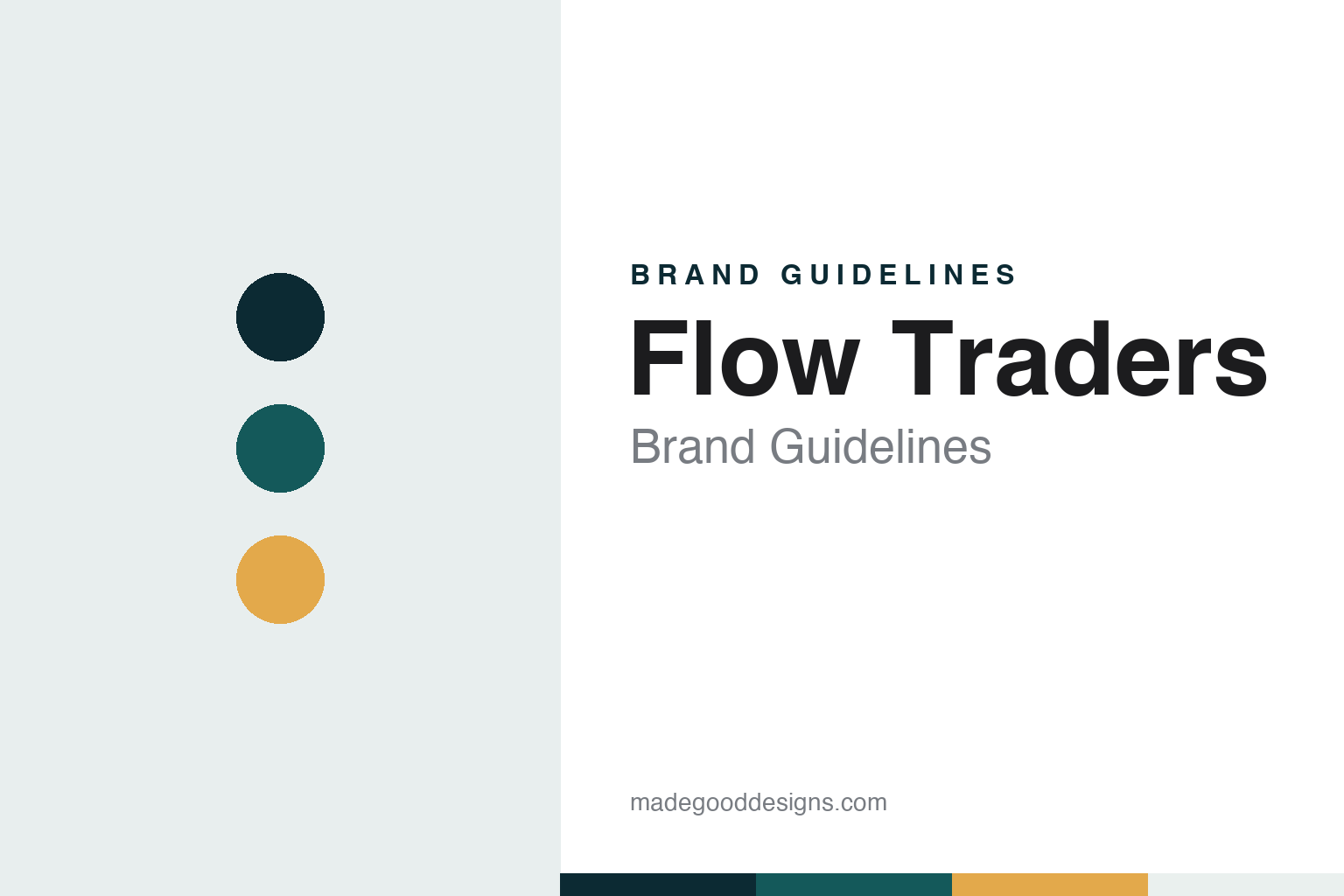
Flow Traders Brand Guidelines
The Amsterdam market maker that grew up quoting exchange-traded products.
Aa
Two constants: a canal teal, harbour ink and amber palette and a Geometric sans register. Abstract homage — not a Flow Traders asset or mark; no logo is reproduced.
Amsterdam, 2004
Two founders and the exchange-traded product.
Flow Traders was founded in Amsterdam in 2004. Dutch Wikipedia names its founders as Jan van Kuijk and Roger Hodenius, and the company’s own website says it was established in a city “with an extensive and rich trading heritage.” It is a market maker: as Dutch Wikipedia explains, it quotes a price at which it will buy, the bid, and one at which it will sell, the ask, and earns the difference between them, the spread, whichever way the market moves.
Its speciality from the start was the exchange-traded product, or ETP, a collective name for index products such as exchange-traded funds that track shares or commodities. Dutch Wikipedia says that when the firm buys or sells ETPs it immediately takes an offsetting position, so that it does not carry the price risk, and that it can grow both as the ETP market grows and by winning market share from rivals. The company still describes itself on its investor pages as “historically specialized in Exchange Traded Products (ETPs), now expanding into other asset classes.”
English Wikipedia describes Flow Traders as a proprietary trading firm that provides liquidity using high-frequency and quantitative trading strategies, and says it quotes bid and ask prices for ETPs, options, fixed-income products and currencies. In 2019, it adds, citing the Financial Times, the firm announced that it would also begin trading cryptocurrencies. Citing a 2020 annual report filed by its US arm with the Securities and Exchange Commission, it says the firm provides liquidity in more than 13,000 ETP listings across North America, Europe and Asia-Pacific, and, citing Financial News, that by 2020 it was Europe’s largest ETF market maker. The company now states its mission as providing “liquidity anytime, anywhere to bring transparency to the market,” and calls itself “entrepreneurs at heart with a challenger mindset.”
Colour
An Amsterdam firm with hubs on three continents.
Flow Traders grew out from Amsterdam in stages, according to its own list of offices. It opened in New York in 2009, in an office it says overlooks Bryant Park and which it calls the primary trading hub for its US business in ETPs, fixed income and digital assets. Hong Kong followed in 2017 as the principal hub for the Asia-Pacific region; Milan opened in 2020; and in early 2023 it added Chicago, on the trading floor of the Franklin building. It also has a London office on Finsbury Square. English Wikipedia’s list of locations adds Paris, Cluj in Romania, Shanghai and Singapore.
Amsterdam remains the centre. The company says around 400 people work at its first office, in the east of the city, and lists facilities there including a gym, free daily lunches, a bar, an arcade room and a Flow Traders boat.
On 10 July 2015 the company listed on Euronext Amsterdam, where its shares trade under the code FLOW. Dutch Wikipedia, citing Het Financieele Dagblad, says up to 40% of the company was offered and that no new shares were issued, so the proceeds went to the selling shareholders rather than to the company. In January 2023, English Wikipedia reports, Flow Traders completed a change to its corporate holding structure, after which its ultimate holding company became Flow Traders Ltd, with the shares remaining on Euronext Amsterdam.
The company is governed by a one-tier board of non-executive and executive members. Its website says Thomas Spitz, who previously led global markets at First Abu Dhabi Bank and spent more than 20 years at Crédit Agricole, was elected chief executive and executive director in October 2025.
Typography
How trading firms present themselves.
Proprietary trading firms and electronic market makers sell little to the public, so their identities are built for a narrow audience: the students, engineers and researchers they hope to hire, and the institutions they trade with. Their websites read less like consumer marketing and more like careers sites, with pages on departments, open roles, interviewing and benefits placed as prominently as any description of the business.
Recruiting shapes the tone. Jane Street, for example, keeps a Puzzles page that posts a new problem every month or two, and its events include meet-ups built around puzzles and technical talks. Coding challenges, internship programmes and scholarships do similar work, signalling that the firm values problem solving before it values a finance background.
The trading floor is the other recurring image. Firms describe offices in several financial centres and present their floors as places of shared work rather than private desks, while technology pages talk about low-latency networks, compilers and research. Blogs and podcasts carry much of the explanation, letting engineers and researchers speak for the firm instead of an advertising campaign.
The marks themselves tend to be modest: a plain name, a simple geometric symbol or a word set in capitals, used consistently across careers pages, legal notices and the regulated subsidiaries that carry the brand in each market. For designers, the category is a study in restraint, where credibility comes from clarity, consistency and a careful choice of tone rather than from colour or spectacle. The palettes in these guides are our own unofficial interpretations.
Aa
A geometric sans for a firm that quotes prices around the clock. (Specimen set in Manrope, a sans STAND-IN; NOT the Flow Traders logo.)
Flow Traders
From ETFs to round-the-clock markets.
The newest part of the business is digital assets. In July 2026 Traders Magazine reported on the strategy update the company had presented to investors in June, called Horizon 2030, which sets out a plan to become “the 24/7 liquidity provider of choice” across traditional and digital assets, with frontier technology, AI and deep learning named as its tools. Its co-chief trading officer told the magazine that Flow Traders began working in crypto about nine years earlier, and argued that more than 20 years of pricing ETFs, including when the markets behind them are closed, carried over to tokenized assets.
In March 2026, the magazine said, the firm extended its digital-asset over-the-counter offering beyond crypto, with round-the-clock two-way prices in tokenized money-market funds, equities and commodities, which counterparties can trade against ordinary currencies or stablecoins. The co-chief trading officer compared minting tokens on a blockchain with the creation and redemption of ETF shares, and claimed that half of crypto ETF trades in Europe, the Middle East and Africa pass through Flow Traders. Alongside trading, the company’s website presents a charitable arm, the Flow Traders Foundation, and a strategic-capital arm that invests in other businesses.
For a design guide, Flow Traders shows a market maker that, unlike its many private peers, speaks to shareholders as well as to recruits, with investor pages, published strategy and a careers site side by side. Compare Optiver and IMC, two other trading firms from Amsterdam. For this guide we use a canal teal, harbour ink and amber with a sans, an unofficial interpretation; no product or logo is reproduced.
Explore & save
Keep Flow Traders’s identity on hand — save it to a board in the Made Good inspiration library.
Flow Traders identity set
Pin the Flow Traders canal teal, harbour ink and amber palette and the Geometric sans register to your own board.