General Catalyst Brand Guidelines
The Cambridge venture firm that bought a hospital system.
Aa
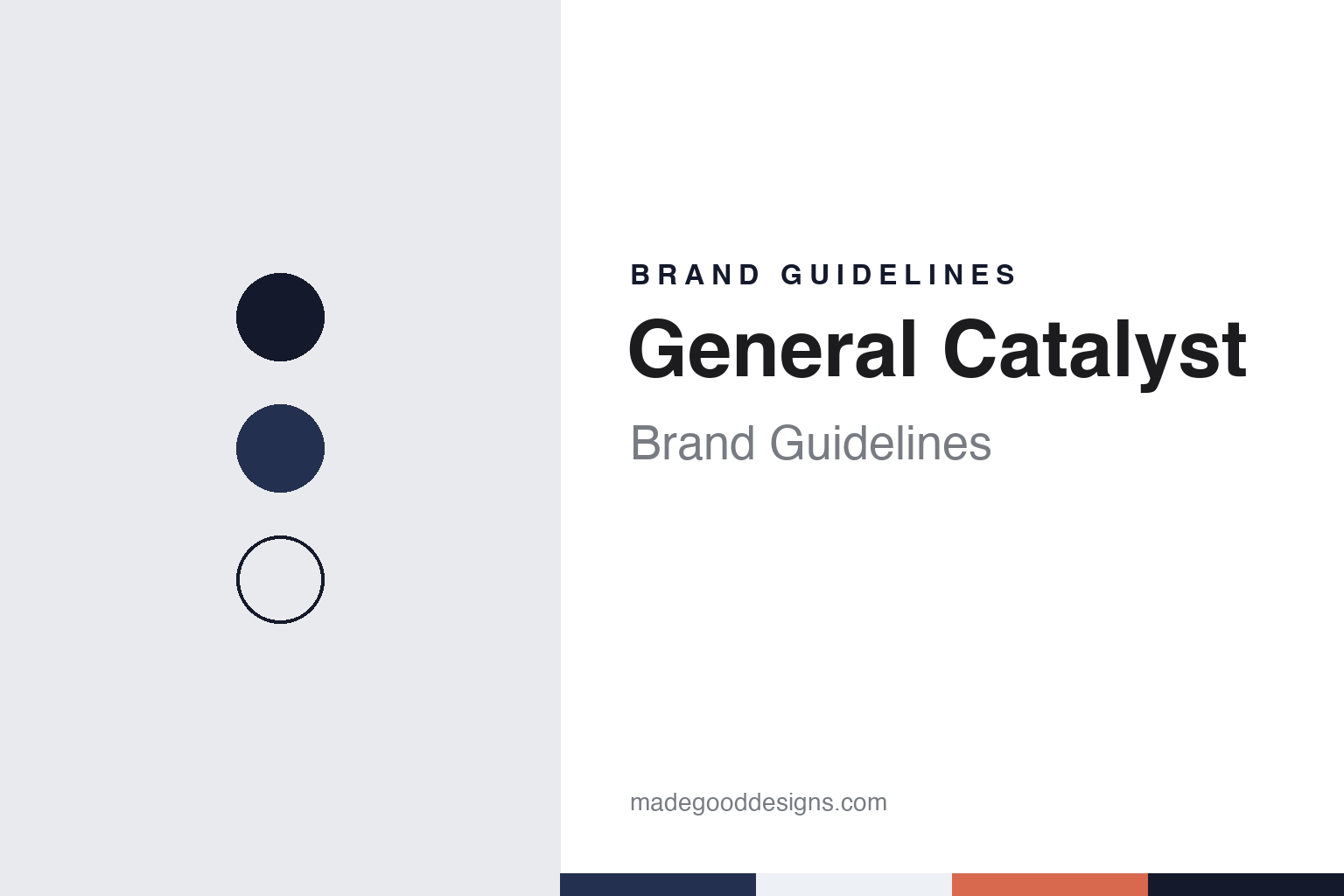
Two constants: a General Catalyst navy and coral palette and a Clean sans register. Abstract homage — not a General Catalyst mark; no logo or wordmark is reproduced.
Cambridge, 2000
A Boston-area firm that went global.
General Catalyst is a venture capital firm headquartered in Cambridge, Massachusetts, across the river from Boston. English Wikipedia says it was founded in 2000 in Massachusetts by Joel Cutler and David Fialkow, that it invests at seed, venture and growth stages, and that it has backed more than 800 companies. The firm often shortens its own name to GC, and the initials run through the names of its newer units, from GC Wealth to the GC Institute.
The firm spread outward from New England in stages. It opened a Silicon Valley office in 2010 and a London office in 2021, English Wikipedia says, and by April 2023 it had invested in 25 Indian start-ups. In June 2024 it absorbed two other investors: La Famiglia, a German early-stage firm, and Venture Highway, an early-stage investor based in New Delhi. Jeannette zu Fürstenberg, a founding partner of La Famiglia, describes herself on General Catalyst’s website as its President and a Managing Director, in charge of its European business; English Wikipedia lists Hemant Taneja as chief executive and Ken Chenault as chairman.
Its public role has sometimes gone beyond its own deals. In March 2023, after regulators closed Silicon Valley Bank during a run on deposits, General Catalyst organised a joint statement of support for the bank and its customers that was signed by more than 110 venture capital firms, English Wikipedia says. In May 2025, according to the same source, it launched a medical-technology venture fund with Britain’s National Health Service and the European investor Speedinvest.
Its portfolio, as English Wikipedia lists it, includes Airbnb, Anthropic and Stripe.
Colour
HATCo and Summa Health.
Health care has become the theme that sets General Catalyst apart. English Wikipedia records a dedicated Health Assurance Fund raised in 2021 and added to in 2022. In October 2023, at the HLTH conference in Las Vegas, the firm launched the Health Assurance Transformation Corporation, known as HATCo. TechCrunch reported on 14 October 2023 that “a key plank” of the plan was that General Catalyst intended to buy an entire healthcare system, and asked why a venture firm would want to own one.
HATCo chose Summa Health, a system in Akron, Ohio, more than 130 years old, with two acute-care hospitals, a rehabilitation hospital, a network of community medical centres and a health insurer, SummaCare. A non-binding deal was announced in January 2024 and firmed up that November. Ohio’s attorney general approved the conversion from a not-for-profit to a for-profit operator in June 2025, after securing a number of pledges from HATCo. On 1 October 2025, Healthcare Dive reported, HATCo completed the purchase — creating, in that publication’s words, the first hospital operator owned by a venture capital firm. The deal had taken about two years to close.
The firm presents the hospital system as a proving ground. Its website says that in 2024 it “made the unprecedented decision to acquire a hospital system” in order to build “a blueprint for proactive, accessible, affordable American healthcare,” and that Summa and HATCo have since built a technology stack with portfolio companies including Aidoc, Commure, Hippocratic AI and Transcarent. HATCo sits on the site under a heading the firm calls “Transformations”, beside Percepta, which General Catalyst describes as a company that places AI engineers, researchers and product managers directly inside organisations.
Typography
Design and documentation.
Venture capital firms sell no products, so their identities rest on a name, a few lines of copy and the companies they back. Their websites can be strikingly spare. Sequoia Capital’s homepage opens on a single sentence, “We help the daring build legendary companies,” and Andreessen Horowitz uses its motto, “Software Is Eating the World,” as the tagline that runs across its site.
The founder is usually the hero. Sequoia describes the people it wants to back rather than the money it manages, and its ethos page lists “the creative spirits” and “the underdogs,” and both firms give over large parts of their sites to founder stories and to portfolio pages that gather the names and marks of the start-ups they have funded. Wikipedia noted in November 2025 that the a16z website listed more than a thousand portfolio companies.
Publishing has become part of the job. Andreessen Horowitz runs a podcast network of about a dozen shows, newsletters, a books list and a New Media team that, in its own words, offers “go-direct as a service” to founders; Tech Times wrote in June 2026 that its thesis urges founders to speak through their own channels. Sequoia’s site mixes partner essays and videos with its Training Data podcast. Essays matter too: Marc Andreessen’s 2011 piece “Why Software Is Eating the World” gave his firm a motto.
Place and name do the rest. Sand Hill Road in Menlo Park, where Andreessen Horowitz lists its headquarters office, has given its name to a book by one of the firm’s partners, Secrets of Sand Hill Road. Names are chosen with care: Sequoia says its founder picked a long-lived tree rather than his own name, while Andreessen Horowitz compressed two surnames into a16z, a short handle it now uses across its website address, podcasts and social accounts.
Aa
A clean sans — GC in two letters. (Specimen set in Inter Tight, a sans STAND-IN; NOT the General Catalyst logo or wordmark.)
General Catalyst
From venture fund to owner.
The firm’s second large move into ownership came outside health. On 21 December 2025 the asset manager Janus Henderson formally agreed to be taken private by Trian Fund Management and General Catalyst, later joined by the Qatar Investment Authority. English Wikipedia records a rival approach from Victory Capital in early 2026 and a raised offer from Trian and General Catalyst in March. The deal completed at the start of July 2026, Portfolio Adviser reported on 1 July 2026, with Janus Henderson keeping its management team under chief executive Ali Dibadj and its main bases in London and Denver. General Catalyst’s own website now pairs the two purchases, saying that Summa is becoming an AI-native hospital system while Janus is rebuilding the wealth experience.
Its website is organised less like a fund than like a group of businesses. The menu lists Seed, Grow, a Customer Value Fund, the Famiglia, the General Catalyst Institute, GC Wealth and the Transformations, and the firm describes its Famiglia as a place where “CEOs, founders, partners, policymakers, and change agents come together.” The header offers buttons to copy the firm’s logo and its wordmark as SVG files, with a link to its brand assets. Home-page panels include a quarterly review by Taneja and a short film built around the line “I want to ride my bike on the moon.”
For a design guide, General Catalyst shows a venture firm presenting itself as a builder and owner of companies, with a short set of initials doing the work of the full name. Compare Andreessen Horowitz, another firm known by a short form of its name, and KKR, the private-equity firm founded in 1976. For this guide we use a deep navy and a warm coral with a sans, an unofficial interpretation; no product or logo is reproduced.
Explore & save
Keep General Catalyst’s identity on hand — save it to a board in the Made Good inspiration library.
General Catalyst identity set
Pin the General Catalyst navy and coral palette and the Clean sans register to your own board.