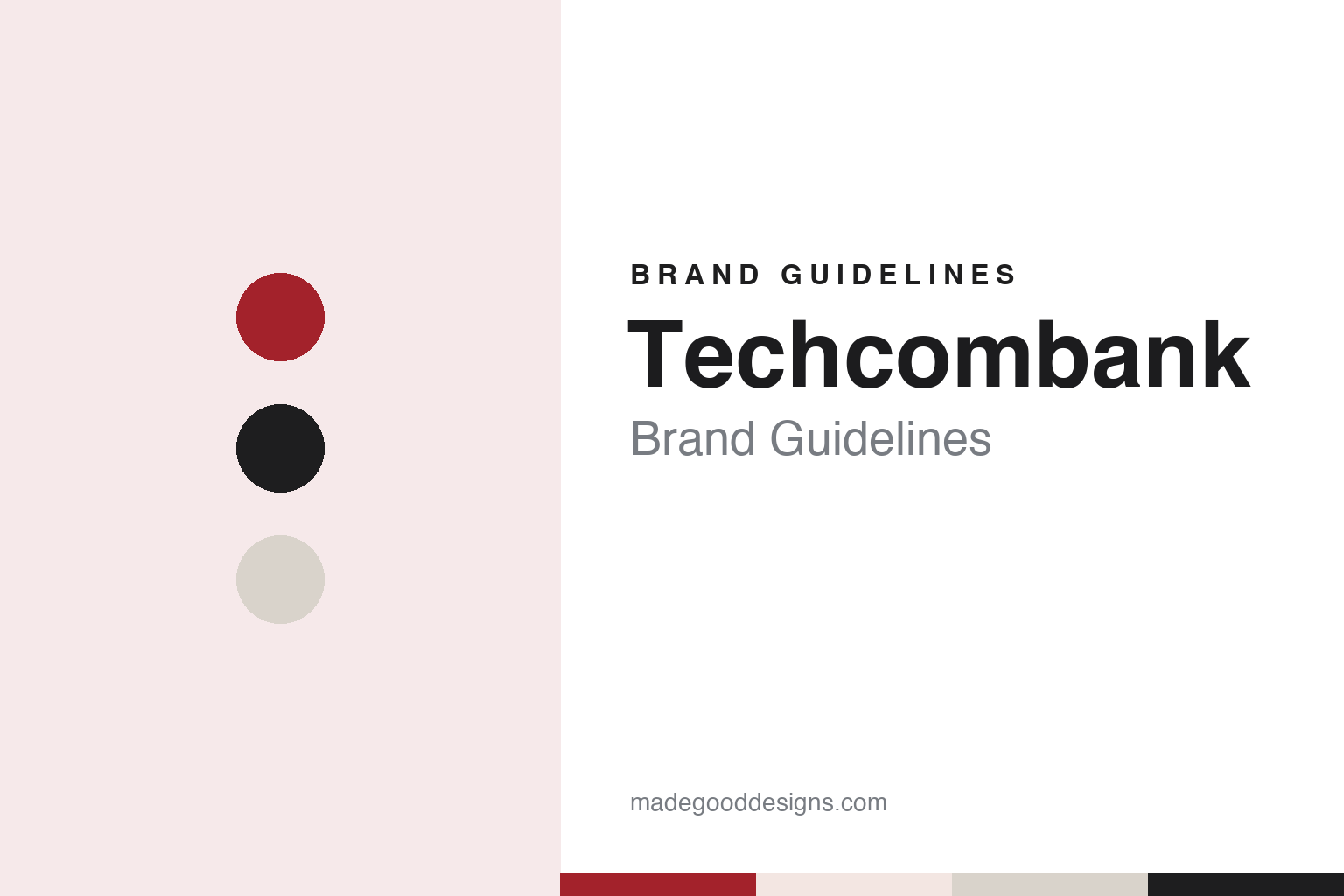
Techcombank Brand Guidelines
A Hanoi joint stock bank that listed in 2018.
Aa
Two constants: a crimson, charcoal and stone palette and a Vietnamese-ready sans register. Abstract homage — not a Techcombank asset; no logo, card or app screen is reproduced.
Hanoi, 1993
A joint stock bank started by returning professionals.
Techcombank is the short name of the Vietnam Technological and Commercial Joint Stock Bank, in Vietnamese Ngân hàng Thương mại Cổ phần Kỹ Thương Việt Nam. Vietnamese Wikipedia says it was founded in Hanoi on 27 September 1993 by a group of intellectuals who had worked in Europe and the Soviet Union; English Wikipedia describes the founders as Vietnamese businessmen who had returned from Russia, and lists Vietnam Airlines among its domestic investors.
The bank grew from Hanoi outwards. Its own timeline records a Ho Chi Minh City branch in 1995, a move of the head office to the Techcombank Building in Hanoi in 1998, the same year it opened in Da Nang, and a contract in 2001 with the software house Temenos for its GLOBUS core banking system, rolled out across the bank in December 2003. That month it also issued the F@stAccess-Connect 24 debit card in cooperation with Vietcombank, which Vietnamese Wikipedia describes as a first for the country.
Card products followed: a Techcombank Visa debit card in December 2006 and a Visa credit card in March 2008, the bank says. The company dates its co-branded Techcombank–Vietnam Airlines–Visa card to September 2008, while Vietnamese Wikipedia gives 2012. In 2008 it also set up a debt management and asset exploitation company, and Vietnamese Wikipedia lists three subsidiaries: a securities company, the debt management company and a fund management company.
Scale came quickly. By the end of 2007 Techcombank had nearly 130 branches and transaction offices, which both the bank and Vietnamese Wikipedia describe as the second-largest network among joint stock banks. In August 2006, the bank says, it became the first Vietnamese joint stock commercial bank to be rated by Moody’s, and in 2009 it began a transformation strategy with the help of the consultancy McKinsey. Its timeline also records the bank formally applying the Basel II standard in 2019.
Colour
A new logo in 2004 and a new vision in 2021.
Techcombank’s own timeline is specific about its identity. It says the bank “started to build a new logo” in 2003 and launched the new logo on 9 June 2004, the same year it signed for card-management software with Compass Plus. Later milestones in the same timeline mark the brand’s public face: sponsorship of the Techcombank Ho Chi Minh City International Marathon, listed under 2017; a southern headquarters in a grade-A building in central Ho Chi Minh City, opened in 2013; the Techcombank Agile Center, a new Hanoi head office opened in 2019; and new head office buildings in Hanoi and Ho Chi Minh City in 2023.
In 2021 the bank announced a new vision and mission. Its website gives the vision as “Change banking, change lives. Uplifting everyone to reach their full potential,” and the mission as leading the digital transformation of the financial industry; the timeline also names a brand spirit for that year, “Be greater every day.” A Techcombank deputy chief executive repeated the “Change Banking, Change Lives” line when accepting awards in 2024, Việt Nam News reported.
The same Việt Nam News report, from May 2024, described four awards from The Asian Banker, covering transaction banking, cash management, a cloud-based customer data and relationship platform, and the WINLife partnership with the consumer group Masan, which by 2023 reached more than 3,600 stores and introduced T-Pay one-touch payments. It also named C-Cash, a treasury platform built with Kyriba, and a certificate of deposit called Bao Loc. In November 2026 the financial paper Đầu tư Tài chính reported that Techcombank had received Euromoney’s transaction-banking award for Vietnam at its 2026 Transaction Banking Awards.
Typography
Malaysian and Vietnamese banks.
Banks in Malaysia and Vietnam tend to present themselves through a bold wordmark or a short set of initials, often set in a single strong colour. Red, green, blue and orange recur across the sector, and many names work in two languages at once: a Malay or Vietnamese name for home customers and an English form or abbreviation for markets, filings and overseas branches. Several of the banks in this guide are known chiefly by initials that began as the names of older holding companies or merged institutions.
In Malaysia, Islamic banking usually sits beside the conventional bank as a range of its own, often run through a separate subsidiary with Shariah-compliant deposits, financing and cards. Public Bank, for example, says it began Islamic banking in 1993 and moved that business into Public Islamic Bank in 2008, while RHB offers its Islamic products through RHB Islamic Bank. RHB’s Sinar Credit Card-i, launched in November 2026, shows the “-i” suffix some Malaysian banks use for Islamic products.
Bank websites in both countries are organised around everyday tasks: deposits and savings accounts, home and vehicle loans, cards, QR payments and mobile apps. In Malaysia the national QR standard, DuitNow QR, was launched by PayNet in July 2019, according to Public Bank, whose own site lists DuitNow QR and its MyPB app under mobile banking. Photography tends to show branches, city skylines, head-office towers and customers at counters or on phones rather than abstract imagery.
Much of how these banks describe themselves appears in formal documents. Listed banks publish annual reports and, increasingly, sustainability reports, and their corporate websites group these with investor pages, milestone timelines and anniversary campaigns. This guide draws on those pages, on encyclopedia entries and on dated press reports, and marks where a fact rests on a bank’s own word.
Aa
A sans that sets Vietnamese diacritics cleanly. (Specimen set in Be Vietnam Pro, a sans STAND-IN; NOT the Techcombank logo.)
Techcombank
HSBC, Warburg Pincus and a 2018 listing.
Foreign shareholders shaped Techcombank’s second decade. English Wikipedia says HSBC bought a 10 per cent stake in 2005; the bank’s timeline records HSBC rising to 15 per cent in 2007 and to 20 per cent in September 2008, and English Wikipedia says HSBC sold its stake in 2017. In March 2018 Private Equity International reported that Warburg Pincus was investing in the bank through two of its global funds, describing it as the largest private equity deal in Vietnam.
The listing came weeks later. In April 2018 The Business Times, carrying a Reuters report, said Techcombank had launched what it called the nation’s biggest initial public offering, with GIC, Fidelity and Dragon Capital among cornerstone investors, and described Techcombank as Vietnam’s largest private-sector bank, with 315 branches and more than 5.4 million customers at the time. Vietnam Investment Review reported that the shares would debut on the Ho Chi Minh City Stock Exchange on 4 June 2018, under the ticker TCB. English Wikipedia describes the bank today as one of the largest joint stock banks in Vietnam.
For a design guide, Techcombank shows how a bank can date its identity precisely — a logo launched on a named day in 2004, a vision line adopted in 2021 — and carry it through foreign investment and a public listing. Compare HSBC, its shareholder from 2005 to 2017, and Vietcombank, its partner on an early debit card. For this guide we use a deep crimson, a charcoal and a stone grey with a sans, an unofficial interpretation; no product or logo is reproduced.
Explore & save
Keep Techcombank’s identity on hand — save it to a board in the Made Good inspiration library.
Techcombank identity set
Pin the Techcombank crimson, charcoal and stone palette and the Vietnamese-ready sans register to your own board.