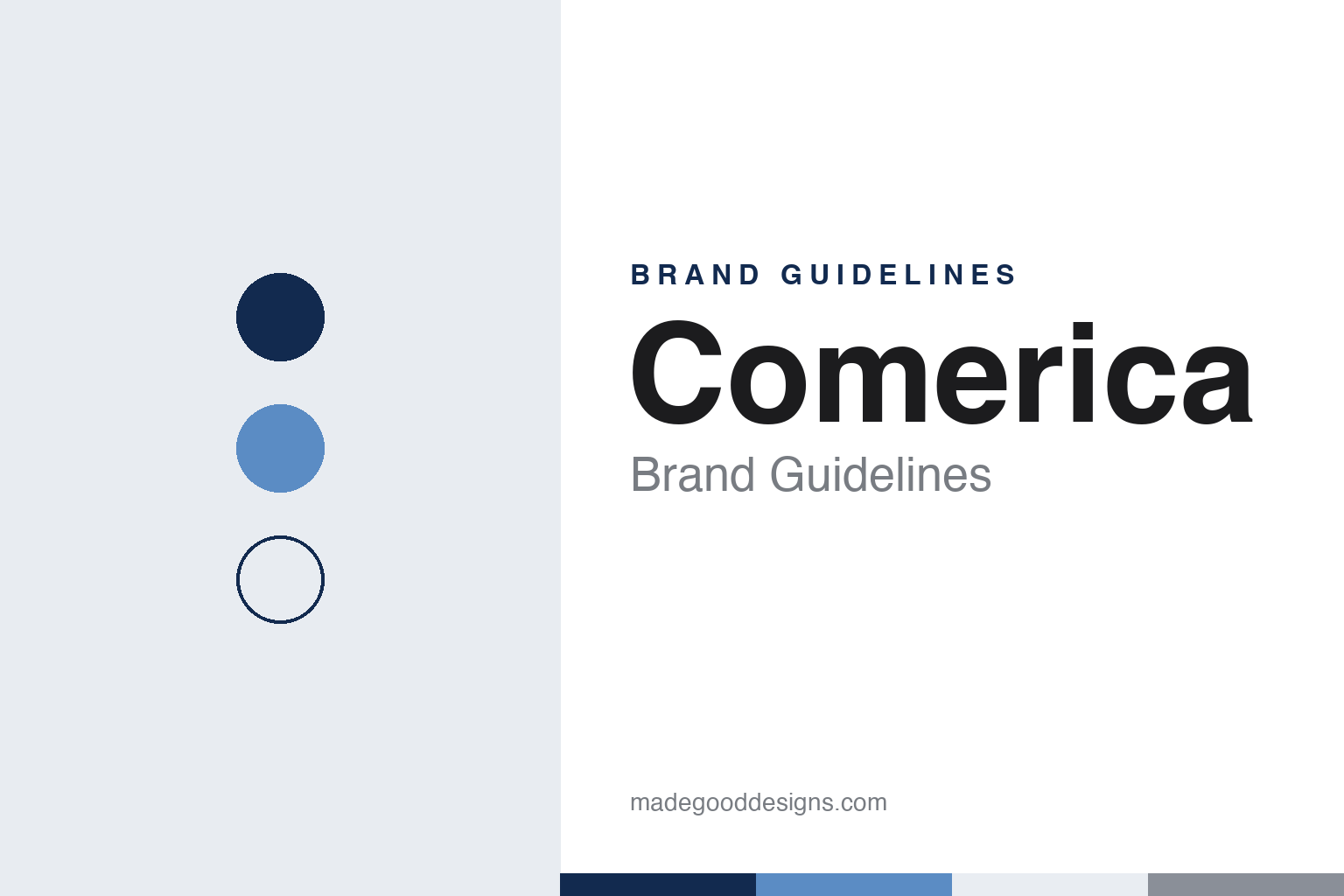
Comerica Brand Guidelines
A Detroit savings fund of 1849 that took a coined national name, moved to Dallas and was folded into Fifth Third in 2026.
Aa
Two constants: a Comerica navy and sky blue palette and a Steady sans register. Abstract homage — not a Comerica product or mark; no logo, card or sign is reproduced.
Detroit Savings Fund Institute
A savings fund for small savers.
Comerica began in Detroit as the Detroit Savings Fund Institute, founded on 17 August 1849. English Wikipedia names its founder as Elon Farnsworth, a lawyer and politician, and says the governor of Michigan signed the act that authorised the institute and appointed eleven unpaid trustees to run it. Its first office stood next to Mariners’ Church, which owned the building. At the start of that year, Wikipedia says, Detroit had just three banks, all of them commercial banks serving business.
The institute was built for small savers. Unlike most banks of its day, Wikipedia says, it paid interest on deposits, had no shareholders or capital stock and was managed by unpaid trustees, and it courted working people, merchants and even children. An advertisement in Detroit’s directory for 1852–53, quoted by Wikipedia, described its purpose as giving people who wanted to save, but did not yet have enough to buy a share in a bank or a railroad, a way to put their money to use.
The name changed as the bank grew. When Michigan passed a law in 1871 to encourage banks offering both savings and commercial services, the institute became a stockholder-owned company, The Detroit Savings Bank. It became The Detroit Bank in 1936, after the banking crises of the early 1930s; on several occasions in 1933, Wikipedia says, it was the only bank in the city offering full personal and commercial services. A 1956 merger with Birmingham National Bank, Ferndale National Bank and Detroit Wabeek Bank and Trust created The Detroit Bank & Trust Company, which opened a London office in 1969, took up Master Charge cards and automated teller machines in the early 1970s and formed a holding company, DetroitBank Corporation, in 1973.
Colour
“Commercial” plus “America.”
The name Comerica arrived in 1982. Wikipedia describes it as a blend of “Commercial” and “America,” a coined word that took the city out of the bank’s name just as the bank began to look beyond Michigan. The same year it entered Florida; in 1983 it entered California and Texas through auto financing, and in 1984 it completed its merger with its Detroit rival, the Bank of the Commonwealth.
Texas became a second home. Wikipedia says the purchase of Grand Bancshares in 1988 was the first of 21 Texas acquisitions, and the bank expanded in California in 1991 with Plaza Commerce Bancorp and InBancshares. In 1990 it received approval for a new Detroit headquarters, Comerica Tower at Detroit Center. In 1992 it merged with Manufacturers National Corporation, a Detroit bank of similar size, creating one of the country’s 25 largest bank holding companies, according to Wikipedia. Later deals included Imperial Bank of California in 2001 and Sterling Bank of Texas in 2011, which took it into San Antonio and Kerrville.
On 6 March 2007 Comerica announced that it would move its headquarters to Dallas, to be closer to its customers in the Sun Belt; executives began moving into a tower on Main Street that November, and the building was renamed Comerica Tower. In January 2008 the US Treasury chose Comerica as the issuing bank for its Direct Express debit card, used to pay federal benefits to people without bank accounts. In 2021 it opened a Southeast market with its headquarters in Raleigh, North Carolina.
The bank’s name was most visible in sport and the arts. It held the naming rights to Comerica Park, the Detroit Tigers’ ballpark, from its opening in 2000, and to the Comerica Center in Frisco, Texas, from 2019, and from 2022 it was the presenting sponsor of Detroit’s Fox Theatre, according to Wikipedia. MLB.com noted in September 2026 that fans had nicknamed the ballpark “Comerica National Park” for its spacious dimensions, or simply “CoPa.”
Typography
How regional banks present themselves.
US regional banks tend to present themselves through place. Many carry a state, a city or a region in their names, or keep the name of the town where they were founded long after they have spread across several states. Their identities usually rest on a short wordmark in blue, green or red, set beside photographs of local streets, branch staff, small-business owners and families buying homes. Founding years matter too: several of the banks in this guide trace their roots to the nineteenth century, and their histories are told through the names they have carried since.
Their websites follow a familiar pattern. Pages for checking and savings accounts, mortgages and personal loans sit alongside sections for commercial lending, treasury services and wealth management, so that one brand speaks both to households and to companies. Several of the banks in this guide also run more than one name: local brands kept after a merger, or a single brand carried into new states.
Visibility outside the branch often comes through sponsorship. Ballparks, arenas, theatres and arts seasons have carried bank names, and those names change when banks merge. Annual reports, community reports and investor presentations form a second public record, setting out where a bank operates, which brands it uses and how it describes its history.
This guide sets out what can be checked about each bank — when and where it was founded, which mergers shaped it, and what has happened to its name — and keeps the bank’s own claims separate from what dated sources report. The palettes and typefaces shown are unofficial interpretations, not the banks’ own.
Aa
A steady sans — a coined name for a commercial bank. (Specimen set in IBM Plex Sans, a sans STAND-IN; NOT the Comerica logo.)
Comerica
Folded into Fifth Third.
The Comerica brand no longer trades. Fifth Third announced an agreement to acquire Comerica on 6 October 2025, Wikipedia says, and the merger closed on 1 February 2026. For several months afterwards Comerica branches kept their name. Over the Labor Day weekend Fifth Third completed the technical and brand conversion of the Comerica franchise, bringing its consumer and commercial customers onto Fifth Third’s platforms and under the Fifth Third brand, PYMNTS reported on 8 September 2026, citing the bank’s release. ClickOnDetroit reported the day before that Comerica customers would log in to Fifth Third’s app from 8 September, and that more than 70 branch closures had been announced as part of the merger.
The ballpark followed. On 21 September 2026 the Tigers and Fifth Third announced that Comerica Park would be renamed Fifth Third Park from the 2027 season, with signage around the ballpark to be updated during the off-season, MLB.com reported; Comerica’s naming deal had been extended in 2018 to run through 2034. Wikipedia gives 2026 as the end of the bank’s ties to the Frisco arena and the Fox Theatre as well.
Its history reads as a sequence of names: a savings fund, a savings bank, a city bank, a bank and trust company, and finally a coined national name, chosen in 1982 and retired in 2026. By the time of the merger, Wikipedia says, its branches were spread across Texas, Michigan, California, Florida and Arizona.
For a design guide, Comerica shows how a coined name can carry a bank far beyond its home city, and how a merger can retire that name within months. Compare Fifth Third, the bank that absorbed it, and Frost Bank, another bank with deep Texas roots. For this guide we use a deep navy and a sky blue with a sans, an unofficial interpretation; no product or logo is reproduced.
Explore & save
Keep Comerica’s identity on hand — save it to a board in the Made Good inspiration library.
Comerica identity set
Pin the Comerica navy and sky blue palette and the Steady sans register to your own board.