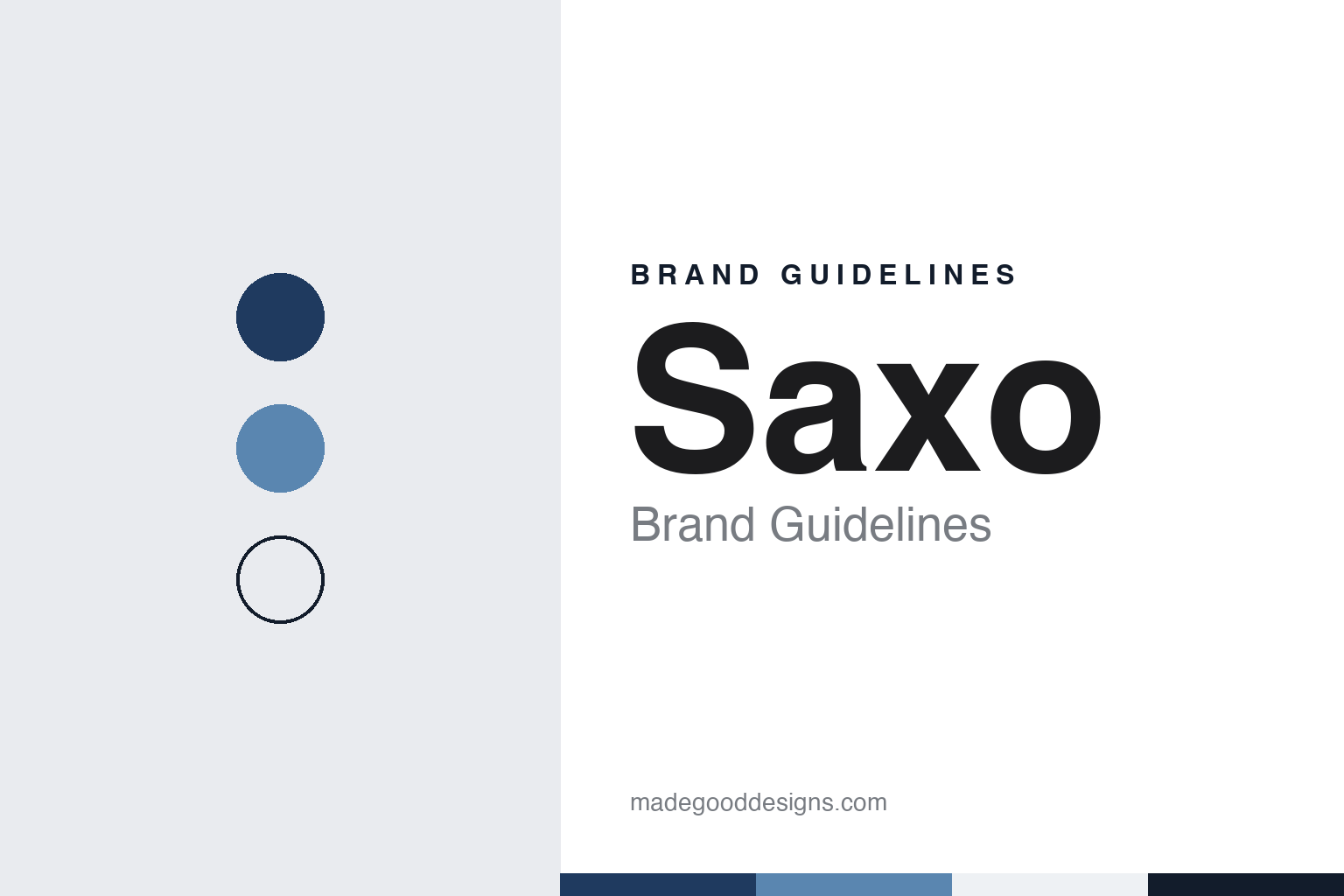
Saxo Brand Guidelines
From a 1992 Copenhagen broker to a bank named after a medieval historian.
Aa
Two constants: a harbour blue and aluminium white palette and a geometric sans register. Abstract homage — not a Saxo asset; no logo, app screen or platform is reproduced.
Midas
A Copenhagen broker that became a bank.
Saxo began in Copenhagen in 1992 as Midas Fondsmæglerselskab, a stockbroking firm. English Wikipedia names Lars Seier Christensen and Kim Fournais as its founders and says the two met in London in the early 1990s; Danish Wikipedia adds a third founder, Marc Hauschildt. The firm’s first internet product, English Wikipedia says, was a currency trading platform called MITS, introduced in 1997 and later replaced by SaxoTrader. Saxo’s own website dates the launch of what it calls one of Europe’s first online trading platforms to 1998.
In 2001 the firm obtained a banking licence and took the name Saxo Bank. English Wikipedia says the new name came from the medieval Danish historian Saxo Grammaticus, and was chosen partly to avoid confusion with a Nigerian bank of a similar name. The same year Saxo launched its first white-label product with a Portuguese securities dealer: the start of a model in which other banks and brokers offer Saxo’s platforms to their own clients under their own names. By 2015, English Wikipedia says, more than 120 financial institutions were using its platforms in this way.
Expansion followed through the 2000s. Saxo set up a regional hub in Singapore in 2006, bought the French broker Cambiste, renamed Saxo Banque France, and the Swiss white-label client Synthesis Bank in 2007, and opened offices in Milan, Prague and Dubai by 2009. In 2008 Citigroup launched CitiFX Pro, a foreign-exchange platform developed by Saxo, and in 2010 Saxo built the “International Trader” share-dealing service for Barclays Stockbrokers. In 2019, according to English Wikipedia, Saxo acquired the Dutch online broker BinckBank.
Colour
Two platforms and a glass headquarters.
The product line is built around trading platforms. In May 2015 Saxo launched SaxoTraderGO, a multi-asset platform, and in September 2015 it opened its trading infrastructure to partners and outside developers through OpenAPI, English Wikipedia says. In 2014 it relaunched TradingFloor.com as a social trading portal where users shared ideas and strategies, and in 2016 it introduced SaxoSelect, managed portfolios built from BlackRock’s iShares ETFs. Today Saxo’s website presents two platforms: SaxoInvestor, which it describes as a simple investing platform, and SaxoTrader, its advanced platform with the full product range, from stocks, ETFs and bonds to options, futures, forex and CFDs.
Saxo’s About page says it serves more than 1.5 million clients, employs people of more than 70 nationalities across 12 countries and gives access to more than 71,000 instruments. It also describes Saxo as a Systemically Important Financial Institution with an A- rating from S&P. English Wikipedia reports that Saxo gave its client count at the end of 2025 as 1.523 million. The same page closes its mission statement with the line “To Be Invested.”
The bank’s headquarters is a design object in its own right. The building at Tuborg Havn, on Copenhagen’s northern edge, was designed by the Danish practice 3XN, which won an international competition for it in 2004, and it received a RIBA International Award, according to English and Danish Wikipedia. Its façade is a pattern of diagonal white aluminium and blue glass. In June 2010 the business daily Børsen named it the kingdom’s finest corporate home, Danish Wikipedia says.
Sport carried the name abroad. Saxo Bank became title sponsor of the Riis Cycling team in June 2008, which rode that year’s Tour de France as Team CSC Saxo Bank, and stayed with the team until the end of the 2016 season. In 2014 it also sponsored the Lotus Formula One team and used the team’s name in its marketing, English Wikipedia says.
Typography
How online brokers present themselves.
Online brokers and trading platforms sell access to markets through a screen, so the screen does much of the branding. Their websites lead with app views and price charts, and many show the same platform on a phone, a tablet and a desktop. Saxo, for example, presents two platforms by name, SaxoInvestor for simple investing and SaxoTrader for its full range, rather than a single product.
The visual language is often restrained. Interfaces come in dark and light modes, numbers are set in clear sans-serif type, and green and blue accents mark rising prices, buttons and links. Wordmarks tend to be short and confident: a single word, two letters or a name with a number, written to sit comfortably in an app icon as well as on a sponsorship board or the name of an arena.
Regulation is part of the page design. Footers carry licence lines that name the regulated companies behind a brand and their supervisors, such as the Financial Conduct Authority in the UK or the Danish Financial Supervisory Authority, and pages for leveraged products carry risk warnings set near the top. IG’s UK website, for instance, names four separate companies behind the one brand in its footer.
Beyond trading, these brands publish a great deal. Product pages explain shares, ETFs, options and, in some markets, savings or pension accounts; education hubs and market commentary aim at newer investors; and listed or bank-owned groups add annual and investor reports and press releases. This guide looks at how each company’s name, ownership and history sit behind that common pattern.
Aa
A geometric sans for a short, confident name. (Specimen set in Manrope, a sans STAND-IN; NOT the Saxo logo.)
Saxo
Geely, then J. Safra Sarasin.
Ownership has changed several times. Geely, the Chinese carmaker’s holding group, announced in October 2017 that it would raise its stake in Saxo Bank to 51.5 per cent, with the Finnish group Sampo taking 19.9 per cent; English Wikipedia says the deal completed in September 2018. Danish Wikipedia notes that co-founder Lars Seier Christensen sold his shares to Geely. A plan to list through a special-purpose acquisition company was dropped in 2022.
In March 2025 the Swiss private banking group J. Safra Sarasin agreed to buy about 70 per cent of Saxo, including the shares of Geely Financials Denmark and Mandatum, the trade journal Asset Servicing Times reported on 10 March 2025. Saxo announced on 2 March 2026 that the purchase of about 71 per cent had completed after approval from FINMA and the Danish Financial Supervisory Authority. Kim Fournais, who kept about 28 per cent, stepped down as chief executive to become chairman, and Daniel Belfer, chief executive of Bank J. Safra Sarasin, became chief executive of Saxo.
On 6 July 2026 Bank J. Safra Sarasin agreed to buy Fournais’s remaining indirect stake of about 28.69 per cent in Saxo Holding AG by exercising a call option, Saxo announced and the Swiss news agency AWP reported. Closing was announced as subject to standard regulatory approvals, and no completion date had been announced at the time of writing, although Saxo’s About page now says the group has full ownership. Saxo says it will continue to operate as a separate entity, with Fournais as chairman.
Regulators have examined the bank’s conduct more than once. After the Swiss National Bank ended its cap on the franc on 15 January 2015, Saxo adjusted the prices of some trades. The Danish Financial Supervisory Authority issued two reprimands in July 2015 over disclosure and client communication, and in October 2019 the Supreme Court of Denmark ruled in one client’s case that Saxo had been entitled to adjust the settlement prices, English Wikipedia says. In December 2024 the Dutch markets authority AFM fined Saxo over violations at BinckBank, and in January 2026 Saxo accepted an administrative fine from the Danish authority over customer due diligence and the monitoring of white-label clients between 2021 and 2023; Saxo said the inspection had found no instances of actual money laundering.
For a design guide, Saxo shows how a Danish broker named after a medieval historian came to present itself under the single word Saxo, and how a headquarters of white aluminium and blue glass can become part of a bank’s public face. Compare DEGIRO, another European online broker, and Interactive Brokers. For this guide we use a harbour blue, a glass blue and aluminium white with a geometric sans, an unofficial interpretation; no product or logo is reproduced.
Explore & save
Keep Saxo’s identity on hand — save it to a board in the Made Good inspiration library.
Saxo identity set
Pin the Saxo harbour blue, glass blue and aluminium white palette and the geometric sans register to your own board.