ForteBank Brand Guidelines
Three banks under one name, and a colour for every customer.
Aa
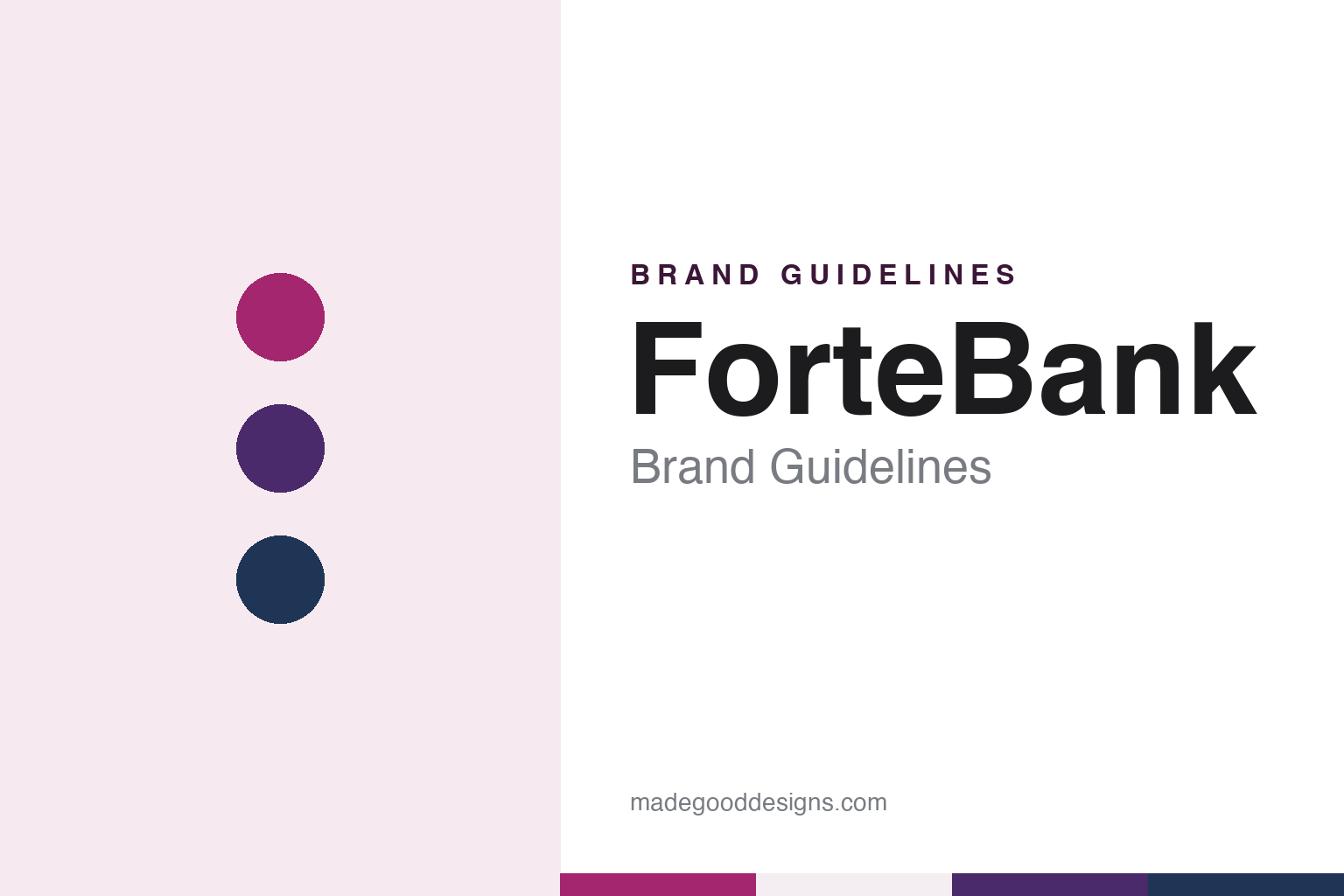
Two constants: a Forte magenta, plum and night blue palette and a confident geometric sans register. Abstract homage — not a ForteBank product or mark; no logo, card or app screen is reproduced.
Three Banks
Alliance Bank, Temirbank and ForteBank.
ForteBank is a bank built from three. Wikipedia dates the present bank to 10 February 2015, when Alliance Bank, Temirbank and an earlier bank already called ForteBank were combined. Russian Wikipedia sets out the legal route: on 1 January 2015 Alliance Bank took over the property, rights and obligations of the other two under transfer deeds, and on 10 February it was itself renamed ForteBank; the reorganisation was completed in December 2016, when the other two companies ceased to exist. The head office is in Astana, with branches across Kazakhstan.
Two of the three dated from the early 1990s. Russian Wikipedia gives Alliance Bank’s founding date as 7 January 1993 and Temirbank’s as 26 March 1992. Temirbank, that source says, began as a specialised railway bank before becoming a general bank, and in 2002 it moved into retail and mortgage lending and began issuing its own Visa cards; its head office was in Almaty.
Both went through restructurings after 2008. Temirbank completed the restructuring of its external obligations on 30 June 2010, after the state wealth fund Samruk-Kazyna became its main shareholder in May 2010, Russian Wikipedia says. In August 2014 Alliance Bank agreed the main terms for restructuring its debt with a committee of its creditors, Tengrinews reported; the bank said the restructuring would restore its capital and prepare the planned joining of Temirbank and ForteBank into one combined bank, with Samruk-Kazyna, its controlling shareholder, supporting the deal, and it hoped to finish by the end of 2014. Russian Wikipedia records that Temirbank closed as a separate bank after its assets were sold to the Verny Capital group and merged into ForteBank.
Colour
A family of Forte names.
From the start ForteBank described itself as a universal bank, serving individuals, small and medium-sized businesses and corporations, and it built its range as a family of Forte names. English Wikipedia lists ForteBusiness for companies and ForteMarket, a marketplace where Kazakh shops sell their goods. It adds ForteMobile, a mobile service launched with the operator Beeline in May 2020, and ForteForex, a currency-trading platform launched the same month. Russian Wikipedia adds FortePremier, for wealthier clients, and ForteTravel, for tours, tickets and car hire.
Its record includes a short-lived purchase: it bought Kassa Nova Bank in December 2018 and sold it to Freedom Finance in August 2020, according to English Wikipedia. In 2021 it launched the Forte Business App for companies, and in November 2023 it launched “Alem,” a service for international transfers to an account or card, with Mastercard, the same source says.
Culture has been part of the brand. In October 2016 the bank opened the ForteBank Kulanshi Art Space, a gallery run with the Kulanshi Centre for Contemporary Art, English Wikipedia records. On its own website the bank also presents “Birlik,” or “Unity,” an art object in Almaty by the sculptor Erbossyn Meldibekov, made with the agency Progression CA; the bank says the campaign won a Grand Prix for PR at the Mad Stars advertising festival in South Korea and was shortlisted at Cannes Lions.
In the capital markets, ForteBank issued perpetual Additional Tier 1 bonds in October 2025, listed in Vienna and on the Astana International Exchange; Trend, reporting the bank’s statement, called it the first AT1 issue on the Kazakh capital market and described ForteBank as one of Kazakhstan’s largest private banks. In October 2026 Trend reported Fitch’s note that the bank had sold 51% of ForteLeasing to a holding company in its wider group and planned to sell the remaining 49% in the first half of 2027; that second step was not completed at the time of writing.
Typography
Design and documentation.
Many banks in Central Asia and the Caucasus now present themselves through their apps. In Kazakhstan, Kaspi.kz describes a single “Super App” that joins bill payments, an online marketplace, consumer credit, transfers and QR payments in shops, while Halyk Bank, the former state savings bank, sells its retail services through the Halyk SuperApp and its business services through Onlinebank. In the apps these two banks describe, loans, deposits, cards and transfers sit beside shopping, travel and government services.
Names are usually shown in more than one language and script. Halyk Bank’s full name appears in Kazakh as Қазақстан Халық Банкі, in Russian as Народный банк Казахстана and in English as Halyk Bank of Kazakhstan; Kaspi Bank was registered for years under the Russian name Банк Каспийский before it took its Latin-letter brand in 2008. Across the region, Kazakh, Uzbek, Georgian, Armenian and Azerbaijani names may appear beside Latin and Cyrillic forms, so a wordmark has to work in several alphabets at once.
Many of these banks now operate across borders. Halyk Group runs subsidiaries in Georgia and Uzbekistan, and Kaspi.kz has bought classified-advert sites in Azerbaijan and businesses in Turkey. Halyk’s website lists loans, deposits, cards and transfers, and both groups, as listed companies, publish investor-relations sections with financial results for shareholders.
Colour and type vary from bank to bank. The palettes in this series of guides — reds, greens, blues and teals among them — are our own unofficial interpretations, set beside a Google Fonts stand-in for each brand. This guide sets out what can be checked about each bank — when it was founded, how its name changed, who owns it and how it presents its services — and keeps figures such as customer numbers to a minimum, attributed to the source and date that gave them.
Aa
A confident geometric sans — one name across many business lines. (Specimen set in Montserrat, a sans STAND-IN; NOT the ForteBank logo.)
Forte
Rays of dawn and a colour code.
The current identity dates from February 2025. To mark ten years of Forte, the bank introduced a new logo, graphic symbol, slogan and colour palette, Tengrinews reported on 5 February 2025. The logo uses smooth rising lines that recall the rays of dawn and stand, the bank said, for the start of a new stage. The slogan runs in Kazakh as “We help people. We support entrepreneurs. We think about the future,” and in Russian, more briefly, as “We help. We support. We create.”
The palette is organised by business line. In the bank’s description, magenta is Forte itself, standing for strength, confidence and resolve; a deep purple marks Forte Solo; a noble green, Forte Premier; a dark blue, Forte Business; and a blue, Forte Corporate. The bank said the rebrand would be rolled out step by step across its branch network.
The group has since grown. ForteBank announced on 27 June 2025 that it had agreed in principle to buy all of Home Credit Bank (Kazakhstan). It raised its stake to 75% in November 2025, making Home Credit a subsidiary that keeps operating under its own brand, Tengrinews reported, and it completed the purchase of 100% on 30 December 2025, the agency AK&M reported, citing the Kazakhstan Stock Exchange.
For a design guide, ForteBank shows how one short name can hold a merged bank together, with each customer group given its own colour. Compare Jusan Bank, another Kazakh bank that grew by merger before taking a new name, and Halyk Bank. For this guide we use a magenta, a deep plum and a night blue with a sans, an unofficial interpretation; no product or logo is reproduced.
Explore & save
Keep ForteBank’s identity on hand — save it to a board in the Made Good inspiration library.
ForteBank identity set
Pin the ForteBank magenta, plum and night blue palette and the confident geometric sans register to your own board.