Santam Brand Guidelines
The Cape Town general insurer that sells freedom from worry.
Aa
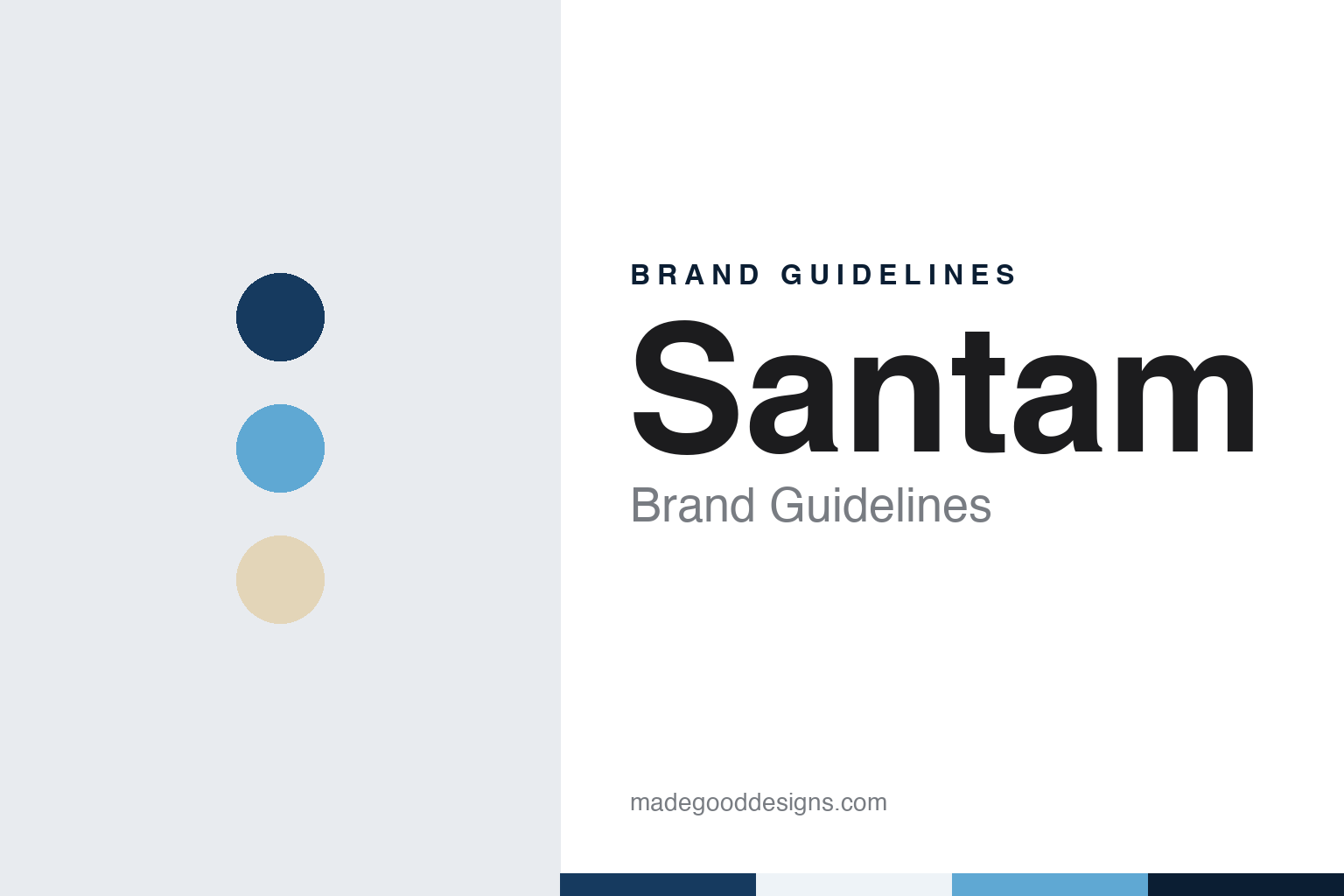
Two constants: a navy, sky blue and sand palette and a grotesque sans register. Abstract homage — not a Santam product or mark; no logo or campaign artwork is reproduced.
Cape Town, 1918
A general insurer and its majority owner.
Santam is a Cape Town general insurer that says it was founded in 1918. Its Who We Are page says the company listed on the Johannesburg Stock Exchange in 1964, in the non-life insurance sector, and that it also has secondary listings on the Namibian Stock Exchange and the A2X exchange. Eyewitness News reported in October 2026 that Santam’s JSE listing had run for 62 years, which matches that date. The same page puts the company’s age at 108 years.
Santam describes itself as a general insurer, the South African term for property and liability cover rather than life cover. Its range runs from car, home contents and building insurance for households to motor, property, liability, engineering and agricultural cover for businesses, including crop, asset and weather insurance for farms. It sells through brokers and other intermediaries, directly, and through partnerships, in South Africa, Namibia and what it calls selected emerging markets. The company says it serves more than one million policyholders in South Africa and Namibia; a Bloomberg report carried by Insurance Journal on 7 October 2026 gave the global figure as nearly 2.5 million and called Santam “South Africa’s biggest general insurer.” Santam’s own page, which also names Cape Town as its headquarters, uses the more modest phrase “a leading general insurer,” with a market share it puts at less than 24%.
Santam is controlled by the financial services group Sanlam. Santam’s website says Sanlam holds 62.3% of its shares; the Namibian news site Observer24 put the figure at 61.9%, excluding treasury shares, in November 2026. The company has been led since 1 July 2022 by chief executive Tavaziva Madzinga, an actuary who, according to Santam, previously ran Britam Holdings in Kenya and Swiss Re’s UK and Ireland business.
Colour
One name over many businesses.
The Santam name sits over several businesses. On its business portfolio page the company lists Santam Client Solutions, the Santam-branded direct business; Santam Broker Solutions, which sells through intermediaries; and Santam Partnership Solutions, a newer unit built around retailers, mobile network operators and banks, which aims at simpler products drawn from partners’ data. Alongside these sit Santam Specialist, for large and complex risks in niche segments, the alternative risk transfer businesses Centriq and Santam Structured Insurance, and the reinsurer Santam Re, which the company says writes property and marine business across Africa, Asia, India, China, Turkey and Central and Eastern Europe.
One sister brand looks quite different. MiWay is described by Santam as a direct general insurer that underwrites mainly personal lines through direct selling, with a smaller intermediated book and some commercial cover; its fully digital car insurance is sold as MiWay Blink. Santam also lists stakes in partner businesses in India and Malaysia held through Sanlam Emerging Markets, part of the parent group.
Abroad, Santam has moved into two specialist markets. The Bloomberg report in Insurance Journal said Syndicate 1918, Santam’s underwriting operation at Lloyd’s of London, began writing business on 1 January 2026, and that Santam had obtained a licence to open a reinsurance branch at Gujarat International Finance Tec-City in India, focusing on property, engineering, marine and liability business. Santam’s own product menu now lists a “GIFT city” offering among its specialist lines, next to aviation, marine, heavy haulage and crop insurance. For farmers, its agriculture menu adds a “Find insurance by farm” route.
Typography
How African insurers present themselves.
Africa’s insurers often carry their history in their names. Some of the oldest were founded in Afrikaans or English and still trade under those words or their acronyms: Sanlam’s name is built from the Afrikaans title it was registered under in 1918, and Old Mutual’s comes from a nickname for a Cape Town society of 1845. Others work in Swahili- and French-speaking markets, and pan-African groups such as SanlamAllianz present their pages in both English and French.
The visual language is usually simple: a wordmark or a monogram, a shield or an emblem, and a small set of corporate colours, with greens, blues, reds and golds common across the sector. Few of these companies publish their colour codes or typefaces, so the palettes in these guides are our own interpretations rather than official values. Brand pages tend to lean on photography of families, workplaces and communities rather than on product images, because the products themselves are policies.
Those policies are organised in familiar ranges: life cover, health cover, motor and property cover, family cover, savings, retirement and investments, alongside business and corporate lines. Many groups sell through branches, tied agents and brokers as well as online, and several have moved into banking or mobile services; Old Mutual, for example, launched the digital-only OM Bank in 2025, and Sanlam announced a banking partnership in 2026. Mobile money and USSD menus are part of how some insurers reach customers who do not use apps.
Listed groups also speak through their reports. Integrated reports, results presentations and sustainability reports set out structure, ownership and strategy, and stock exchange listings in Johannesburg, Windhoek, Nairobi, Lagos and elsewhere keep a record of mergers and joint ventures. This guide sets out what those sources show for each company, and marks what rests only on a company’s own word.
Aa
A sturdy grotesque for a broad general insurer. (Specimen set in Libre Franklin, a sans STAND-IN; NOT the Santam logo.)
This is freedom
A consumer voice, and a pending buyout.
Santam’s current consumer language centres on freedom from worry. The title of its home page reads “This is freedom,” car insurance is offered with the line “Find your freedom,” and the Who We Are page opens with “Live in the moment. Not in the worry.” The company states its purpose as to “safeguard what is important” to clients, sets a vision of narrowing what it calls “the risk protection gap,” and lists four values: care, collaboration, innovation and integrity. A cash-back offer, Santam CashBack, promises 10% back after three claim-free years “with no complicated rules,” according to the home page.
Its listed status is set to change. On 5 October 2026 Sanlam and Santam announced that Sanlam, through its subsidiary Sanlam Life, would offer to buy all the Santam shares it does not already own through a scheme of arrangement, Eyewitness News reported, and Santam’s independent board backed the offer. If approved, Santam would become a wholly owned Sanlam subsidiary and leave the JSE, A2X and the Namibian exchange. Observer24 reported in November 2026 that the shareholder meeting is set for 2 December 2026 and that the scheme is expected to take effect in February 2027. The deal was agreed in October 2026 and had not been completed at the time of writing.
For a design guide, Santam shows how one name can stretch across direct, broker, partner, reinsurance and Lloyd’s businesses while a separate brand, MiWay, speaks to direct buyers. Compare it with its parent Sanlam and with Hollard, its Johannesburg peer. For this guide we use a deep navy, a sky blue and a sand neutral with a grotesque sans, an unofficial interpretation; no product or logo is reproduced.
Explore & save
Keep Santam’s identity on hand — save it to a board in the Made Good inspiration library.
Santam identity set
Pin the navy, sky blue and sand palette and the grotesque sans register to your own board.