Sanlam Brand Guidelines
A Cape Town life office of 1918 that grew into a pan-African group.
Aa
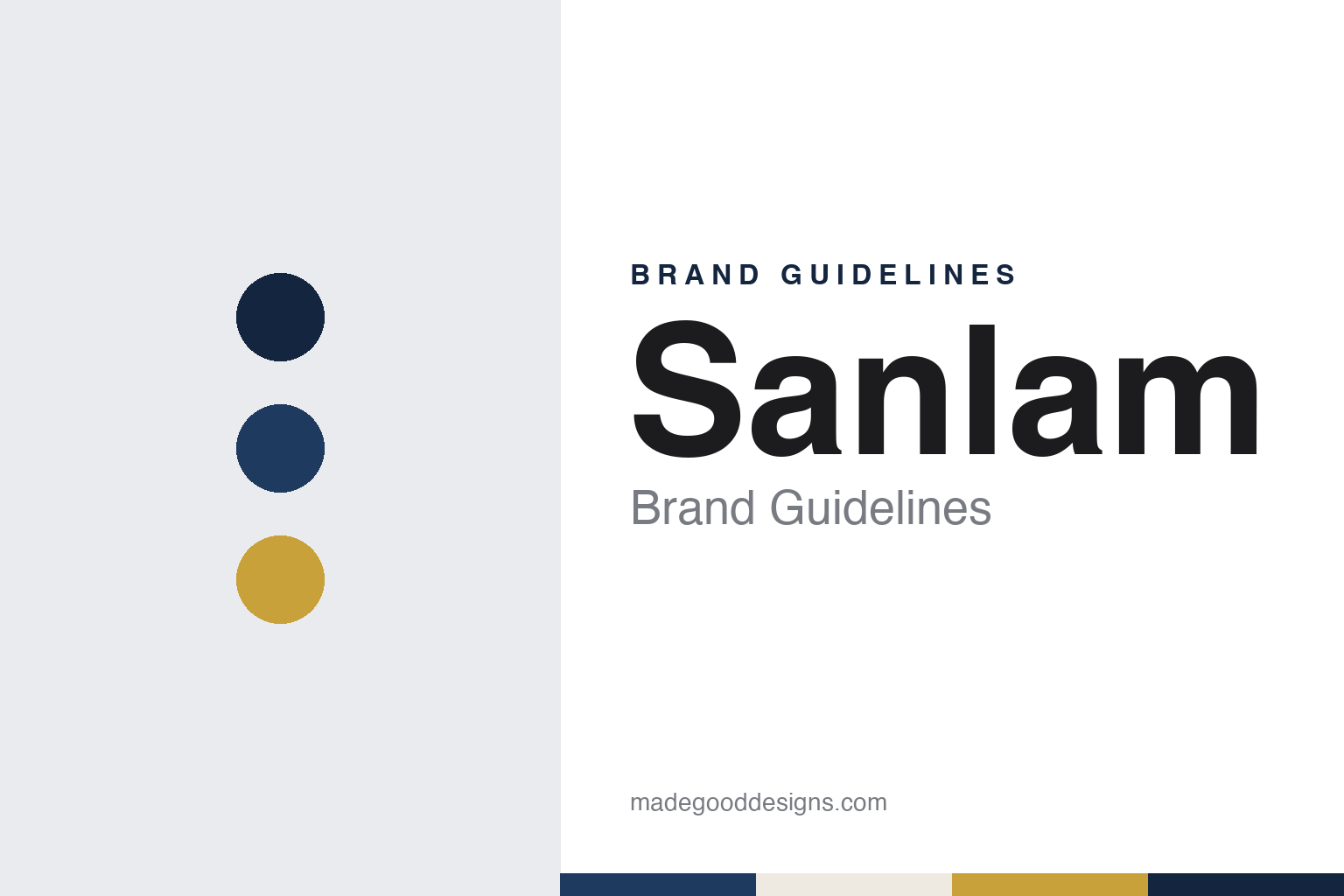
Two constants: a deep blue, navy and gold palette of our own and a plain corporate sans register. Abstract homage — not a Sanlam product or mark; no shield, logo or nameplate is reproduced.
A life office in Afrikaans
A meeting at the Royal Hotel and two companies in 1918.
Sanlam traces its start to December 1917, when, the company says, “a small group of Afrikaners and a Scotsman” met at the Royal Hotel in Cape Town to discuss forming a new company. What followed was two businesses rather than one. English Wikipedia says the Suid-Afrikaanse Nasionale Trust en Assuransie Maatskappij, or South African National Trust and Assurance Company, known as Santam, was registered on 28 March 1918. Its life assurance department was then turned into a separate company, the Suid-Afrikaanse Nasionale Lewens Assuransie Maatskappij, the South African National Life Assurance Company, registered on 8 June 1918. Afrikaans Wikipedia gives the same date. The name Sanlam is built from that long Afrikaans title.
For its first decades the life company sat under its sister. Santam remained the controlling shareholder until 1954, when, the company says, Sanlam became an independent mutual life assurance company and the largest single shareholder in Santam. English Wikipedia describes how the life company later became the spearhead of the group, while Santam stayed focused on short-term insurance.
Property became part of the story. Sanlam says it was the first investment company to use the leaseback model and was for a long time South Africa’s largest developer of shopping centres. Land was reclaimed at Roggebaai, on the Cape Town foreshore, to build the Sanlam Centre, which the company says was the tallest building in Africa when it opened in 1962.
New products followed. In 1985 Sanlam launched the One Policy, which the company describes as hugely popular for its flexibility and its range of payment options. In 1995, it says, its unit trust business set up OptiRandtrust and so became the first South African financial institution to let clients invest offshore; that business is now called Sanlam Collective Investments.
The largest change came in 1998, when Sanlam demutualised. English Wikipedia says it listed on the Johannesburg Stock Exchange and the Namibian Stock Exchange, turning from a mutual into a public company with share capital, Sanlam Life Insurance Ltd, with a separate company, Sanlam Ltd, set up as the parent of the group. The company calls the listing the largest initial public offering in South Africa’s history at the time. After demutualisation, it says, Sanlam Namibia began to do business as a full insurer.
Colour
A torch, a horseman and a lettered shield.
Sanlam’s own history gives two dated details about its marks. In December 1932 the company launched its first in-house magazine, Die Sanlam-Fakkel (fakkel is Afrikaans for torch), with what the company calls a striking cover showing a horseman, a flaming torch and the corporate shield. In 1968, when Sanlam turned fifty, the logo “took another new turn,” the company says, with the introduction of a shield carrying the letter S, which it describes as a symbol of security. The company’s pages do not set out a typeface or colour code for the mark, and the palette in this guide is our own.
The group itself is built from several brands. English Wikipedia lists five divisions: Sanlam Personal Finance, SanlamAllianz, Sanlam Investments, Sanlam Corporate and Santam, the short-term insurer in which Sanlam held 62.7 percent in 2026. The same article lists the group’s fields as life and general insurance, financial planning, retirement annuities, trusts, wills, asset management, investment and wealth, with operations across Africa and in India, Malaysia, the United Kingdom, the United States, Australia and the Philippines.
The company also presents itself through a list of firsts. Beyond the 1995 offshore unit trust, it says it launched Sanlam iTrade in 2006 as the first online trading portal in the life insurance industry. It describes its 2004 contract with Ubuntu-Botho, a broad-based empowerment partner, as one of the country’s most successful such transactions, and says the partnership was renewed in 2024 for a further ten years, to 31 December 2034.
Sanlam’s shares trade on the Johannesburg Stock Exchange, the Namibian Stock Exchange and A2X, according to English Wikipedia, and its head office is in Bellville, in the City of Cape Town. In September 2026, the same article says, Sanlam announced that it would start offering banking services in South Africa with GoTyme Bank from 1 November 2026, after regulatory approval, with a soft launch before a national rollout in 2027.
Typography
African insurers and their names.
Africa’s insurers often carry their history in their names. Some of the oldest were founded in Afrikaans or English and still trade under those words or their acronyms: Sanlam’s name is built from the Afrikaans title it was registered under in 1918, and Old Mutual’s comes from a nickname for a Cape Town society of 1845. Others work in Swahili- and French-speaking markets, and pan-African groups such as SanlamAllianz present their pages in both English and French.
The visual language is usually simple: a wordmark or a monogram, a shield or an emblem, and a small set of corporate colours, with greens, blues, reds and golds common across the sector. Few of these companies publish their colour codes or typefaces, so the palettes in these guides are our own interpretations rather than official values. Brand pages tend to lean on photography of families, workplaces and communities rather than on product images, because the products themselves are policies.
Those policies are organised in familiar ranges: life cover, health cover, motor and property cover, family cover, savings, retirement and investments, alongside business and corporate lines. Many groups sell through branches, tied agents and brokers as well as online, and several have moved into banking or mobile services; Old Mutual, for example, launched the digital-only OM Bank in 2025, and Sanlam announced a banking partnership in 2026. Mobile money and USSD menus are part of how some insurers reach customers who do not use apps.
Listed groups also speak through their reports. Integrated reports, results presentations and sustainability reports set out structure, ownership and strategy, and stock exchange listings in Johannesburg, Windhoek, Nairobi, Lagos and elsewhere keep a record of mergers and joint ventures. This guide sets out what those sources show for each company, and marks what rests only on a company’s own word.
Aa
A plain corporate sans for a group that speaks in Afrikaans, English and French. (Specimen set in Libre Franklin, a sans STAND-IN; NOT the Sanlam logo.)
SanlamAllianz
A joint venture with Allianz, launched in 2023.
Sanlam’s reach across Africa grew in steps. In 2018, English Wikipedia says, it concluded its acquisition of the Moroccan group SAHAM Finances, which made it, in that article’s words, Africa’s largest non-banking financial services group. In December 2021 the group entered talks with Allianz about combining their businesses in Africa outside South Africa, English and Afrikaans Wikipedia both say.
The result was SanlamAllianz, which the joint venture says officially launched in September 2023. Its website describes a business covering 25 African countries, from Morocco and Egypt to Namibia and Mozambique, in life and general insurance, assistance, third-party administration, asset management and retail credit, and offers its pages in English and French. In October 2025 The Independent, a Ugandan news magazine, reported that the SanlamAllianz brand had been launched to the Ugandan public at an event in Kampala, describing the venture as formed by Sanlam and Allianz in 2023.
The venture is still being assembled market by market. Its press page lists a March 2026 announcement that Sanlam Maroc and Allianz Maroc planned to merge, and in July 2026 Business Insurance, citing Middle East Insurance Review, reported that shareholders had formally approved the merger, with Sanlam Maroc absorbing Allianz Maroc.
At home, Sanlam’s links with Santam may also change. In October 2026, English Wikipedia says, Sanlam made an offer to acquire all of Santam, in which it already held a majority; the deal was announced in October 2026 and is subject to regulatory approvals, and it had not been completed at the time of writing.
For a design guide, Sanlam shows how a company can keep a name drawn from its founding language while trading under joint brands across a continent. Compare Santam, its sister company of 1918, and Allianz, its partner in SanlamAllianz. For this guide we use a deep blue, a navy and a gold with a sans, an unofficial interpretation; no product or logo is reproduced.
Explore & save
Keep Sanlam’s identity on hand — save it to a board in the Made Good inspiration library.
Sanlam identity set
Pin the deep blue, navy and gold palette and the plain corporate sans register to your own board.