ACLEDA Bank Brand Guidelines
A Phnom Penh NGO of 1993 that became a listed commercial bank.
Aa
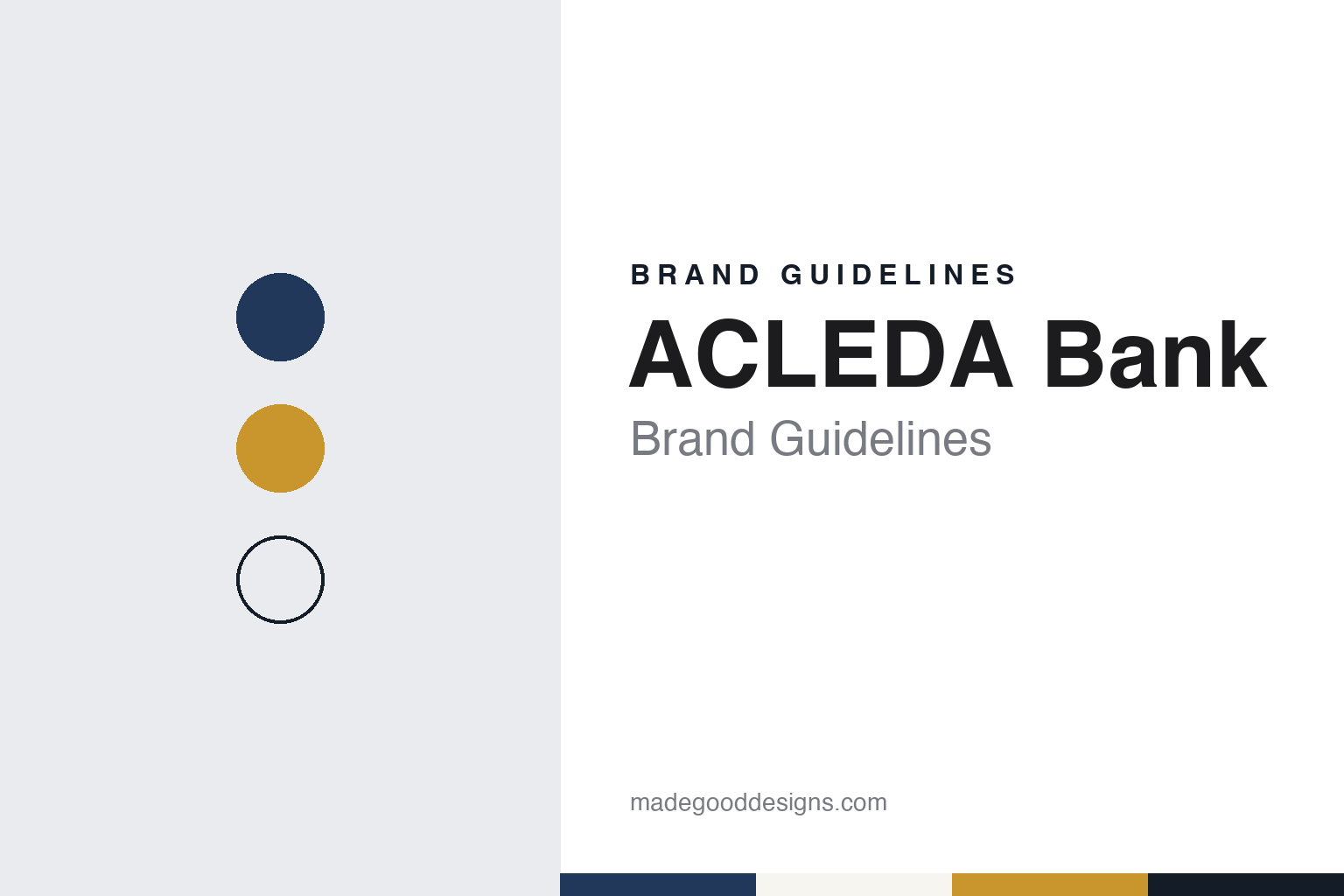
Two constants: a navy, gold and paper palette and a plain bilingual sans register. Abstract homage — not an ACLEDA Bank product or mark; no logo, card or sign is reproduced.
An NGO in Phnom Penh
A development project with an acronym for a name.
ACLEDA began in Phnom Penh in January 1993 as a non-governmental organisation. The name is an acronym for the Association of Cambodian Local Economic Development Agencies, according to English and French Wikipedia. Khmer Wikipedia says it was set up with support from the International Labour Organization and the United Nations Development Programme, to develop micro and small businesses through credit. In a February 2013 article for the German development magazine D+C, Anja Strautz of the German development financier DEG wrote that its early lending went to people rebuilding their livelihoods after years of conflict, including displaced people and former combatants.
As its network grew across the country, the organisation’s board and international partners decided to turn it into a bank, Khmer Wikipedia says, so that it could take public deposits and raise capital more widely to fund its microfinance work. A three-year transformation programme began in 1998, with support from USAID, the IFC-run Mekong Private Sector Development Facility and UNDP. The D+C article dates ACLEDA’s move into the formal sector to 1998, while Khmer and French Wikipedia give 2000 for its first banking licence.
On 7 October 2000 the National Bank of Cambodia licensed ACLEDA as a specialised bank, Khmer Wikipedia says. In that change the original NGO transferred its assets and its long-term donor loans to the new bank in return for 44.91 per cent of the shares; a staff association, set up so that employees could own part of the bank, bought 6.09 per cent; and the remaining 49 per cent went in equal parts to four foreign investors: the World Bank Group’s International Finance Corporation, Germany’s DEG, the Dutch development bank FMO and Triodos Bank, according to Khmer and French Wikipedia. D+C also names those four as the shareholders who joined in 2000.
Colour
A commercial licence, then Laos and Myanmar.
The second step came on 1 December 2003, when ACLEDA received a commercial banking licence from the National Bank of Cambodia, after tripling its capital, and took the name ACLEDA Bank Plc., Khmer Wikipedia says; French Wikipedia gives the same date, and D+C describes it as a universal banking licence obtained in 2003. From then on, the D+C article says, ACLEDA stayed in microfinance but also served small and medium-sized enterprises and private clients, collecting deposits from savers and lending them out.
Expansion abroad followed. ACLEDA opened its first foreign subsidiary, in Laos, on 8 July 2008, French Wikipedia says; English Wikipedia describes it as the first Cambodian bank to operate in that country. In Myanmar it applied for a microfinance licence in June 2012 and opened a subsidiary in 2013, with offices in the Yangon and Bago regions, according to English Wikipedia. D+C added in 2013 that bankers from other countries were being taught at ACLEDA’s training centre, which had support from the German development bank KfW; English Wikipedia lists a related ACLEDA Institute of Business. A brokerage arm, ACLEDA Securities, gave investors access through 21 of the bank’s branches when the Phnom Penh Water Supply Authority made Cambodia’s first initial public offering on the Cambodia Securities Exchange in March 2012, English Wikipedia says.
Ownership changed as the early development investors moved on. D+C reported in 2013 that DEG had sold its shares and was supporting the bank with long-term loans instead. English Wikipedia, giving the shareholder list as at 19 June 2019, says Cambodian interests including the staff held 51 per cent, and the remaining 49 per cent was held in equal parts by Sumitomo Mitsui Banking Corporation, COFIBRED, a subsidiary of France’s BRED Banque Populaire, ORIX Corporation and three funds managed by Triodos Investment Management. English Wikipedia also says ACLEDA was the first bank in Cambodia to be rated by Standard & Poor’s, and that on 25 September 2025 the agency kept its issuer credit rating at B+ with a stable outlook.
Typography
Microfinance lenders and how they present themselves.
Microfinance lenders present themselves less through products than through method. Grameen Bank’s website opens on its line “A bank for the poor” and describes loans made without collateral, with all transactions except disbursement handled at village-level centres. ASA International sets out the “ASA Model” on a page of its own, from the size of a branch to the rhythm of weekly or fortnightly collections. For these institutions the method is the brand.
Their websites are built around networks and products. They publish branch, client and village counts as dated figures, offer branch locators, and list named loans for small businesses, crops, livestock, housing and education, alongside savings accounts, pension schemes and insurance. Newer pages describe digital wallets and digital financial services, sometimes launched market by market. Where a lender’s pages show small shops, farms or field officers at work, this guide describes them in words rather than reproducing them.
Documentation is a large part of the look. Lenders publish annual reports, monthly reports, governance pages and pages on social performance or impact, and listed groups add investor sections and regulatory news. Regulators are part of the picture too: in Bangladesh, the economist Mustafa K Mujeri wrote in The Daily Star in 2025, non-governmental lenders are licensed by the Microcredit Regulatory Authority, set up under an act of 2006. Claims about what microcredit achieves are the lenders’ own, or those of prize committees and researchers, and are contested in the research literature.
This guide reads each lender from its own pages and from dated outside sources: who founded it, how its lending works, and how its name is used. The palettes here — warm oranges, greens and blues — are our own unofficial interpretations, not the lenders’ published values, and no logo, photograph or document is reproduced.
Aa
A plain sans that can sit beside Khmer script. (Specimen set in Kantumruy Pro, a sans STAND-IN; NOT the ACLEDA Bank logo.)
ACLEDA Bank
From an acronym to a listed share.
On 25 May 2020 ACLEDA Bank listed its shares on the Cambodia Securities Exchange. The Bangkok Post, carrying an AFP report that day, called it the first lender to trade on the exchange and the sixth company to join it since the bourse opened in 2011, after a garment factory, two state-owned ports and a special economic zone. The same report described ACLEDA as Cambodia’s largest commercial bank, said it had been operating since 1993, and said about 2,500 public investors became its shareholders on the first day.
The bank has since linked its network to payment systems beyond Cambodia. In June 2026 India’s public broadcaster News On AIR reported that the National Payments Corporation of India had partnered with ACLEDA Bank to launch acceptance of India’s Unified Payments Interface in Cambodia, letting Indian travellers pay by QR code, with a two-way corridor planned for a later phase. Through all of these changes, from a donor-backed association to a specialised bank, a commercial bank and a listed company, the organisation has kept the acronym it was given in 1993.
For a design guide, ACLEDA Bank shows how a lender can keep one short acronym through every change of legal form, from NGO to listed bank, and let the name carry its history. Compare BRI, the Indonesian bank with a long record of village lending, and Grameen Bank, the Bangladeshi microcredit bank. For this guide we use a deep navy, a warm gold and a paddy green with a sans, an unofficial interpretation; no product or logo is reproduced.
Explore & save
Keep ACLEDA Bank’s identity on hand — save it to a board in the Made Good inspiration library.
ACLEDA Bank identity set
Pin the ACLEDA Bank navy, gold and paper palette and the plain bilingual sans register to your own board.