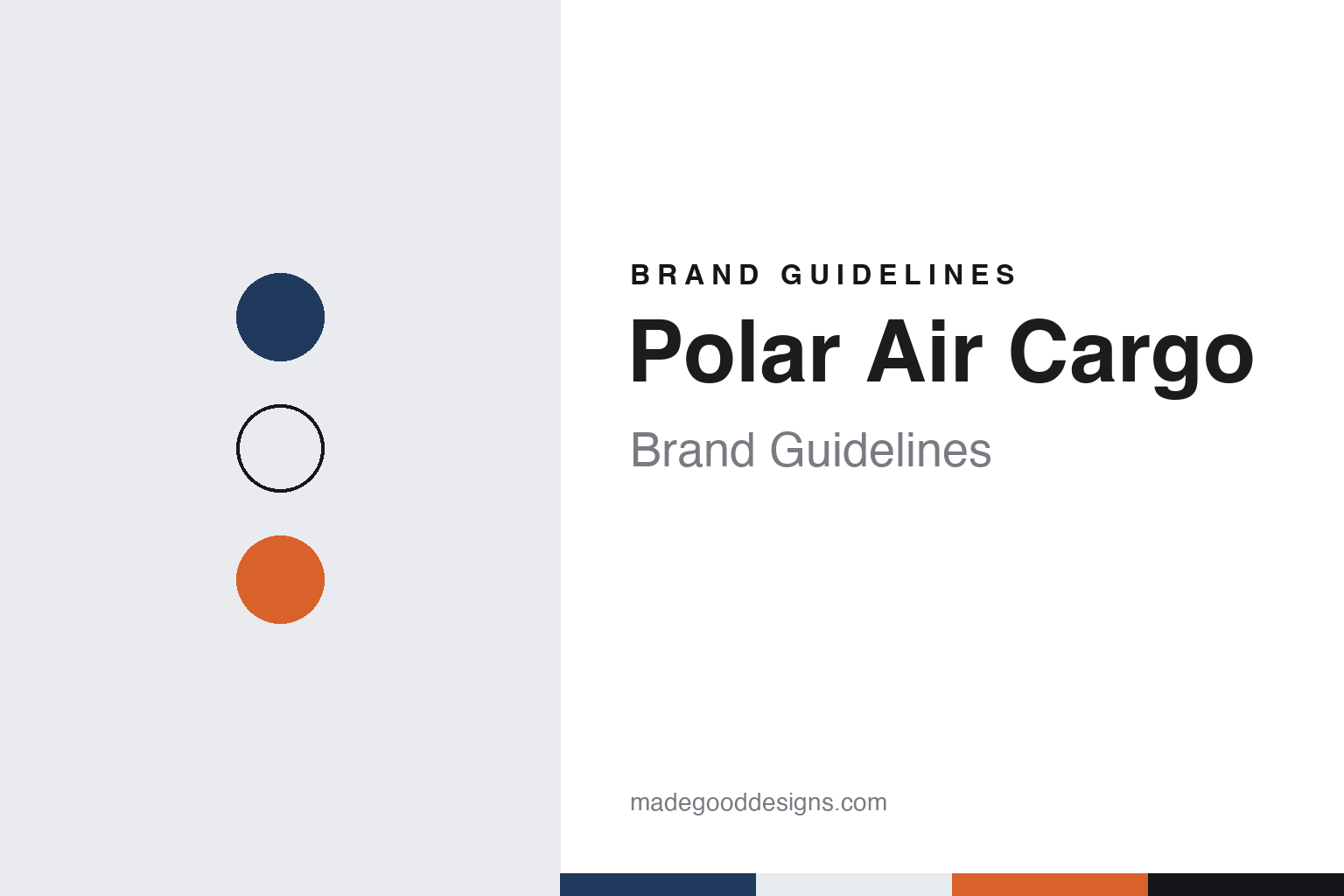
Polar Air Cargo Brand Guidelines
A 1993 freighter line that flew between a parent and a partner.
Aa
Two constants: a polar blue, ice grey and signal orange palette and a freight sans register. Abstract homage — not a Polar Air Cargo asset; no aircraft, livery or logo is reproduced.
A leased 747
One scheduled route out of New York.
Polar Air Cargo began in 1993. Its own history page says it was founded that year by NedMark Transportation Services, with Southern Air Transport and Polaris as limited partners, and that its first scheduled flight left New York on 13 May 1993: a leased Boeing 747-100 that called at Ireland, Moscow, Hong Kong and Columbus, Ohio, before returning to New York. English Wikipedia describes the start differently, as a joint venture between Southern Air Transport and GE Capital Aviation Services (GECAS) that began with charter flights in June 1993 and added scheduled services later. Both accounts agree on the year and on Southern Air Transport’s part.
Certification followed in 1994. Wikipedia says the Federal Aviation Administration certified Polar as a supplemental air carrier that year, and both Wikipedia and the company date its certification as a US scheduled all-cargo carrier to 4 July 1994. The company says NedMark changed its name to Polar Air Cargo, Inc. the same year, taking over Southern Air Transport’s initial role, and that Polar kept flying for Polaris while adding new customers. By 1996, the company says, Polar was one of the five largest all-cargo airlines, connecting every continent except Antarctica; that is its own description.
Ownership then changed hands. The company says GECAS acquired all of Polar in 1998 and that the fleet grew in the years that followed. Wikipedia’s fleet history lists Boeing 747-100SF, 747-200F and 747-200SF freighters in service between 1994 and 2007, and two 747-300SF aircraft leased from Atlas Air between 2002 and 2004. The company sums up the arc as growth from two leased 747-100s to an owned all-Boeing fleet of 747s, 767s and 777s.
Colour
Atlas, DHL and a 51/49 split.
In November 2001 Polar was acquired by Atlas Air Worldwide Holdings (AAWW), the parent of Atlas Air, according to Wikipedia. Inside the group Polar became the scheduled-service carrier, while Atlas Air leased Boeing 747-400 freighters to other airlines on an ACMI basis, meaning aircraft, crew, maintenance and insurance. AAWW entered Chapter 11 on 30 January 2004 and completed its restructuring in July 2004, Wikipedia says, citing Flight International.
The partnership that shaped Polar for nearly two decades began in 2007. Wikipedia says the purchase of a 49% stake by DHL Express was announced in October 2006. Polar’s website says that in 2007 AAWW formed a long-term strategic alliance with DHL Express, which took the 49% equity interest and gained access to capacity on Polar’s freighters, pairing DHL’s position in Asia with Polar’s US–Asia routes. Air Cargo News confirmed in February 2025 that Polar had been 51% owned by Atlas and 49% by DHL Express since 2007. FreightWaves described the working model in the same month: Polar sold scheduled express service, Atlas operated the aircraft, most of the space was reserved for DHL, which set the network, and Atlas marketed the rest to freight forwarders.
The network centred on the United States and Asia. Air Cargo News listed hubs at Cincinnati/Northern Kentucky and Los Angeles in May 2024, with Asian points including Shanghai Pudong, Hong Kong, Narita and Incheon, and Leipzig/Halle in Germany as its European call. The fleet changed with it: Wikipedia lists Boeing 747-400 freighters from 2000 to 2022, 767-300ERFs from 2014 until February 2024, and, latterly, 747-8Fs and 777Fs. Polar’s website lists cargo such as perishables, machinery, apparel, electronics and pharmaceuticals, and offers a special-loads service for oversized or unusual goods.
There was also a criminal case. In February 2025 FreightWaves reported that four former Polar executives had been sentenced to prison the previous year for accepting kickbacks from companies that provided services to Polar or were its customers, in exchange for favourable business deals. Air Cargo News wrote at the same time that the airline had since come under completely new management.
Typography
Cargo airlines in context.
A cargo airline sells something its customers rarely see: space in the dark of a main deck. Its identity therefore lives on the outside of the aircraft. A freighter has few or no cabin windows, so the fuselage reads as one long, clean surface, and the tail becomes the main signature. Across the category, tails are painted in strong, simple fields of red, blue, orange or grey that can be recognised from an apron or a ramp camera at a distance, with the name in large capitals along the side.
The aircraft themselves are part of the message. Freighter operators name their types openly, and widebody freighters such as the Boeing 747-8F and 777F are presented as capability rather than decoration: the nose door of a 747, the main-deck side door, the number of pallet positions. Fleet lists, with types, counts and specification sheets, sit near the top of many cargo airline websites, often next to the next aircraft on order.
The network is shown as a map. A hub sits at the centre, and lines run out to gateways on several continents, sometimes with the road-feeder trucks that carry freight on from the airport drawn in as well. Schedules are published as downloadable timetables, because the reader is usually a freight forwarder planning a booking rather than a traveller.
The rest of the visual language comes from the cargo. Pages on special cargo, from live animals and fresh produce to pharmaceuticals, dangerous goods and outsized machinery, each get their own name and photograph. Charter pages show unusual loads, and partner pages name the logistics companies and shippers for which aircraft are flown. For a designer, the category is a study in practical identity: few elements, large scale, and a register built for operations staff, not for passengers.
Aa
A freight sans for a scheduled-cargo name. (Specimen set in Archivo, a sans STAND-IN; NOT the Polar Air Cargo logo.)
Polar Air Cargo
The joint venture ends.
On 21 February 2025 the trade publication Cargo Facts reported that Atlas and DHL were closing Polar, and both companies confirmed that the joint venture would end. Atlas said the venture “no longer aligns with the strategic direction of either shareholder company,” FreightWaves reported on 22 February. Under the arrangement FreightWaves described, Atlas would keep Polar’s air operator certificate and redeploy the four Boeing 747-8 freighters flying for DHL through Polar with other customers under long-term contracts, while DHL took back the two Boeing 777 freighters it had contributed, with Atlas providing the crews, maintenance and insurance. Some operations and staff were to move to Atlas and others to DHL. Air Cargo News noted on 23 February that no closing date had been confirmed.
Polar’s website, still live in 2026 and signed “An Atlas Air Worldwide Holdings, Inc. Company,” says the joint venture concluded in 2025 and that Atlas Air Worldwide acquired the remaining equity in Polar. It says the Polar airline “continues to provide airline operations in some locations for certain services,” and lists a fleet of Boeing 747-8F and 777-200F aircraft. Wikipedia, citing Airliner World, gave Polar four aircraft in August 2025, two 747-8Fs operating for Atlas and two 777Fs operating for DHL, and describes it as a wholly owned subsidiary of Atlas Air Worldwide.
For a design guide, Polar Air Cargo shows how a carrier name can sit between a parent and a partner: a scheduled-cargo brand whose capacity was largely reserved for an express company. Compare Atlas Air, its parent’s airline, and DHL, its partner from 2007 to 2025. For this guide we use a deep polar blue, an ice grey and a signal orange with a sans, an unofficial interpretation; no product or logo is reproduced.
Explore & save
Keep Polar Air Cargo’s identity on hand — save it to a board in the Made Good inspiration library.
Polar Air Cargo identity set
Pin the Polar Air Cargo polar blue, ice grey and signal orange palette and the freight sans register to your own board.