Kredivo Brand Guidelines
The Indonesian credit app that grew a bank.
Aa
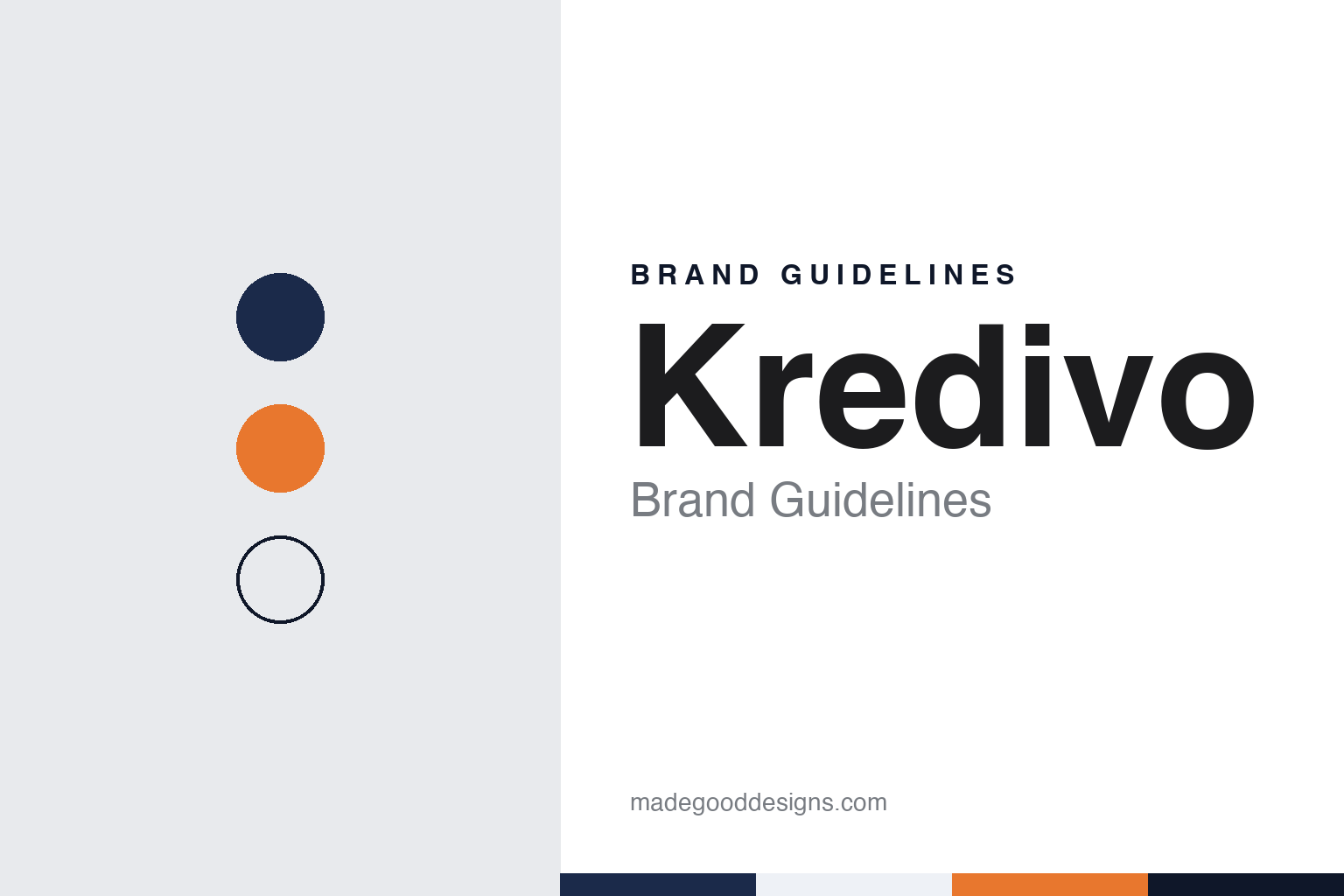
Two constants: an unofficial navy and orange palette and a modern sans register. Abstract homage — not a Kredivo product or mark; no app screen, card or logo is reproduced.
FinAccel
From a 2015 start-up to Kredivo Group.
Kredivo is a digital credit and buy now, pay later app that began in Indonesia. Its parent, then called FinAccel, was incorporated in December 2015 with a seed round led by Jungle Ventures, and Kredivo started operating in April 2016, when it made its first loan, according to the milestones on the group’s website; an instalment product followed that August. In September 2026 the group marked ten years of operation with a social and economic impact report written with the Demographic Institute of the Faculty of Economics and Business at Universitas Indonesia.
The group names Akshay Garg, its group chief executive, Alie Tan and Umang Rustagi as co-founders; Rustagi is president director of the Indonesian business. TechCrunch identified Garg as chief executive in 2023, and the Indonesian news site detik quoted him as FinAccel’s group CEO and co-founder in April 2022.
The parent took the Kredivo name in March 2023, when it closed a Series D round led by Mizuho, the group says. TechCrunch reported the round that month, described the company as “formerly known as FinAccel,” and said it served underbanked consumers in Indonesia and Vietnam. Earlier, in August 2021, the company had announced a plan to list in the United States through a merger with VPC Impact Acquisition Holdings II, a special-purpose acquisition company. It dropped the plan in 2022, “citing adverse market conditions,” TechCrunch reported, adding that there were no plans to revive it.
Group press releases are datelined Singapore. The Indonesian lending business, PT Kredivo Finance Indonesia, says on its website that it is licensed and supervised by OJK, Indonesia’s financial services authority.
Colour
Checkout credit, cards and cash loans.
Kredivo’s core product is credit at the checkout. The Indonesian site offers shoppers the choice of paying within 30 days or in instalments of 3, 6, 12, 18 or 24 months at merchants online and offline, and the group says Kredivo also offers personal loans “based on real-time decisioning.” By March 2017, the group says, it was live with Indonesia’s top five e-commerce merchants; its site today links to marketplaces such as Tokopedia, Shopee, Lazada and Blibli. The group also lists a “zero-click checkout,” launched in September 2019.
TechCrunch described the target customer in 2023 as underbanked consumers — people with bank accounts but little access to credit — and reported that Kredivo judges creditworthiness with data from sources such as telecoms, e-commerce and bank accounts, focusing on urban, salaried workers. Cards extend the idea. The group says it launched a physical pay-later card, the Flexi Card, with Bank Sahabat Sampoerna in December 2021, and the Infinite Card, a virtual card with Mastercard and Bank BNI, in April 2022.
The name also appears away from shopping sites. The group says Kredivo became the first pay-later payment method for MRT Jakarta rides in October 2024 and added pay-later payment on Transjakarta services in November 2025. It runs KrediFazz, a peer-to-peer cash lending service that received an OJK licence in October 2021, and in February 2025 it bought the earned-wage-access platform GajiGesa, the group says.
The group’s stated vision is financial services that are “fast, affordable and widely accessible, wrapped up in a beautiful UX.” Its three principles are Convenience, Transparency and Access, and under the first it says: “We obsess over simplicity and minimalism.” In 2017, the group says, Kredivo was a Google Play “Hidden Gem” pick, and it lists IDC’s “Information Visionary” award in 2018 and 2019.
Typography
Design and documentation.
Buy now, pay later providers sell a way of paying rather than a product, so most of their design work happens on other companies’ pages. A shopper meets the brand as a small wordmark beside a price, a badge in a row of card logos, or a button at the end of a checkout. Many of these marks are short, rounded names set in bright mint, pink, purple or plain black, and several providers publish kits for merchants with approved logos, lockups and banners in light and dark versions.
The second surface is the app. Providers show purchases as instalment schedules: a row of dates and amounts, a progress marker for payments made, and reminders of what is due next. Many also run shopping directories of participating merchants, with categories, deals and store pages, which turn the payment brand into a place to browse.
The third surface is explanation. Providers typically keep a page on how payments work, usually a sequence of three or four steps, and most carry dense small print: who the lender is, which licences apply, what fees and rates can be charged and where to go for help with hardship. In several markets these disclosures are set by regulators, and merchant kits often spell out which phrases need a full disclaimer and which claims may not be made at all.
The last surface is the investor page. Several providers are listed companies, in Sydney, New York or both, and publish results, presentations and announcements alongside their consumer sites. This guide sets out what can be checked about each provider — who founded it, who owns it, where it operates and how regulators have treated it — and gives company statements as the company’s own.
Aa
A modern sans for a credit app. (Specimen set in Manrope, a sans STAND-IN; NOT the Kredivo logo.)
Krom
An older bank, relaunched as an app.
The group’s move into banking began with Bank Bisnis Internasional. On 4 April 2022 FinAccel said that, once the purchase closed that week, its Indonesian unit would own 75 per cent of the bank, with the previous majority owners, a family, keeping a significant minority stake, and with all regulatory approvals, including OJK’s, obtained, detik reported. The group lists the majority purchase as completed in April 2022. The bank is now Krom Bank Indonesia, listed in Jakarta under the code BBSI, the group says.
The consumer app, Krom, launched in Jakarta on 27 February 2024, detik and The Jakarta Post reported. The Post described Krom as a youth-focused digital banking app run by the subsidiary PT Krom Bank Indonesia. At the launch the bank’s president director said the company behind it had existed for six decades, and its head of marketing described features such as choosing one’s own account number and time deposits with terms set by the day, from 14 to 180 days, detik reported. The group said in June 2026 that Krom had passed one million accounts by April 2026.
Outside Indonesia, Kredivo entered Vietnam in August 2021 through a joint venture with Phoenix Holding, the group says. On 6 May 2026 it announced that it was acquiring nearly all of Timo, a Vietnamese digital banking platform founded in 2015 and developed with BVBank. According to that release, Timo was to keep its own brand, Kredivo’s Vietnamese business was to be renamed Timo Credit, and the group described itself as operating in Indonesia, Vietnam and Thailand. Investors named in the release include Mizuho Bank, Amazon, Square Peg Capital and Cathay Innovation.
For a design guide, Kredivo shows how a credit brand can carry one name across checkout financing, cards and transport fares while giving its bank a separate name. Compare Akulaku, whose pay-later service TechCrunch also listed among Kredivo’s competitors, and Atome, the Singapore-based app named in the same report. For this guide we use a deep navy, a warm orange and a soft paper white with a sans, an unofficial interpretation; no product or logo is reproduced.
Explore & save
Keep Kredivo’s identity on hand — save it to a board in the Made Good inspiration library.
Kredivo identity set
Pin the unofficial navy and orange palette and the modern sans register to your own board.