Tabby Brand Guidelines
The Gulf pay-later app that moved from Dubai to Riyadh.
Aa
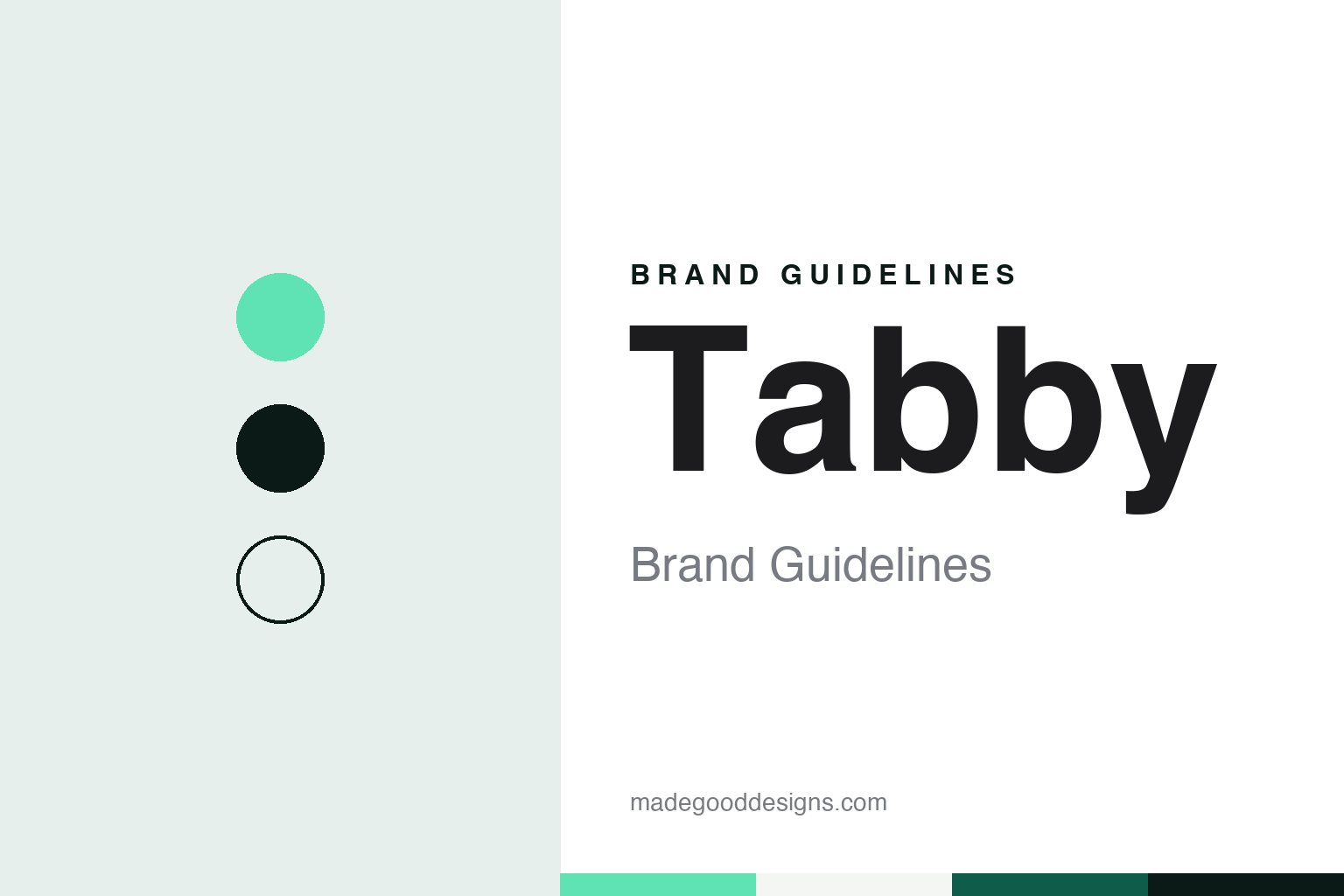
Two constants: a mint, pine and near-black palette and a rounded modern sans register. Abstract homage — not a Tabby product or mark; no app screen, logo or card is reproduced.
Out of Namshi
An answer to cash on delivery.
Tabby was founded in late 2019 by Hosam Arab, who had previously led the fashion e-commerce company Namshi as chief executive, TechCrunch reported in August 2021. The service went live in early 2020. At the time it was a Dubai-based company, and Arab described it as a pay-later product aimed specifically at the economic problems of the Middle East and the wider Gulf. Later reports call him Tabby’s co-founder and chief executive.
The idea came from a problem Arab had seen at Namshi. He told TechCrunch that around 80 percent of the transactions there had been paid in cash, which made online retail hard to scale. A pay-later service, in his view, could give shoppers another way to pay digitally, and that in turn would interest retailers. Tabby integrates with merchants so that their customers can pay in instalments, online and in physical stores.
The company grew quickly in its first years. By August 2021 Tabby said it had more than 400,000 active shoppers and more than 2,000 brands and small businesses on the platform, including Adidas, IKEA and Marks & Spencer. It also tested new markets: TechCrunch reported in October 2023 that Tabby had left Egypt in February 2023, six months after entering it, citing macroeconomic reasons.
The same October 2023 report recorded a bigger change: Tabby, “previously headquartered in Dubai,” was now based in Riyadh. By February 2025 TechCrunch described it as Riyadh-headquartered and working across Saudi Arabia, the UAE and Kuwait, the three markets it still names today.
Colour
From split payments to a money app.
Tabby began with split payments at checkout and has added products around them. On its UAE website it now calls itself “the money app” for spending, sending and saving, and advertises splitting a purchase into four payments or into up to 12 monthly payments. TechCrunch reported in February 2025 that Tabby had moved from online payments into in-store payments and then into wider retail and financial services, listing the Tabby Card for flexible spending, Tabby Plus, a subscription rewards programme, and Tabby Shop, which offers longer payment plans.
The same report said Tabby had acquired Tweeq, a Saudi digital-wallet provider, in 2024, as part of a move into digital accounts, payments and money-management tools. Arab told TechCrunch that customers who once used Tabby only for e-commerce or point-of-sale spending now, especially in the UAE, used it to manage everyday spending, from a coffee to a taxi ride.
In July 2026 Tabby launched Tabby Cash in the UAE, an account and card it presents as an alternative to a debit account; it opened to all UAE residents on 1 September 2026. On 10 November 2026 Fintech News Middle East reported that Tabby Cash had passed one million accounts in the UAE, a figure from the company, which added options to send money abroad, pay telecom, utility and transport bills and receive refunds into the balance.
Tabby’s scale figures come from the company. It told TechCrunch in February 2025 that it had 15 million customers and more than 40,000 brands and merchants, among them Amazon, IKEA, Samsung and Noon. In November 2026 it said it served more than 25 million customers and 70,000 brands across its three markets.
Typography
How pay-later brands present themselves.
Buy now, pay later providers sell a way of paying rather than a product, so most of their design work happens on other companies’ pages. A shopper meets the brand as a small wordmark beside a price, a badge in a row of card logos, or a button at the end of a checkout. Many of these marks are short, rounded names set in bright mint, pink, purple or plain black, and several providers publish kits for merchants with approved logos, lockups and banners in light and dark versions.
The second surface is the app. Providers show purchases as instalment schedules: a row of dates and amounts, a progress marker for payments made, and reminders of what is due next. Many also run shopping directories of participating merchants, with categories, deals and store pages, which turn the payment brand into a place to browse.
The third surface is explanation. Providers typically keep a page on how payments work, usually a sequence of three or four steps, and most carry dense small print: who the lender is, which licences apply, what fees and rates can be charged and where to go for help with hardship. In several markets these disclosures are set by regulators, and merchant kits often spell out which phrases need a full disclaimer and which claims may not be made at all.
The last surface is the investor page. Several providers are listed companies, in Sydney, New York or both, and publish results, presentations and announcements alongside their consumer sites. This guide sets out what can be checked about each provider — who founded it, who owns it, where it operates and how regulators have treated it — and gives company statements as the company’s own.
Aa
A rounded modern sans — the register of a consumer money app. (Specimen set in Manrope, a sans STAND-IN; NOT the Tabby logo.)
Tabby
Licences, funding rounds and a listing plan.
Tabby’s regulatory standing has grown with its products. In October 2023 Arab told TechCrunch that Saudi Arabia already had a buy now, pay later permit. In April 2026 Fintech News Middle East reported that Tabby had secured a pay-later licence from the Saudi Central Bank (SAMA) the previous year, and that the Central Bank of the UAE had granted it a Stored Value Facilities licence, allowing it to hold customer funds and launch accounts and cards. In June 2026 SAMA granted Tabby consumer and SME finance licences, after the company graduated from the central bank’s regulatory sandbox; the longer consumer plans use a Shariah-compliant Murabaha structure, and the SME licence lets Tabby provide working capital to merchants on its platform.
The company has been funded through a series of private rounds. TechCrunch reported a Series B led by Global Founders Capital and STV in August 2021, and a Series D in October 2023 led by Wellington Management, which it said made Tabby the first fintech startup unicorn in the Gulf. A Series E co-led by Blue Pool Capital and Hassana Investment Company followed in February 2025; TechCrunch then called Tabby the most valuable fintech in the Middle East and North Africa. In October 2025 a secondary sale of existing investors’ shares to buyers including HSG and Boyu Capital was completed, with no new shares issued. A further round led by Blue Pool Capital was announced in September 2026; it was subject to regulatory approvals, including from SAMA, and was not reported as completed at the time of writing.
A stock-market listing remains a plan. In February 2025 Arab told TechCrunch that the company’s intention to go public on the Saudi Exchange was unchanged. In September 2026 the company was still raising money through private rounds.
For a design guide, Tabby shows how a pay-later brand can widen into a full money app while keeping a short, friendly name at every step. Compare Tamara, another Gulf pay-later brand, and Klarna, the Swedish pay-later company. For this guide we use a mint, a deep pine green and a near-black with a sans, an unofficial interpretation; no product or logo is reproduced.
Explore & save
Keep Tabby’s identity on hand — save it to a board in the Made Good inspiration library.
Tabby identity set
Pin the Tabby mint, pine and near-black palette and the rounded modern sans register to your own board.