Trinity Industries Brand Guidelines
From Dallas butane tanks to tank cars, hoppers and a railcar lease fleet.
Aa
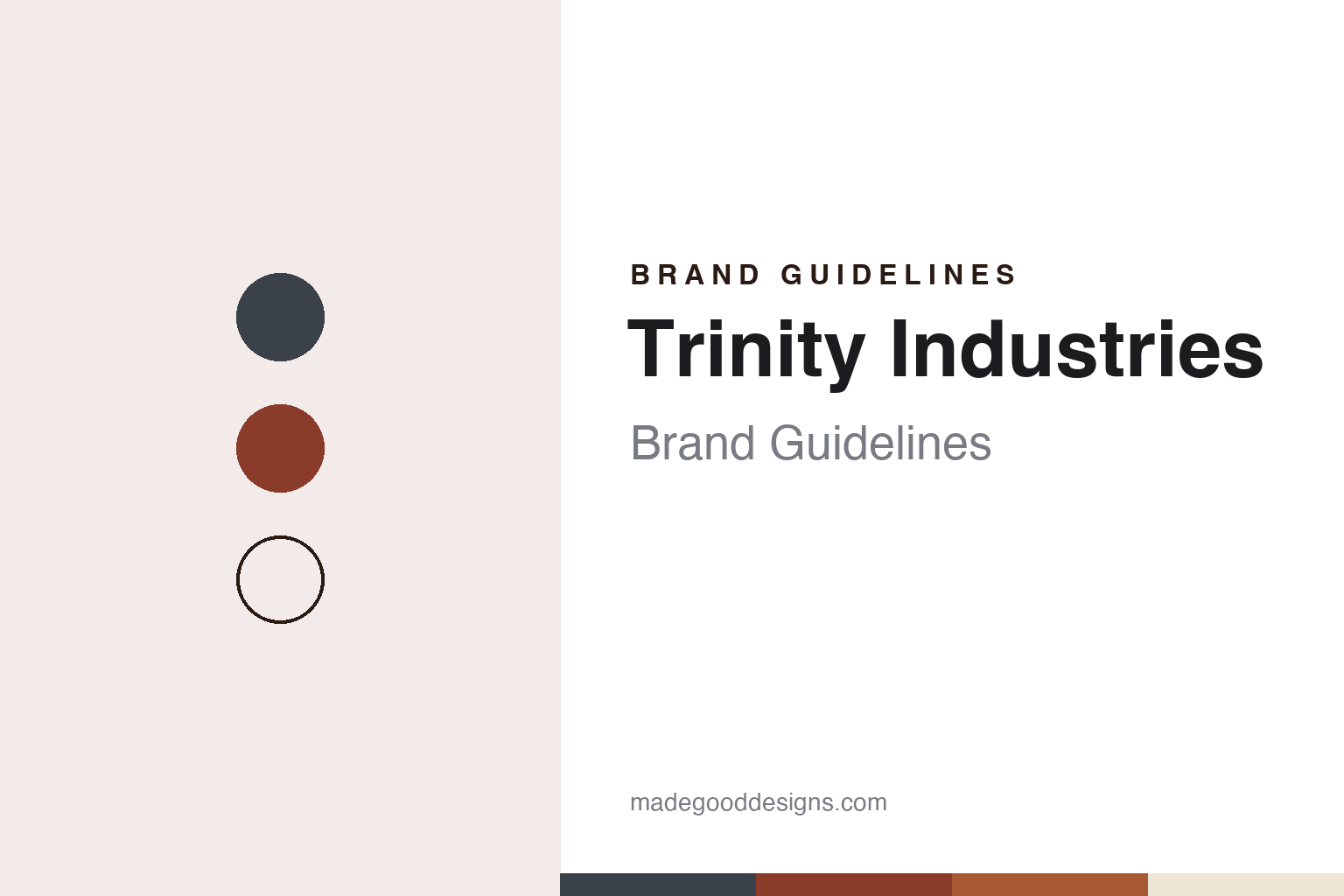
Two constants: a Trinity brick, steel and cream palette and a sturdy sans register. Abstract homage — not a Trinity Industries product or mark; no railcar, logo or nameplate is reproduced.
Trinity Steel
Butane tanks in a Dallas County mule barn.
Trinity Industries grew out of tank-making in Dallas. The Handbook of Texas, in an entry by Diana J. Kleiner last revised in 2020, says the company was first known as Trinity Steel, founded by C. J. Bender in Dallas in 1944, and that it made butane tanks in a Dallas County mule barn; English Wikipedia dates Trinity Steel to 1933. Both say W. Ray Wallace, an engineering graduate of Louisiana Tech, joined in 1946 as the seventeenth employee.
In 1958 Trinity Steel merged with Dallas Tank, a competitor founded in 1933, to form a public company, and Wallace was chosen to lead it, the Handbook says. Between 1961 and 1970 Trinity added 15 companies or plants, most of them tank makers, and by 1962 it employed about 490 people. It took the name Trinity Industries in 1967 to reflect its widening product lines and began trading on the New York Stock Exchange under the symbol TRN in 1972. Its structural steel work, the Handbook adds, included Texas Stadium and New York’s World Trade Center, and by 2000 it ran 76 plants in 21 states, Mexico, Romania, Argentina and Brazil.
Railcars came first through subcontracting and then through acquisitions. English Wikipedia says Trinity fabricated tank car bodies for other builders from 1966 and began producing complete tank and covered hopper cars in 1978. In 1984 it took over the railcar designs and plants of Pullman-Standard and the railcar designs of General American Transportation, then bought Greenville Steel Car in 1986, Ortner Freight Car in 1987 and Thrall Car in 2001. English Wikipedia says these purchases made Trinity the largest railcar manufacturer in North America. Its plant at Monclova, Mexico, has been part of its network since 1998, the company told Railway Supply in 2026.
Colour
TrinityRail, leasing and spin-offs.
The railcar business took a single name in 2002–2003, when Trinity consolidated its car-building operations as Trinity Rail Group and then shortened that to TrinityRail, according to English Wikipedia. The same source lists products from hopper cars and gondolas to autoracks and tank cars, sold to railroads, leasing companies and shippers. Leasing sits alongside manufacturing: a Railcar Leasing and Management Services Group provides fleet management, maintenance and leasing, English Wikipedia says, and the Handbook of Texas notes that Trinity already held two railcar leasing subsidiaries in the 1980s, when it built cars in Oklahoma City and Longview, Texas.
The group has also shed businesses. In August 2006 it sold its European rail business to International Railway Systems, English Wikipedia says, and in November 2018 its Energy Equipment Group, including Trinity Containers, was spun off as Arcosa, a separate company listed on the New York Stock Exchange. Trinity Highway Products was sold to the private-equity firm Monomoy Capital in November 2021; Holden America of Montreal was bought in December 2022 and RSI Logistics in March 2023.
Trinity Highway Products had been the subject of a federal False Claims Act case, filed in 2012, over changes to its ET-Plus guardrail end terminal. English Wikipedia says a jury found against Trinity in October 2014 and a district court entered judgment in 2015; the Fifth Circuit Court of Appeals reversed that judgment and entered judgment in Trinity’s favour in 2017.
Railway Supply reported on 1 November 2026 that the Dallas-based railcar lessor and manufacturer delivered 2,030 railcars in the third quarter of 2026, booked 2,190 orders, ended September with lease fleet utilisation of 97.0% and completed 355 of what it calls sustainable railcar conversions. Jean Savage is chief executive, a post she has held since 2020, according to English Wikipedia.
Typography
How lessors present themselves.
Railcar and wagon lessors sell something most people only glimpse from a level crossing: the use of a freight car for a fixed term. Their identities are built for two audiences at once. One is the shipper, railroad or logistics firm signing a lease; the other is everyone who sees the car roll past, because the lessor’s name is often painted on the side of the wagon itself. The car body works as a moving sign for the company that owns it.
Their websites tend to be organised around equipment. Fleet pages are usually split by wagon type, so tank cars for chemicals and mineral oils sit apart from covered hoppers, gondolas, flat cars, boxcars and intermodal wagons, and locomotives often have their own section. Photographs show the cars as the companies publish them, side-on and in yards or on the main line, with the lessor’s name and markings clearly legible.
Service pages carry much of the rest. Lessors describe maintenance workshops and field teams, training on handling wagons, and customer portals where fleets can be managed online. Several now present telematics: sensors and wireless devices that report a car’s location, condition and cargo status in near real time. Sustainability pages make the case for rail freight more broadly, and some describe the conversion or rebuilding of older cars.
Several of these companies are listed or owned by infrastructure investors, so investor pages, quarterly results and fleet counts take up a large share of what they publish. Palettes in this category are often restrained, with blues, reds, greens, greys and black recurring as our interpretation of the sector rather than as any company’s official colours. The guides that follow use tones of our own choosing.
Aa
A sturdy sans for a builder’s name. (Specimen set in Libre Franklin, a sans STAND-IN; NOT the Trinity Industries logo.)
Trinity Industries
One parent, a one-word rail brand.
Trinity’s names are layered. The parent company is Trinity Industries, traded on the New York Stock Exchange as TRN since 1972, while the railcar business has used the one-word name TrinityRail since 2002–2003. The 2018 spin-off moved the container and energy-equipment lines into Arcosa, a separately named company, and the 2021 sale took the highway-products business out of the group.
The work itself is heavy industry: tank cars, covered hoppers and gondolas built at plants that, over the decades, included Oklahoma City, Longview in Texas and Monclova in Mexico, according to the Handbook of Texas and Railway Supply. In the third quarter of 2026, Railway Supply reported, Trinity sold part of its Longview facility. Before the spin-offs the group ranged wider still: in the 1980s, the Handbook says, its marine subsidiary Equitable Shipyards built LASH barges and riverboats, and Trinity also made containers for fertilizer and liquefied petroleum gas; it re-entered the wind tower structure business in 2004.
For a design guide, Trinity Industries shows a builder’s identity carried from Dallas tank-making into a railcar maker and lessor with a one-word rail brand. Compare GATX, the Chicago lessor whose railcar designs Trinity acquired in 1984, and BNSF, a North American freight railroad. For this guide we use a Texas brick red, a steel grey and a tank cream with a sturdy sans, an unofficial interpretation; no product or logo is reproduced.
Explore & save
Keep Trinity Industries’s identity on hand — save it to a board in the Made Good inspiration library.
Trinity Industries identity set
Pin the Trinity brick, steel and cream palette and the sturdy sans register to your own board.