Beacon Brand Guidelines
The rail lessor that let one yellow letter carry its name.
Aa
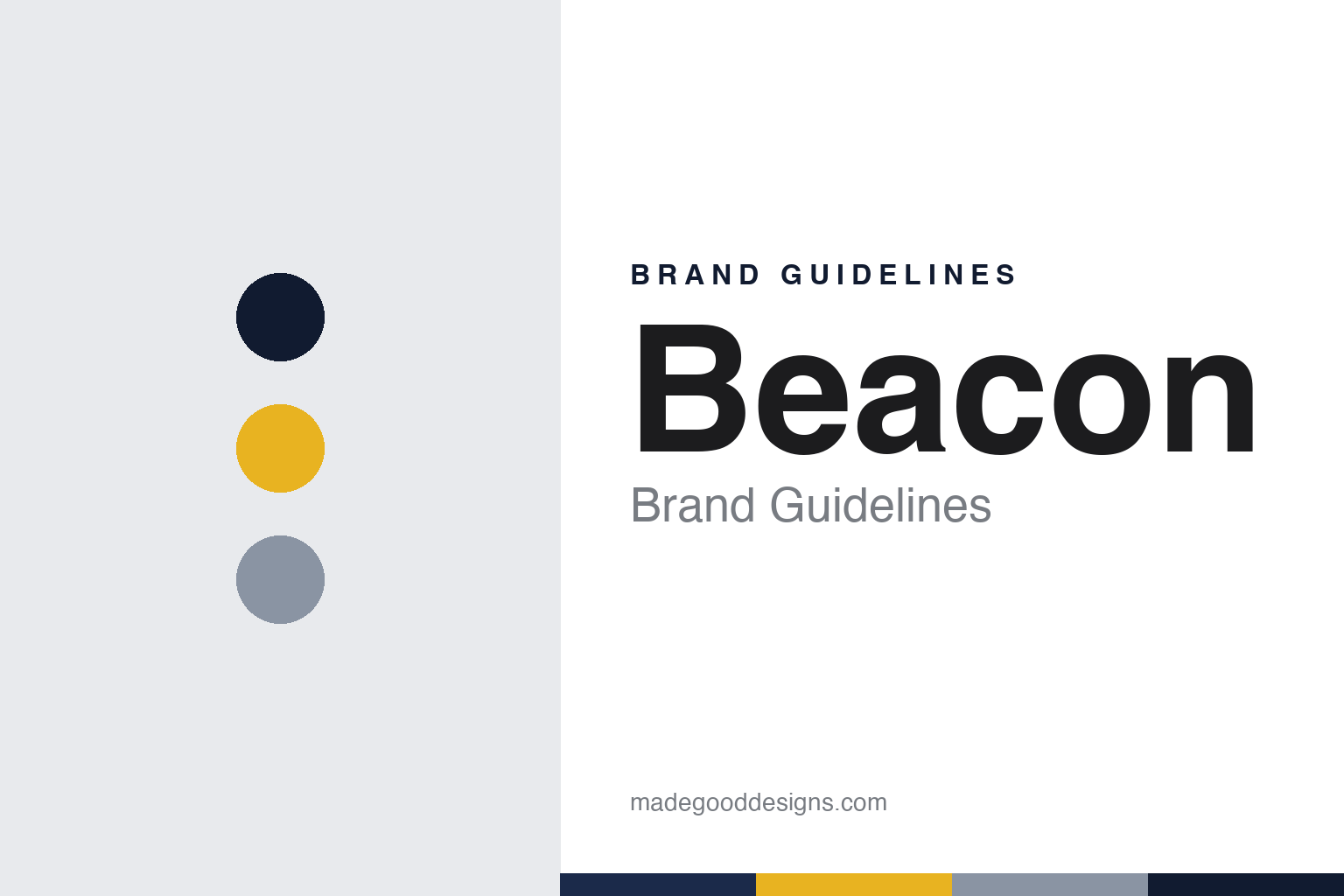
Two constants: a night blue, lamp yellow and grey palette and a geometric sans register. Abstract homage — not a Beacon product or mark; no train, logo or wordmark is reproduced.
From Allco to Beacon
A Japanese bank’s new rail lessor.
Beacon grew out of the European rolling-stock leasing business of the Australian group Allco Finance Group. In May 2008 Japan’s Mitsubishi UFJ Financial Group bought that business, English Wikipedia says, citing British rail trade magazines of 2008, and in January 2009 it was renamed Beacon Rail. The company itself gives 2008 as the year it was established. Its first fleet, Wikipedia says, was 15 Class 66 diesel locomotives, 12 Bombardier TRAXX locomotives and 15 coal wagons.
The name came with a picture. Beacon’s original logo was based on a lighthouse on Brewster Island, off Boston, Massachusetts, according to Fellowship, the agency that later redrew the brand; the company’s office then moved from Boston to London. Growth came quickly. In 2009, Wikipedia says, Beacon bought the European business of HSBC Rail with 20 EMD JT42CWR locomotives, and the same year, with the British freight operator Direct Rail Services, it approached the Swiss builder Stadler about a bespoke locomotive based on Stadler’s Eurolight design. That project became the Class 68; 32 were delivered from 2014, followed by ten electro-diesel Class 88 locomotives that share most of their components.
Ownership changed twice in the next decade. Mitsubishi sold Beacon to Pamplona Capital Management in 2014, and in 2017 it was bought by JPMorgan Chase, English Wikipedia says, citing International Railway Journal and Modern Railways; at that point the portfolio held 190 locomotives, 944 freight wagons and 20 passenger trains. By the time of its 2020 rebrand, Fellowship says, Beacon leased nearly two thousand locomotives, freight wagons and passenger vehicles in 17 countries from offices in Luxembourg and London. The group’s parent today is Beacon Rail Lux Holdings, the Luxembourg company named on its website and in UK competition filings.
Colour
Locomotives, passenger trains and wagons.
Beacon leases all three main kinds of rolling stock. Its website lists 776 locomotives, 515 passenger vehicles and 1,100 freight wagons (figures shown in November 2026), operating in 18 countries “from Portugal to Poland, Sweden to Croatia,” from four main offices. Its services page offers dry, “soggy” and full-service leases, sale-and-leaseback of older fleets, financing for new-build trains and funding for refurbishment; under a dry lease, it says, the lessee handles day-to-day maintenance and Beacon the heavy maintenance.
Passenger stock arrived later than engines. Wikipedia records 20 Class 313 electric units leased to Southern from 2012, the purchase of Ascendos Rail Leasing in 2016, 67 double-deck coaches in service in Denmark by 2016 and, with TransPennine Express and the Spanish builder CAF, 66 Mark 5A coaches to be hauled by Class 68s. In 2017 Beacon bought the Class 220 and 221 Voyager diesel units from subsidiaries of Lloyds Bank and Royal Bank of Scotland, and in 2018 it bought 67 locomotives from Colas Rail, Wikipedia says. In March 2026 Beacon said it had signed a contract to lease 22 Class 222 trains to ScotRail.
Freight engines remain central. In April 2022 GB Railfreight and Stadler announced an order for 30 Class 99 bi-mode heavy freight locomotives, Wikipedia says, and the UK Competition and Markets Authority noted in January 2026 that the 30 Class 99s are owned by Beacon and already leased to GB Railfreight. Beacon marked the launch of the first two at an industry event in Peterborough in December 2025. Earlier, in February 2023, it bought 12 BB 27300 locomotives at auction from the Paris-region Transilien fleet, according to Wikipedia.
Typography
How railcar and wagon lessors present themselves.
Railcar and wagon lessors sell something most people only glimpse from a level crossing: the use of a freight car for a fixed term. Their identities are built for two audiences at once. One is the shipper, railroad or logistics firm signing a lease; the other is everyone who sees the car roll past, because the lessor’s name is often painted on the side of the wagon itself. The car body works as a moving sign for the company that owns it.
Their websites tend to be organised around equipment. Fleet pages are usually split by wagon type, so tank cars for chemicals and mineral oils sit apart from covered hoppers, gondolas, flat cars, boxcars and intermodal wagons, and locomotives often have their own section. Photographs show the cars as the companies publish them, side-on and in yards or on the main line, with the lessor’s name and markings clearly legible.
Service pages carry much of the rest. Lessors describe maintenance workshops and field teams, training on handling wagons, and customer portals where fleets can be managed online. Several now present telematics: sensors and wireless devices that report a car’s location, condition and cargo status in near real time. Sustainability pages make the case for rail freight more broadly, and some describe the conversion or rebuilding of older cars.
Several of these companies are listed or owned by infrastructure investors, so investor pages, quarterly results and fleet counts take up a large share of what they publish. Palettes in this category are often restrained, with blues, reds, greens, greys and black recurring as our interpretation of the sector rather than as any company’s official colours. The guides that follow use tones of our own choosing.
Aa
A geometric sans with round, open letters. (Specimen set in Outfit, a sans STAND-IN; NOT the Beacon logo.)
Beacon
A yellow ‘O’ and a bigger fleet.
The current identity dates from July 2020. Fellowship says the work began with interviews with the senior team and key stakeholders, a survey of all staff and a selection of clients, and a brand workshop. It then shortened the trading name from Beacon Rail Leasing to Beacon and drew a modern wordmark with an illuminated yellow ‘O’ made of three concentric circles, meant to illustrate the word beacon and to suggest parallel railway tracks. The agency also produced a website in four languages with an interactive fleet area of technical illustrations and bespoke icons, along with values posters, staff ID cards, office signage in London and an exhibition stand for the InnoTrans rail fair. The legal company names still carry “Beacon Rail”.
The largest change came in 2026. On 24 July 2025 Beacon Rail Lux Holdings agreed to buy Eversholt UK Rails, the Competition and Markets Authority’s decision says; the authority opened its inquiry on 28 November 2025 and cleared the deal on 9 January 2026, noting that both companies lease passenger trains and freight locomotives in Great Britain and that Beacon also owns freight wagons. Beacon announced on 21 January 2026 that Eversholt Rail was now part of Beacon.
For a design guide, Beacon shows how a lessor can carry one plain word and one symbol across locomotives, passenger trains and wagons: a wordmark in which a single letter does the work of a logo, and a fleet shown in technical illustrations. Compare the French locomotive lessor Akiem and the rolling-stock lessor Railpool. For this guide we use a deep night blue, a lamp yellow and a ballast grey with a geometric sans, an unofficial interpretation; no product or logo is reproduced.
Explore & save
Keep Beacon’s identity on hand — save it to a board in the Made Good inspiration library.
Beacon identity set
Keep the Beacon night blue, lamp yellow and grey palette and the geometric sans register for your own board.