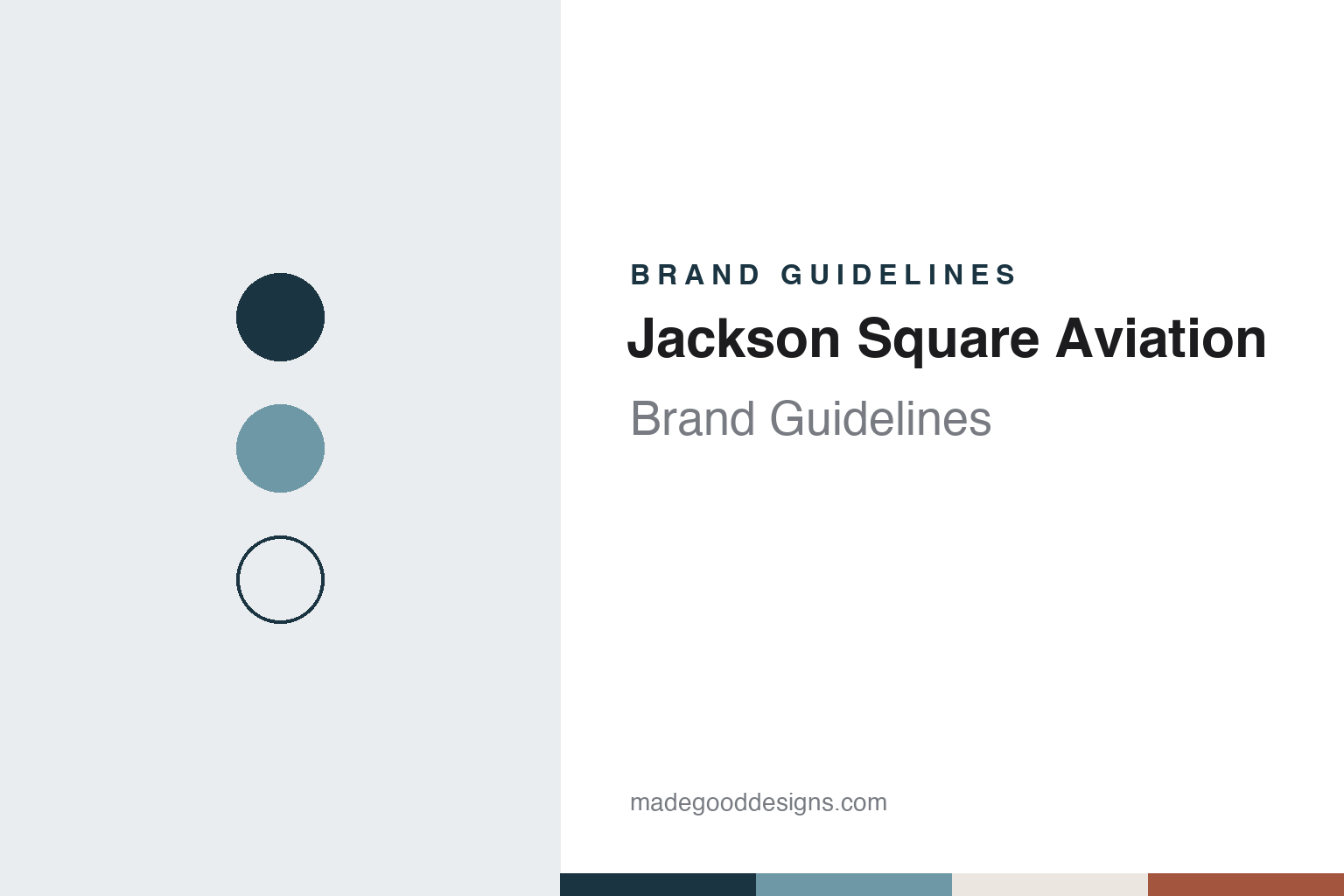
Jackson Square Aviation Brand Guidelines
A 2010 San Francisco lessor inside a Tokyo leasing group.
Aa
Two constants: a slate, fog blue and brick palette and a civic sans register. Abstract homage — not a Jackson Square Aviation asset or mark; no aircraft, logo or livery is reproduced.
A 2010 start
A young lessor backed by Oaktree Capital.
Jackson Square Aviation, usually shortened to JSA, is a commercial aircraft lessor with offices in San Francisco and Dublin. Its own history timeline dates the company to 2010, when it was founded with an initial equity injection from the investment firm Oaktree Capital and acquired its first aircraft for lease. The timeline names Rich Wiley as a co-founder and its first chief executive.
The company grew quickly in its first years, according to that timeline. In 2011 it opened an office in Singapore and closed its first export credit facility with European export credit agencies, for three aircraft; the company says it was one of the youngest companies to obtain that kind of approval. In 2014 it reached its 100th aircraft, a Boeing 737 for Pegasus Airlines, took delivery of its first Boeing 787 and opened a Dublin office.
The ownership changed in 2013. JSA says it was acquired that year by Mitsubishi UFJ Lease & Finance, the Tokyo leasing company now called Mitsubishi HC Capital. The Dublin office followed the integration of MUL Aviation Capital, the Japanese group’s existing aircraft business, into JSA. In 2015 Toby Bright succeeded Rich Wiley as president and chief executive, and in 2019 Kevin McDonald became chief executive, the timeline says. McDonald is still named as chief executive in the company’s 2026 press releases.
Both the shorter jsa.com address and the longer jacksonsquareaviation.com address lead to the same company website.
Colour
Operating leases for Airbus and Boeing jets.
JSA describes its business as anchored in operating leases, complemented by targeted financing for airlines replacing or growing their fleets. Its fleet page lists aircraft it owns or has committed to buy across seven families: the Airbus A220, A320, A330 and A350 and the Boeing 737, 787 and 777, the last a single 777 freighter. The A320 family is the largest group on that page, followed by the 737. As of 31 March 2026, the company says, its owned, committed and managed fleet stood at 344 aircraft with 64 airlines in 34 countries.
The timeline marks the firsts. JSA lists its first A320neo delivery in 2016, its first Boeing 737 MAX 8 commitment in 2017, and in 2018 its first direct order with Boeing and its first A350-900. In 2015 it closed its first large-scale aircraft sale, a 14-aircraft deal with Cheung Kong. In 2019 it signed an agreement to buy a large portfolio of aircraft from GECAS, in 2021 it arranged its first finance lease, for an Airbus A321neo flown by Pegasus Airlines, and in 2022 it added its first A220. By 2023 it counted 300 aircraft acquisitions and 100 aircraft sales since it began.
The newest step is an Airbus order. On 12 March 2025 eTurboNews reported that JSA had confirmed a firm order for 50 aircraft from the A320neo family, its first direct order with Airbus, which made the lessor a new Airbus customer; the report described JSA as operating under the Mitsubishi HC Capital group. In a press release dated 20 July 2026, JSA said it had chosen both CFM International LEAP-1A and Pratt & Whitney GTF engines for aircraft from that order. In its fiscal-year 2025 review, published in April 2026, the company said it had placed its whole 737 MAX order book with airlines and added six new customers.
Typography
How aircraft lessors present themselves.
Aircraft lessors sell nothing to the travelling public. They buy commercial jets, lease them to airlines and sell them on, so their identities are built for airlines, lenders and investors rather than passengers. Their websites tend to open with a short line of figures — aircraft owned and managed, airline customers, countries — dated to the end of a reporting quarter, as Aircastle and Aviation Capital Group both do.
The aircraft themselves carry other companies’ colours. A lessor’s jet flies in its customer’s livery, so the photographs on lessors’ sites and in their press releases show airlines’ paint schemes rather than the lessor’s own. Aviation Capital Group announced in September 2026, for example, that it had delivered the first Boeing 737-8 in Trinity Airways’ new identity. Fleet pages list aircraft by type, and order-book pages count commitments from the manufacturers years ahead.
Customer pages are often walls of airline logos, sometimes grouped by region, and services pages explain the business in plain terms: operating leases, sale-and-leaseback deals in which a lessor buys an airline’s new aircraft and leases it back, trading in mid-life aircraft, and managing aircraft for other owners. Engines are a business of their own; trade reports describe lessors balancing engine use across their fleets, and some groups plan to expand into engine leasing.
Many of these companies are owned by banks, trading houses or investment firms, and their investor pages — results, fact sheets, credit ratings and bond reports — carry as much weight as the leasing pages. For the guides in this group we use navy, teal and silver tones with sans and serif stand-ins, an unofficial interpretation chosen for a finance-led sector; no company’s logo, livery or photograph is reproduced.
Aa
A civic sans for a San Francisco and Dublin lessor. (Specimen set in Libre Franklin, a sans STAND-IN; NOT the Jackson Square Aviation logo.)
Jackson Square Aviation
Part of a Tokyo leasing group.
The owner has itself changed shape. Mitsubishi HC Capital’s corporate history traces one side of the group to Diamond Lease, established in 1971, which merged with UFJ Central Leasing in 2007 to form Mitsubishi UFJ Lease & Finance. In 2021 that company merged with Hitachi Capital and took the name Mitsubishi HC Capital. JSA’s shareholder page says the group is listed on the Tokyo Stock Exchange, that its principal shareholders include Mitsubishi Corporation and MUFG, and that it leases cars, property, rail cars, ships, aircraft engines and aircraft.
Inside the group, JSA has a sister company: Engine Lease Finance, an engine lessor based in Shannon, Ireland, which is also owned by Mitsubishi HC Capital, according to JSA. JSA says it runs a dual headquarters, with its main offices in San Francisco and Dublin, a growing presence in Singapore, staff in Dubai and Lima, and a shareholder team in Tokyo. Its website greets visitors with the line “Here for the long haul,” and its about page says the fleet has grown since 2010 with young Airbus and Boeing aircraft.
JSA’s about page names the group’s other businesses in North America as CAI International, PNW Railcars, Mitsubishi HC Capital America and Engine Lease Finance. Its history page also counts milestones in fleet value and aircraft numbers year by year, from the first aircraft in 2010 to the 300th acquisition in 2023, and the company publishes its annual results as a review of the fiscal year, as it did for fiscal 2025 in April 2026.
For a design guide, Jackson Square Aviation shows how a lessor can keep its founding name and its short JSA initials after a change of owner. Compare SMBC Aviation Capital, another lessor with a Japanese parent and a Dublin base, and Aviation Capital Group. For this guide we use a harbour slate, a fog blue and a brick red with a sans, an unofficial interpretation; no product or logo is reproduced.
Explore & save
Keep Jackson Square Aviation’s identity on hand — save it to a board in the Made Good inspiration library.
Jackson Square Aviation identity set
Pin the Jackson Square Aviation slate, fog blue and brick palette and the civic sans register to your own board.