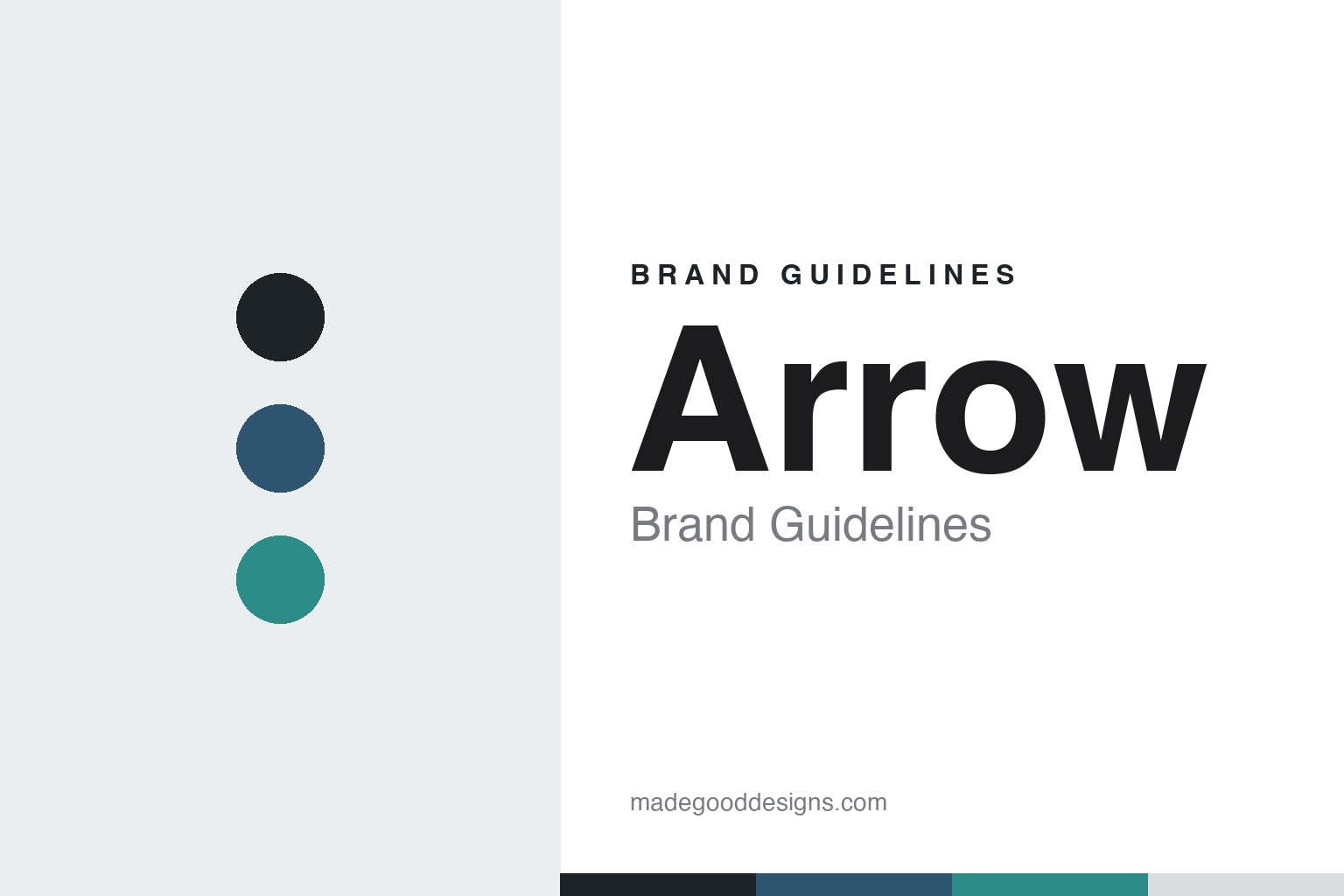
Arrow Brand Guidelines
The London shipbroker founded by shipbrokers in 1990.
Aa
Two constants: an Arrow charcoal, steel and teal palette and a Capitalised sans register. Abstract homage — not an Arrow product or mark; no logo or wordmark is reproduced.
Built by shipbrokers
A London firm from 1990.
Arrow, which sets its name in capitals as ARROW on its website, says it was founded in London in 1990 as “a shipbroking firm built and established by shipbrokers.” The UK company register supports the date: Arrow Shipping (U.K.) Limited, an active private company in London, was incorporated on 17 January 1990, according to Companies House. A second company, Arrow Chartering (UK) Limited, was incorporated on 28 January 1992 and is registered at the same London address.
The group has kept that founding line in its own words. Its shipping pages describe a business “established and privately owned by shipbrokers 35 years ago.” Its Modern Slavery Act statement, dated 30 April 2025, says that “for more than 25 years” the group has grown and consolidated its position, and describes it as one of the largest independent shipbroking groups; the website’s current wording calls it one of the largest privately owned shipping and energy brokerages. Those are the company’s own descriptions.
The name most often used in the shipping press, Arrow Shipbroking Group, belongs to a separate company in the register. Arrow Shipbroking Group Limited was incorporated in May 2002 as Arrow Trading Limited and took its present name in December 2019, Companies House shows; it is listed as a non-trading company. The register also lists Arrow companies for futures, asset finance, capital and energy markets at the group’s London address. The 2025 statement names Arrow Shipping (U.K.) Limited as the group’s principal parent company and London as its headquarters, and the website says the business remains privately owned by shipbrokers.
Colour
Desks, research and seventeen offices.
Arrow Shipping, the broking side, lists its work as sale and purchase, newbuilding, freight derivatives, dry bulk and tanker chartering. Its shipping pages break that into divisions: Capesize, Geared and Panamax for dry cargo; tankers; LPG; sale and purchase; freight derivatives; and Capital, Research and Valuations. The Modern Slavery Act statement adds asset finance and an in-house derivatives brokerage for freight futures, and describes a research division that gathers and analyses global data for the group, its associated companies and its clients.
That research is quoted in the trade press. In March 2026 Hellenic Shipping News, carrying a Korean report, cited Arrow Shipbroking Group, “a global ship brokerage,” for a forecast that the newbuilding ordering cycle would peak only in the mid-2030s, with 46,000 vessels expected to be built over 15 years as ships delivered in the 2009–2012 building boom come up for replacement.
The group says it employs “400 plus professionals across 17 international offices.” Its locations page lists London, Athens, Geneva, Monaco, Copenhagen, Hamburg and Genoa in Europe; Dubai; Singapore, Hong Kong, Shanghai, Tokyo, Seoul, Bangkok and New Delhi in Asia; Sydney; and Houston. London, Singapore and Dubai carry the widest spread of desks on that page, from tankers and dry bulk to sale and purchase and energy derivatives. In Greece the group works through Arrow Shipping Hellas SA, whose workplace policies are posted in Greek and English in the group’s legal library.
In Asia the group also uses the name Arrow Asia. In August 2025 Hellenic Shipping News reported that the Singapore Maritime Foundation had launched the sixth MaritimeONE Case Summit, a case competition for students at Singapore’s universities and polytechnics, with sponsors including Arrow Asia, the Maritime and Port Authority of Singapore, NorthStandard and Ocean Network Express. Philipp Schulte-Westhof, managing director of Arrow Asia, was quoted on the importance of nurturing young talent and of working with the student teams to help develop the next generation of shipping experts.
Typography
Design and documentation.
Shipbrokers arrange charters and ship sales rather than make products, and their websites lean on age, reach and research. Many London houses put a long founding date close to the name: Clarksons traces its business to 1852, and Braemar counts more than fifty years since its 1971 start. This guide reads the category through a sober register of navy, deep red and stone with plain wordmarks, an unofficial interpretation rather than any firm’s own colours.
The websites tend to be organised by market. Clarksons and Braemar both split their chartering pages into desks for tankers, dry cargo, gas and containers, with sale and purchase alongside, and both run derivatives teams that trade freight futures. At Clarksons, offshore and renewables appear as further desks, so a visitor can go straight to the market they trade.
Research is the second pillar. Clarksons runs Clarksons Research as its own business line, with data platforms sold by subscription, while Braemar keeps a research team next to its broking desks and a news and insights section. Market reports, forecasts and conference talks give these firms a public voice between deals, and trade publications such as gCaptain and The Maritime Executive have reported their outlooks and results.
Office maps and careers pages complete the picture. Clarksons says it has more than 70 offices in 26 countries, and Braemar lists tanker desks from London and Madrid to Houston, Geneva and Singapore. Both publish trainee broker programmes for graduates and newcomers, and Clarksons adds summer internships in London and Oslo. The guides that follow look at how each house presents its history, its markets and its people.
Aa
A capitalised sans for a one-word name. (Specimen set in Archivo, a sans STAND-IN; NOT the Arrow logo.)
Arrow
Shipping and Energy Markets.
In 2024 the group added a second business, Arrow Energy Markets, known as AEM, which the website says “commenced business in 2024” and which offers specialist broking in energy commodity derivatives. AEM says its clients include major oil companies, independent refiners, state-owned entities, banks and investment funds. It has its own website and publishes its own terms of business for the UK, Singapore, the Dubai International Financial Centre and Australia. A section 172 statement posted in the group’s library is issued by Arrow Energy Markets (Holdings) Limited for the year ended 31 December 2024. The website now presents the group in two halves, Shipping and Energy Markets, each with its own page and its own list of offices and desks.
The group’s public identity is spare. The website sets the name in capitals throughout its menus and headings, and its legal library, with terms of business, a code of business ethics and conduct, modern slavery statements, whistleblowing policies and MIFIDPRU disclosures, sits in the main menu beside the shipping and energy pages. The group lists the values it says it has held since it began as “integrity, discretion, innovation and excellence,” and describes its brokers as offering market reporting from in-house research and consultancy teams.
For a design guide, Arrow shows how a broker founded in 1990 can present itself through a single capitalised word and a clear list of desks rather than a long founding date. Compare Braemar, another London shipbroker, and Fearnleys, the Oslo broker whose history runs back to 1869. For this guide we use a charcoal, a steel blue and a sea teal with a sans, an unofficial interpretation; no product or logo is reproduced.
Explore & save
Keep Arrow’s identity on hand — save it to a board in the Made Good inspiration library.
Arrow identity set
Pin the Arrow charcoal, steel and teal palette and the Capitalised sans register to your own board.