Howe Robinson Brand Guidelines
An 1883 City of London name that became an employee-owned broking house.
Aa
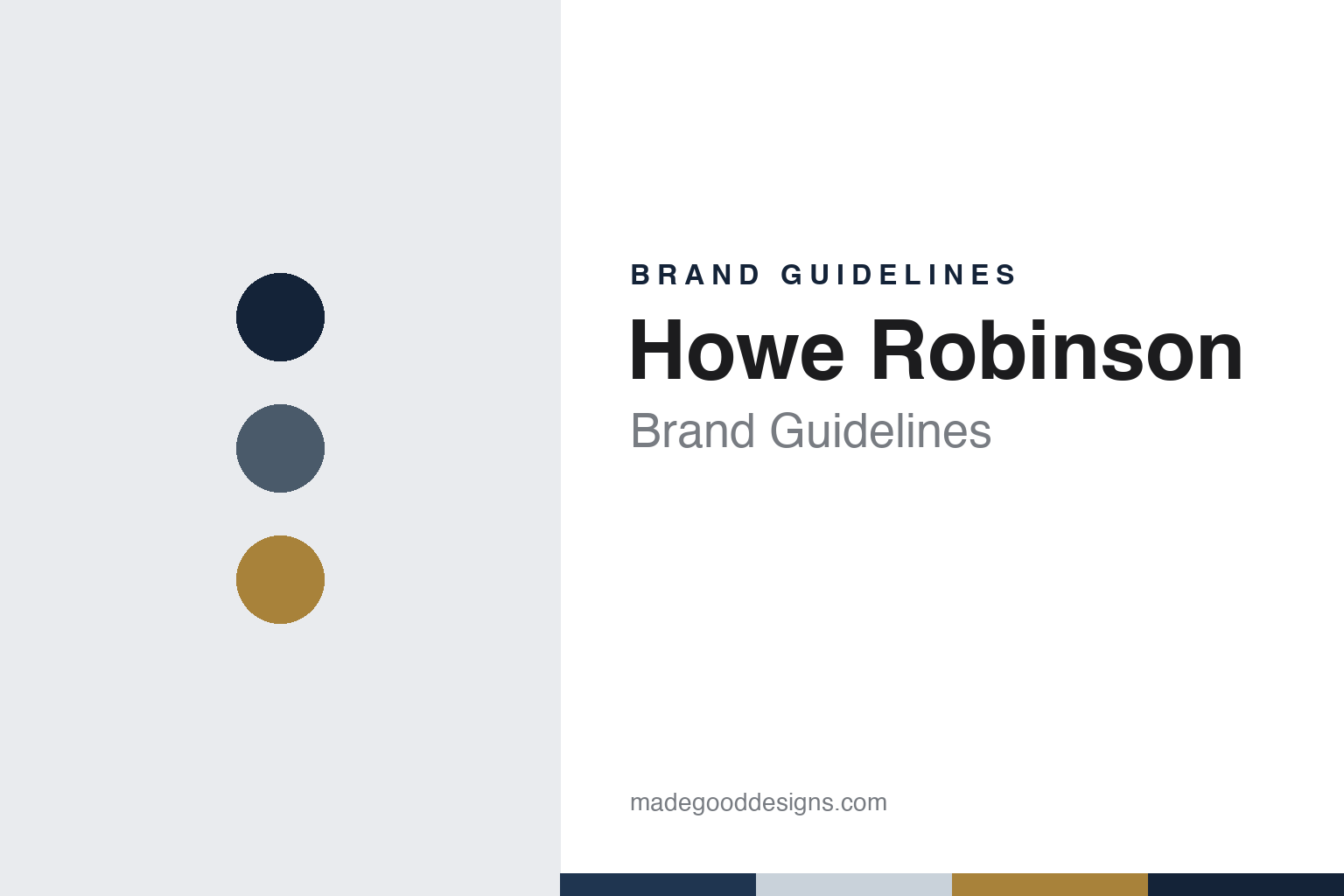
Two constants: a harbour navy, slate and brass palette and a plain broking sans register. Abstract homage — not a Howe Robinson asset; no logo, wordmark or report is reproduced.
Howe Robinson and Co
A City of London name from 1883.
Howe Robinson traces its name to the City of London in the 1880s. The company says its group “can trace its origins to the foundation of Howe Robinson and Co Ltd in the City of London in 1883,” and a Bloomberg report republished by gCaptain in November 2014 gave the same year, saying Howe Robinson “was started in London in 1883.” The UK companies register today lists a Howe Robinson and Company Limited incorporated in 1974.
For most of its history the firm was a London broking house that grew by buying other brokers. Its website says it expanded both organically and through a series of acquisitions, naming the businesses of Lambert Bros, Killick Martin, Erlebach Shipbrokers, R. B. Hunt and Partners, Angus Graham and Partners, and Shyvers Savoy Shipping. Its dry cargo page says the firm “has maintained its global presence in the dry cargo market since the late 1800s.”
By 2014 the business had a Singapore parent. Bloomberg’s November 2014 report named it Howe Robinson Group Pte. Ltd. and, citing the firm’s website at the time, described a house of more than 100 brokers in six offices, specialising in dry cargo and container shipbroking.
That month the London broker ICAP plc said it was in talks to combine its shipbroking unit with Howe Robinson, with the new company set to operate from the second quarter of 2015, Bloomberg reported. A Reuters report republished by gCaptain placed the talks in a run of broker deals that year, including Clarksons’ approach to the Norwegian broker RS Platou and the July 2014 merger of Braemar Seascope with ACM Shipping. In January 2016 Reuters reported that ICAP’s shipping business had completed its tie-up with Howe Robinson the previous year.
The company dates the result to April 2015: the Howe Robinson businesses merged with ICAP Shipping, which brought in Capital Shipbrokers, Island Shipbrokers and J E Hyde, to form Howe Robinson Partners. The UK register shows Howe Robinson Partners (UK) Limited incorporated in London in February 2015.
Colour
Dry cargo first, then every other desk.
Howe Robinson Partners describes itself as domiciled in Singapore and as “one of the largest privately owned shipbroking houses” — its own description. Its about page counts more than 370 employees, including more than 240 brokers; its careers page, updated in December 2025, gives more than 200 brokers. The homepage lists 16 offices, with cities from Singapore, Hong Kong and London to Bergen, Copenhagen, Hamburg, Dubai, New Delhi, Tokyo, New York, Houston, Shanghai, Gibraltar, Geneva and Athens. Ownership is the point the company stresses most: it says Howe Robinson Partners is wholly owned by its employees, more than half of whom are shareholders.
The desks follow the freight markets. The website lists dry cargo, containers, tankers, specialised tankers, LNG and offshore as broking areas, with sale and purchase, newbuildings, recycling, marine evaluations, and research and consultancy alongside. Dry cargo has the longest history at the firm: the company says more than 100 brokers in 13 offices work on it, covering ships from Capesize down to Handysize and cargoes from grain, iron ore and coal to cement and wood products, under contracts that run from spot charters to contracts of affreightment, time charters and bareboat charters. Smaller units sit within it — a mini-bulker desk, a cement desk, and Shyvers Savoy, which the company describes as a chartering agent for mineral sands and feedstocks used by the titanium dioxide and ceramics industries.
Research is part of the offer. The firm issues a weekly dry cargo report, and the trade press quotes it: in February 2026 SAFETY4SEA reported the report’s view that Pacific Panamax grain trade was set for further growth that year. The consultancy side includes MSI, Maritime Strategies International, which the website says has worked for banks, shipowners, shipyards, investors and insurers for more than 30 years with sector reports, forecasting models and vessel valuations; in 2016 SAFETY4SEA quoted the Howe Robinson Partners chairman, also an MSI board member, at the launch of an MSI forecasting tool. A valuation unit, HRPME, says it values around 4,000 bulkers, tankers, LNG carriers and containerships a year.
Its brokers also sit on the market’s own bodies. In December 2024 SAFETY4SEA reported that Guy Hindley, managing partner of Howe Robinson’s dry cargo division and a member of the Baltic Exchange Council since 2019, would become chairman of that council from 1 January 2025.
Typography
How shipbroking houses present themselves.
Shipbrokers arrange charters and ship sales rather than make products, and their websites lean on age, reach and research. Many London houses put a long founding date close to the name: Clarksons traces its business to 1852, and Braemar counts more than fifty years since its 1971 start. This guide reads the category through a sober register of navy, deep red and stone with plain wordmarks, an unofficial interpretation rather than any firm’s own colours.
The websites tend to be organised by market. Clarksons and Braemar both split their chartering pages into desks for tankers, dry cargo, gas and containers, with sale and purchase alongside, and both run derivatives teams that trade freight futures. At Clarksons, offshore and renewables appear as further desks, so a visitor can go straight to the market they trade.
Research is the second pillar. Clarksons runs Clarksons Research as its own business line, with data platforms sold by subscription, while Braemar keeps a research team next to its broking desks and a news and insights section. Market reports, forecasts and conference talks give these firms a public voice between deals, and trade publications such as gCaptain and The Maritime Executive have reported their outlooks and results.
Office maps and careers pages complete the picture. Clarksons says it has more than 70 offices in 26 countries, and Braemar lists tanker desks from London and Madrid to Houston, Geneva and Singapore. Both publish trainee broker programmes for graduates and newcomers, and Clarksons adds summer internships in London and Oslo. The guides that follow look at how each house presents its history, its markets and its people.
Aa
A plain broking sans for a name built from two surnames. (Specimen set in IBM Plex Sans, a sans STAND-IN; NOT the Howe Robinson logo.)
Howe Robinson Partners
One name through a merger.
The firm has kept adding desks since the merger. The company says that in 2019 it acquired BBT, a New York dry cargo shipbroking business. Its careers page says it hires summer interns, arranges work experience placements and runs a shipbroker development programme, and in late 2025 it listed openings for trainee brokers, an experienced sale and purchase broker and an LNG broker in London or Singapore.
The identity is restrained. The homepage opens on a video under a dark navy overlay, followed by short statements — “Established in 1883,” “Global Network,” “Our people, our strengths” — and a row of images of its office cities. The name carries the identity: two surnames from the City of London, with “Partners” added when the merged house was formed in 2015.
For a design guide, Howe Robinson shows how a broker’s old name can carry through a merger: the 1883 name survived the 2015 combination with ICAP Shipping and became the name of the merged business. Compare Braemar, another London broker whose name came through broker mergers, and Clarksons, the London shipbroking house that was in talks with RS Platou the same year. For this guide we use a harbour navy, slate and a brass accent with a sans, an unofficial interpretation; no product or logo is reproduced.
Explore & save
Keep Howe Robinson’s identity on hand — save it to a board in the Made Good inspiration library.
Howe Robinson identity set
Save the Howe Robinson harbour navy, slate and brass palette and the plain broking sans register to your own board.