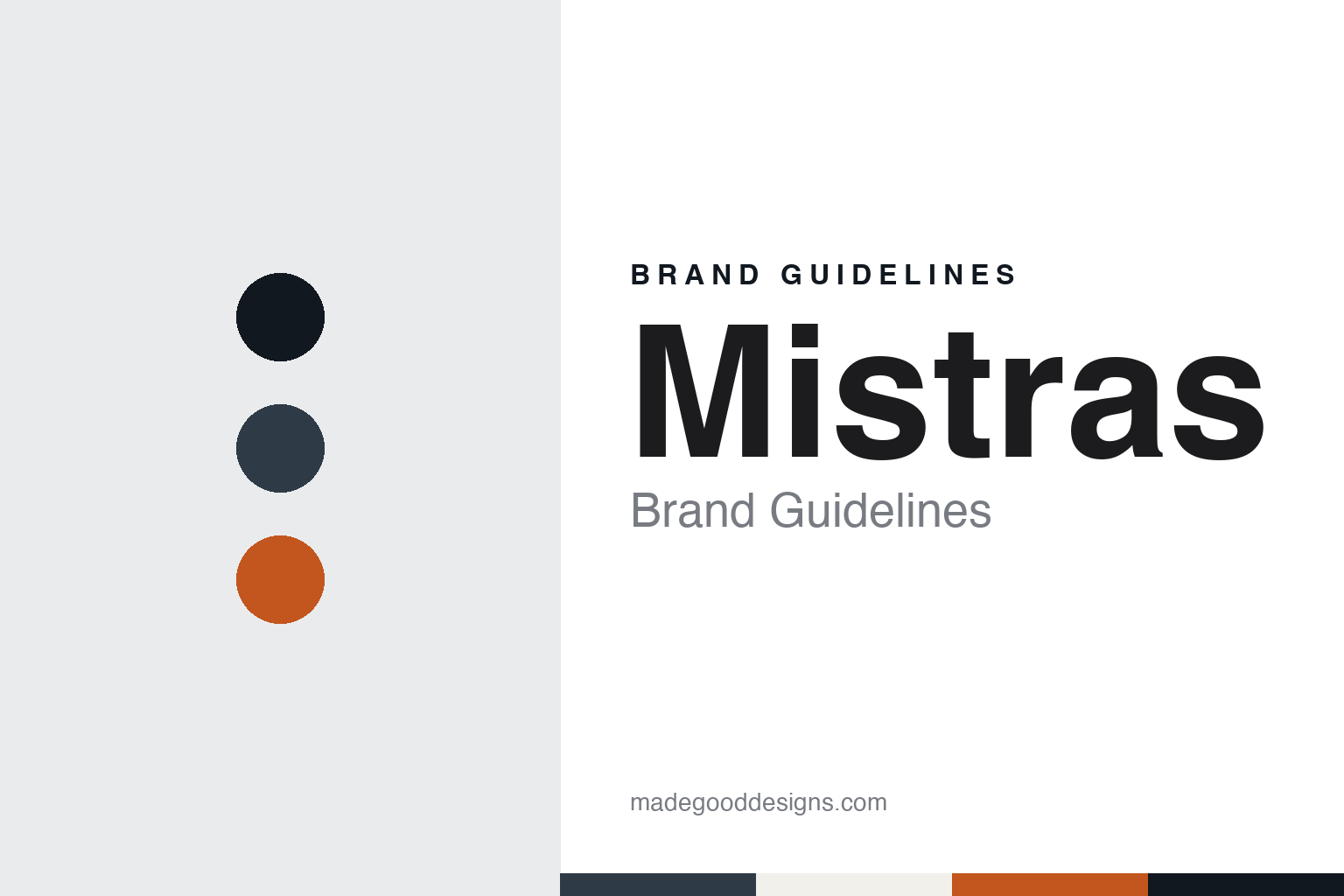
Mistras Brand Guidelines
Princeton Junction inspection, Physical Acoustics and a name in capitals.
Aa
Two constants: a Mistras steel, blue and orange palette and an industrial grotesque register. Abstract homage — not a Mistras asset; no logo, report or mark is reproduced.
Princeton Junction
A New Jersey group built around non-destructive testing.
Mistras is an American testing and inspection company based in Princeton Junction, New Jersey, the location the Associated Press gave for it in August 2026, when it described Mistras as an engineering services company. Wikidata records 1978 as the year the company began. The group trades on the New York Stock Exchange under the symbol MG and writes its name in capitals, as MISTRAS Group, Inc., in its own releases.
The company calls its field “industrial asset integrity.” Its own summary lists advanced non-destructive testing, pipeline inspections, real-time condition monitoring, maintenance planning and specialised engineering, tied together by its own software for managing inspection data. Non-destructive testing means examining materials, welds and parts without cutting or damaging them, using methods such as ultrasound. The company says the aim is to help clients reduce risk, extend asset life and improve operational performance.
One of the older names inside the group is Physical Acoustics. In September 2010 the trade magazine Construction Equipment listed Physical Acoustics Corporation among the brand names under which Mistras offered non-destructive testing products and services, alongside CONAM Inspection & Engineering Services, Code Services and Quality Services Laboratories. Today the old physicalacoustics.com address forwards to a Physical Acoustics page on the Mistras website, and acoustic emission work still appears in the company’s menu of research and specialist applications.
The company says its Research, Contracts & Application group was formed in 1992 to develop new inspection techniques with partners, industry organisations and universities, and that it has worked on non-destructive testing methods and applications for decades.
Colour
Acquired specialists and three service lines.
Much of the group was assembled by purchase. Construction Equipment reported in September 2010 that Mistras had acquired Controlled Vibrations Inc. of Doylestown, Pennsylvania, a predictive-maintenance business working since 1991. Its services included vibration programmes, infrared thermography surveys, oil analysis and motor condition monitoring, and its former owner was to manage another Mistras subsidiary, Vibra-Metrics, a maker of vibration sensors and instruments, the magazine said. The same report described Mistras as also offering asset inspection and mechanical integrity services to oil and gas, power generation, public infrastructure and manufacturing customers, along with online instrumentation used in managing plant assets.
Today the website arranges the work into three lines, each with a short slogan. Data Solutions (“Information to insight”) covers software platforms and monitoring technologies, including the PCMS plant condition management software. Field Services (“Compliance to confidence”) covers inspection and testing on clients’ sites, from core non-destructive testing to pipeline inspection. In-Lab Services (“Precision to resilience”) covers laboratory work such as chemical analysis, destructive and non-destructive testing, and 3D metrology, along with machining and finishing.
The industries named on the site include oil and gas, from upstream fields to petrochemical plants; power generation and transmission, including renewable and nuclear plants; infrastructure such as bridges, tunnels, roads, ports and data centres; and chemicals, mining, pulp and paper, and food and pharmaceutical processing.
Some acquired names keep their own websites. The company lists separate business sites including New Century Software, Onstream, Ropeworks and the University of Ultrasonics, and country websites for nine markets, among them Canada, France, Germany and Greece.
Behind the three lines sits a long menu of engineering and monitoring services. The data side lists mechanical integrity programmes, audits and assessments, fitness-for-service assessments, risk-based inspection and corrosion management, and failure analysis. Pipeline work runs from inspection to pipeline data and mapping services and integrity software, and the monitoring menu covers leak detection, crack and fatigue detection, electrical and thermal monitoring, and structural monitoring of bridges and other structures.
Typography
Design and documentation.
Testing, inspection and certification companies sell work that customers rarely see in full: a laboratory report, an inspector’s visit, a certificate. Their websites lean on a small set of visual and verbal devices to make that work visible. Service catalogues are often organised by industry rather than by technique, so a visitor looking for vehicle inspection, battery testing or management-system certification finds it under automotive, energy or certification headings, as the Applus+ and Element sites show.
Accreditation pages carry much of the weight. Firms list the standards their laboratories and certification bodies are accredited to, such as ISO/IEC 17025 for testing and calibration laboratories, and some publish counts of their accreditations and approvals; Element’s website, for example, gives a figure of more than 1,000. Certification marks and logos appear as the companies publish them, usually beside the scheme or standard they belong to.
Photography on these sites commonly shows people at work: technicians at laboratory benches, inspectors on site, engineers beside test rigs and proving grounds. Corporate pages add brand promises and value statements, such as the “Together beyond standards” promise Applus+ publishes, and history pages that trace how a group was assembled, often through long runs of acquisitions.
Investor and sustainability pages complete the picture. Applus+ keeps the records of its shareholder meetings online, including those of 2024, the year it left the stock market, and both Applus+ and Element publish sustainability or ESG sections beside their codes of ethics and corporate responsibility policies. The guides in this set describe each brand from those published materials and from dated independent sources; the colours and typefaces shown here are unofficial interpretations, not the companies’ own.
Aa
An industrial grotesque for a name set in capitals. (Specimen set in Archivo, a sans STAND-IN; NOT the Mistras logo.)
MISTRAS
A capitalised name and a pending sale.
The company’s leadership changed in 2025. Its website names Natalia Shuman as president and chief executive, a role she took in 2025 after senior work at Eurofins Scientific, and Manuel Stamatakis as executive chairman; he had served as chief executive from 2023 to the start of 2025. The website sets out four values: Driven to Win, Accountable, Connected and Innovative.
On 17 September 2026 Mistras agreed to be acquired by affiliates of H.I.G. Capital in an all-cash merger that would take the company private and end its New York listing, according to a summary of the company’s announcement published by The Globe and Mail. A 40-day “go-shop” period, during which the board could look for other offers, ran until 27 October 2026. On 28 October the company said that period had expired and that it had filed a definitive proxy statement for a special meeting of shareholders. The merger needs shareholder and regulatory approval and was expected to close in late 2026 or early 2027; agreed in September 2026, it had not completed at the time of writing.
In print the name is set in capitals, as MISTRAS, in the company’s releases and on its website, while acquired specialists such as Physical Acoustics appear as named pages within the main site.
For a design guide, Mistras shows how a group assembled from specialist inspection businesses can present itself under one capitalised name while keeping some older brands visible on their own pages. Compare UL Solutions, another American testing name, and Element Materials Technology, a materials-testing group. For this guide we use a steel grey, ink, an ultrasonic blue and a signal orange with a sans, an unofficial interpretation; no product or logo is reproduced.
Explore & save
Keep Mistras’s identity on hand — save it to a board in the Made Good inspiration library.
Mistras identity set
Pin the Mistras steel, blue and orange palette and the industrial grotesque register to your own board.