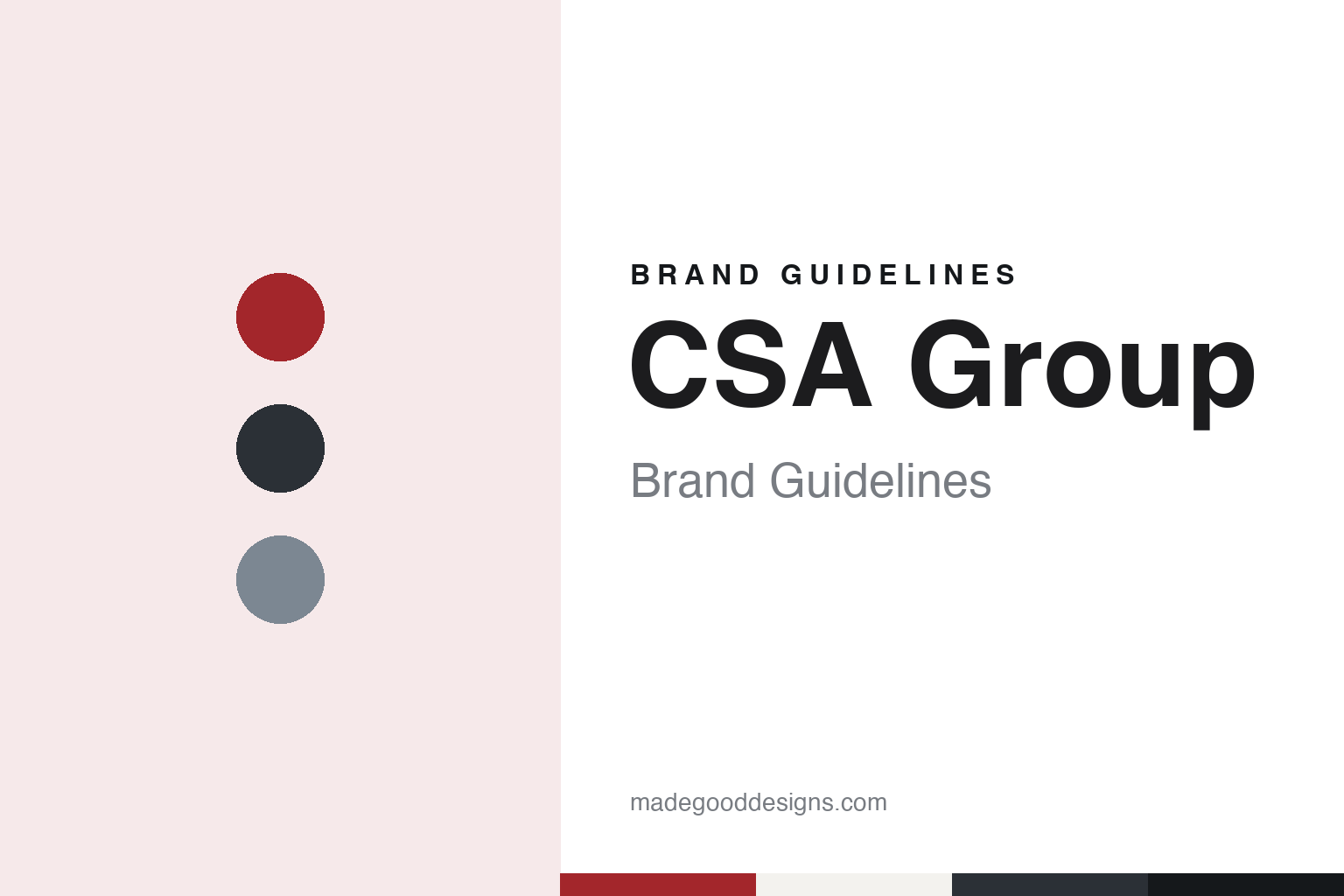
CSA Group Brand Guidelines
Three letters for a rule book and a test mark, in two languages.
Aa
Two constants: a maple red, slate and steel palette and a civic sans register. Abstract homage — not a CSA Group asset or mark; no certification mark, logo or standard is reproduced.
CESA
An engineering standards body chartered in 1919.
CSA Group began in 1919 as the Canadian Engineering Standards Association, or CESA. English Wikipedia says it was federally chartered to write standards, after an investigation led by Sir John Kennedy, chairman of the Civil Engineers’ Canadian Advisory Committee, into whether Canada needed an independent standards organisation. Its early committees dealt with specific needs, Wikipedia says, among them bridges, building construction, electrical work and wire rope.
Electrical work set its direction. In 1927 CESA published the Canadian Electrical Code, and enforcing the code called for product testing. Wikipedia says that in 1933 the Hydro-Electric Power Commission of Ontario became the sole source of that testing nationwide, and that in 1940 CESA took on responsibility for testing and certifying electrical products meant for sale and installation in Canada. In 1944 the body was renamed the Canadian Standards Association. In French it was the Association canadienne de normalisation, long abbreviated ACNOR; Wikipedia says the initials CSA are now used in both official languages.
Later decades widened the scope. In 1984 the association set up QMI, the Quality Management Institute, to register companies to ISO 9000 and other management standards. In 1999 it created CSA International to provide product testing and certification around the world, while the association concentrated on standards development and training. In 2001, Wikipedia says, these divisions were joined under the name CSA Group. A fourth division, OnSpeX, followed in 2004, and in 2009 CSA bought the certification business Sira. Wikipedia lists the group’s regions as Canada, the United States, Asia and Europe, and gives its headquarters as Toronto, where the testing business is also based.
Colour
A rule book and a test laboratory under one name.
CSA Group has worked on two tracks. The first is standards development. Wikipedia says it writes standards in 57 areas, publishes them in print and electronic form, and draws its committees from industry, government and consumer groups. It is accredited by the Standards Council of Canada, a federal Crown corporation, to develop standards and to certify. Recent work shows the range. Construction Canada reported on 4 November 2026 that CSA Group, with support from the Standards Council of Canada, had published CSA D700, a National Standard of Canada on climate adaptation for transit and passenger rail systems. Canadian Occupational Safety reported on 30 October 2026 that CSA Group and WorkSafeBC had agreed, in an announcement of 28 October, to develop a national standard for rigging and hoisting competencies, with CSA Group leading the drafting.
The second track is testing, inspection and certification. The CSA mark is a registered certification mark that, Wikipedia says, may be applied only by those licensed or otherwise authorised by CSA, and that shows a product has been independently tested and certified to recognised standards. In the United States, CSA Group is recognised by OSHA as a Nationally Recognized Testing Laboratory. Kiwa’s announcement of August 2026 describes this business, led by CSA Group Testing & Certification Inc., as headquartered in Toronto, with 20 specialised laboratories in 12 countries, around 2,100 employees and about 11,000 customers in North America, Europe and Asia.
That split is now becoming formal. On 28 August 2026 the Dutch testing group Kiwa announced that it had signed an agreement with CSA Group to take over the testing, inspection and certification business. The deal was agreed in August 2026 and was not completed at the time of writing: Kiwa said it remained subject to approval by the members of the Canadian Standards Association and to regulatory and other customary closing conditions, and was expected to close in the coming months. Kiwa also said the Canadian Standards Association is not part of the transaction and will continue as a member-based, not-for-profit organisation focused on its standards mandate.
Typography
How certification bodies present themselves.
Testing, inspection and certification companies sell work that customers rarely see in full: a laboratory report, an inspector’s visit, a certificate. Their websites lean on a small set of visual and verbal devices to make that work visible. Service catalogues are often organised by industry rather than by technique, so a visitor looking for vehicle inspection, battery testing or management-system certification finds it under automotive, energy or certification headings, as the Applus+ and Element sites show.
Accreditation pages carry much of the weight. Firms list the standards their laboratories and certification bodies are accredited to, such as ISO/IEC 17025 for testing and calibration laboratories, and some publish counts of their accreditations and approvals; Element’s website, for example, gives a figure of more than 1,000. Certification marks and logos appear as the companies publish them, usually beside the scheme or standard they belong to.
Photography on these sites commonly shows people at work: technicians at laboratory benches, inspectors on site, engineers beside test rigs and proving grounds. Corporate pages add brand promises and value statements, such as the “Together beyond standards” promise Applus+ publishes, and history pages that trace how a group was assembled, often through long runs of acquisitions.
Investor and sustainability pages complete the picture. Applus+ keeps the records of its shareholder meetings online, including those of 2024, the year it left the stock market, and both Applus+ and Element publish sustainability or ESG sections beside their codes of ethics and corporate responsibility policies. The guides in this set describe each brand from those published materials and from dated independent sources; the colours and typefaces shown here are unofficial interpretations, not the companies’ own.
Aa
A civic sans for three initials. (Specimen set in Libre Franklin, a sans STAND-IN; NOT the CSA Group logo or the CSA mark.)
CSA Group
Three letters in two official languages.
The identity rests on three letters. The initials began as the English abbreviation beside the French ACNOR and now serve both languages, and the same letters run through the certification mark and through the names of its standards, from CSA D700 to the CAN/CSA Z299 quality-assurance series, which Wikipedia says is now called N299 and is aimed at companies supplying goods to nuclear power plants. CSA Group’s own description, printed at the foot of Kiwa’s announcement, calls it a global organisation dedicated to safety, social good and sustainability, with a mandate “to hold the future to a higher standard.”
Kiwa’s announcement sets out what happens to the name next. After completion, it says, the testing business moves into Kiwa Group while the Canadian Standards Association carries on as a standards body; until then the two remain separate companies, with no change to services, contracts, certificates or points of contact. Kiwa’s chief executive is quoted describing the CSA business as one with “a trusted mark,” and noting that Kiwa itself began in 1948 as a public-interest institute in the Netherlands. He added that both organisations were founded to serve the public interest and have cultures rooted in shared values.
For a design guide, CSA Group shows how one set of initials can carry both a rule book and a test mark. Compare Kiwa, the Dutch group that agreed in 2026 to buy the testing business, and UL Solutions, another North American name built around a certification mark. For this guide we use a maple red, a slate and a cool steel with a sans, an unofficial interpretation; no product or logo is reproduced.
Explore & save
Keep CSA Group’s identity on hand — save it to a board in the Made Good inspiration library.
CSA Group identity set
Pin the CSA Group maple red, slate and steel palette and the civic sans register to your own board.