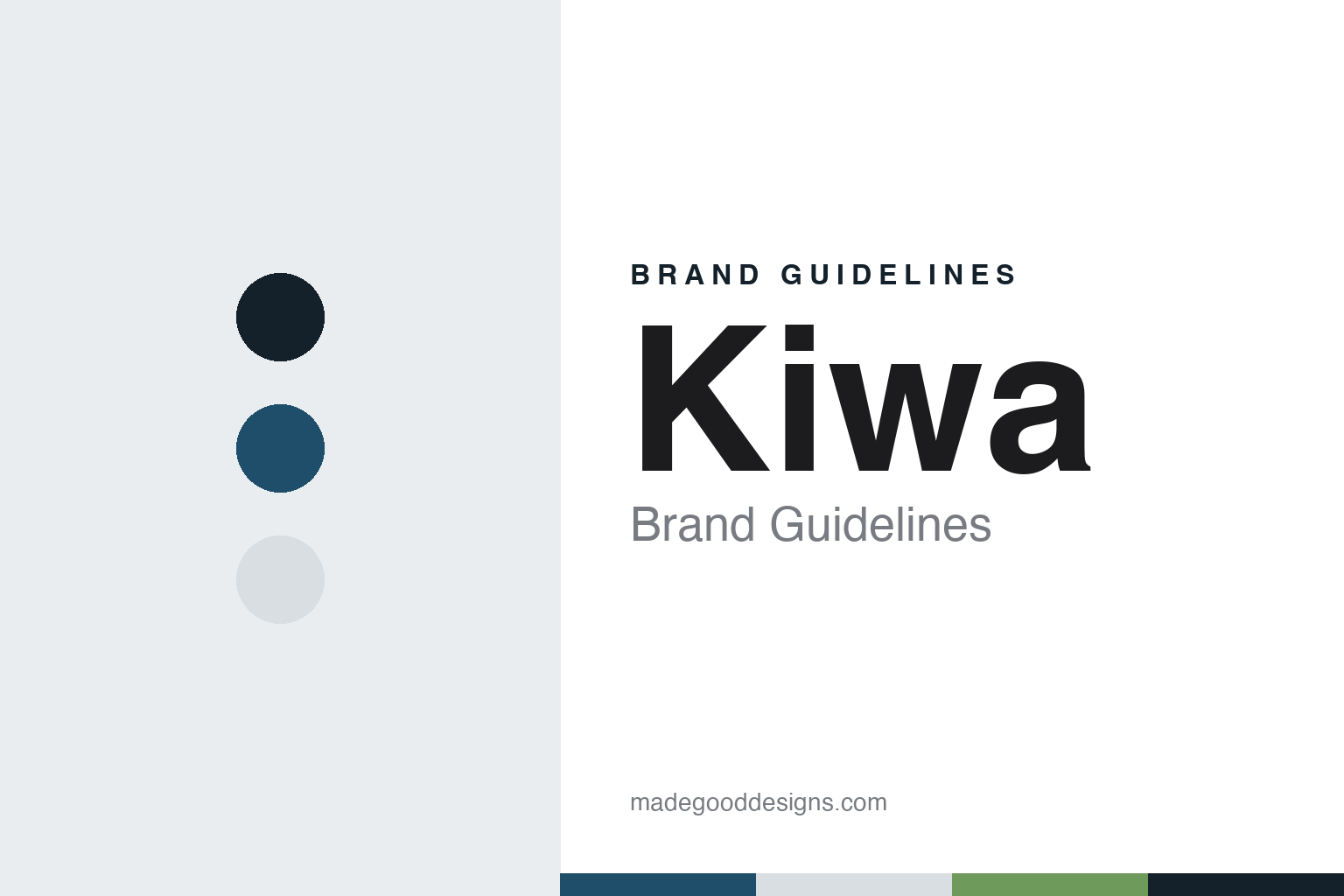
Kiwa Brand Guidelines
A 1948 waterworks test institute turned TIC group.
Aa
Two constants: a Kiwa reservoir blue and green palette and a Clear sans register. Abstract homage — not a Kiwa product or mark; no certificate, logo or certification mark is reproduced.
Keuringsinstituut
Waterworks articles, examined since 1948.
Kiwa began in the Netherlands in 1948. It was set up by the Dutch drinking-water companies, which wanted every material and component that could come into contact with drinking water to be examined first, the company says. The name was an acronym: KIWA, then written in capitals, stood for Keuringsinstituut voor Waterleidingartikelen, roughly “institute for the examination of waterworks articles”. Dutch Wikipedia adds that the institute drew up the requirements that such articles, from pipes to fittings and taps, had to meet, tested products against them and gave those that passed the Kiwa quality mark.
Testing for the water sector led into other fields. Dutch Wikipedia says the institute’s test methods carried it into building and the environment, and that the company was renamed Kiwa N.V. as its scope widened. Kiwa itself says it dropped the acronym because today’s company covers much more than drinking water. In the Netherlands its certification work includes KOMO certification in building, Kiwa Keur for drinking water and Gaskeur in energy and gas, according to Dutch Wikipedia.
Ownership moved away from the water companies in 2006. NRC Handelsblad reported on 29 August 2006 that ABN Amro Participaties, the bank’s private-equity arm, had bought Kiwa NV, which the paper called the certification company of the Dutch water companies, known above all as a tester of sanitary ware. Kiwa wanted to take part in the international market for quality marks, the paper reported. Dutch Wikipedia says the research arm, Kiwa Water Research, was split off before the sale and stayed with the water companies. In 2011 NPM Capital became the main investor, according to the company’s own timeline.
Colour
From Gastec to Vinçotte.
Much of Kiwa’s growth came through acquisitions. The company’s timeline dates the first major one to 2005, when Gastec joined; Dutch Wikipedia describes Gastec, of Apeldoorn, as the former Dutch gas institute. The same year brought Kiwa’s first purchases in Germany. Later additions on the timeline include Kiwa Cermet in Italy in 2013, the organic-certification body BCS Öko-Garantie in Germany in 2014, which took Kiwa into food, feed and farming, and in 2015 the Nordic and Baltic inspection company Inspecta, whose businesses now trade as Kiwa Industrial Inspection.
The largest step came at the end of 2021. Installatie.nl reported on 6 December 2021 that Kiwa was taking over its Belgian counterpart Vinçotte, with approval from the Belgian competition authorities still to come; Kiwa’s chief executive described the deal as a union of two complementary players, with Vinçotte stronger in inspection and Kiwa in certification. Kiwa’s timeline says the purchase was completed in May 2022, and Vinçotte’s own website now describes it as part of the Kiwa group. In 2021 Kiwa also bought the remaining shares of PVEL, a US business that tests solar panels, and the Intega Group, a geotechnical engineering business in Australia, New Zealand, Canada and the US, the company says.
Also in 2021 Kiwa became part of the SHV family of companies, a Dutch group whose other members include Makro, Mammoet and Nutreco, according to Kiwa’s website; Installatie.nl described Kiwa as part of SHV in its December 2021 report. Kiwa says SHV does not interfere in its testing, inspection and certification decisions, on which customers and authorities rely to be impartial. Kiwa marked its 75th anniversary in 2023. Its website said in November 2026 that it had more than 12,000 employees, a presence in more than 35 countries and over 200 locations including offices and laboratories; in December 2021 Installatie.nl gave a figure of more than 5,500 staff. Dutch Wikipedia says that in 2021 Kiwa had offices and national organisations in 35 countries and agencies in 20 more.
Typography
How the inspectors present themselves.
Testing, inspection and certification companies sell work that customers rarely see in full: a laboratory report, an inspector’s visit, a certificate. Their websites lean on a small set of visual and verbal devices to make that work visible. Service catalogues are often organised by industry rather than by technique, so a visitor looking for vehicle inspection, battery testing or management-system certification finds it under automotive, energy or certification headings, as the Applus+ and Element sites show.
Accreditation pages carry much of the weight. Firms list the standards their laboratories and certification bodies are accredited to, such as ISO/IEC 17025 for testing and calibration laboratories, and some publish counts of their accreditations and approvals; Element’s website, for example, gives a figure of more than 1,000. Certification marks and logos appear as the companies publish them, usually beside the scheme or standard they belong to.
Photography on these sites commonly shows people at work: technicians at laboratory benches, inspectors on site, engineers beside test rigs and proving grounds. Corporate pages add brand promises and value statements, such as the “Together beyond standards” promise Applus+ publishes, and history pages that trace how a group was assembled, often through long runs of acquisitions.
Investor and sustainability pages complete the picture. Applus+ keeps the records of its shareholder meetings online, including those of 2024, the year it left the stock market, and both Applus+ and Element publish sustainability or ESG sections beside their codes of ethics and corporate responsibility policies. The guides in this set describe each brand from those published materials and from dated independent sources; the colours and typefaces shown here are unofficial interpretations, not the companies’ own.
Aa
A clear sans for a single parent brand. (Specimen set in Figtree, a sans STAND-IN; NOT the Kiwa logo.)
One Kiwa
A rebrand and a parent mark.
For the brand, the key dates are 2016 and 2017. Kiwa’s timeline records the start of a company-wide rebranding in 2016 and the move of the group to the Kiwa name across the business in 2017. Kiwa says today that it presents its own and licensed certification marks together with the Kiwa name, and that where scheme owners and accreditation rules allow it, scheme marks are shown with Kiwa as the parent brand.
The certification mark itself works as a system. Kiwa says its mark combines the Kiwa logo with a reference to the relevant certification scheme and, where it applies, the accreditation level, a country code or name and the scheme number, and that only the holder of a valid certificate may use it. On its English website Kiwa groups its work as testing, inspection, certification, training, consultancy, digital solutions and calibration, across fields from construction and energy to drinking water, food, feed and farming. It is a member of the TIC Council, the industry association, the company says, and its website carries the line “creating trust, driving progress” in its footer.
The headquarters are in Rijswijk, next to The Hague, Dutch Wikipedia says.
For a design guide, Kiwa shows how a name coined as a waterworks acronym can become one parent brand over many acquired firms and a family of certification marks. Compare DNV, another European testing and certification group, and SOCOTEC, a French inspection group that also moved the companies it bought to its own name. For this guide we use a reservoir blue, ink, a pipe grey and a fresh green with a sans, an unofficial interpretation; no product or logo is reproduced.
Explore & save
Keep Kiwa’s identity on hand — save it to a board in the Made Good inspiration library.
Kiwa identity set
Pin the Kiwa reservoir blue and green palette and the Clear sans register to your own board.