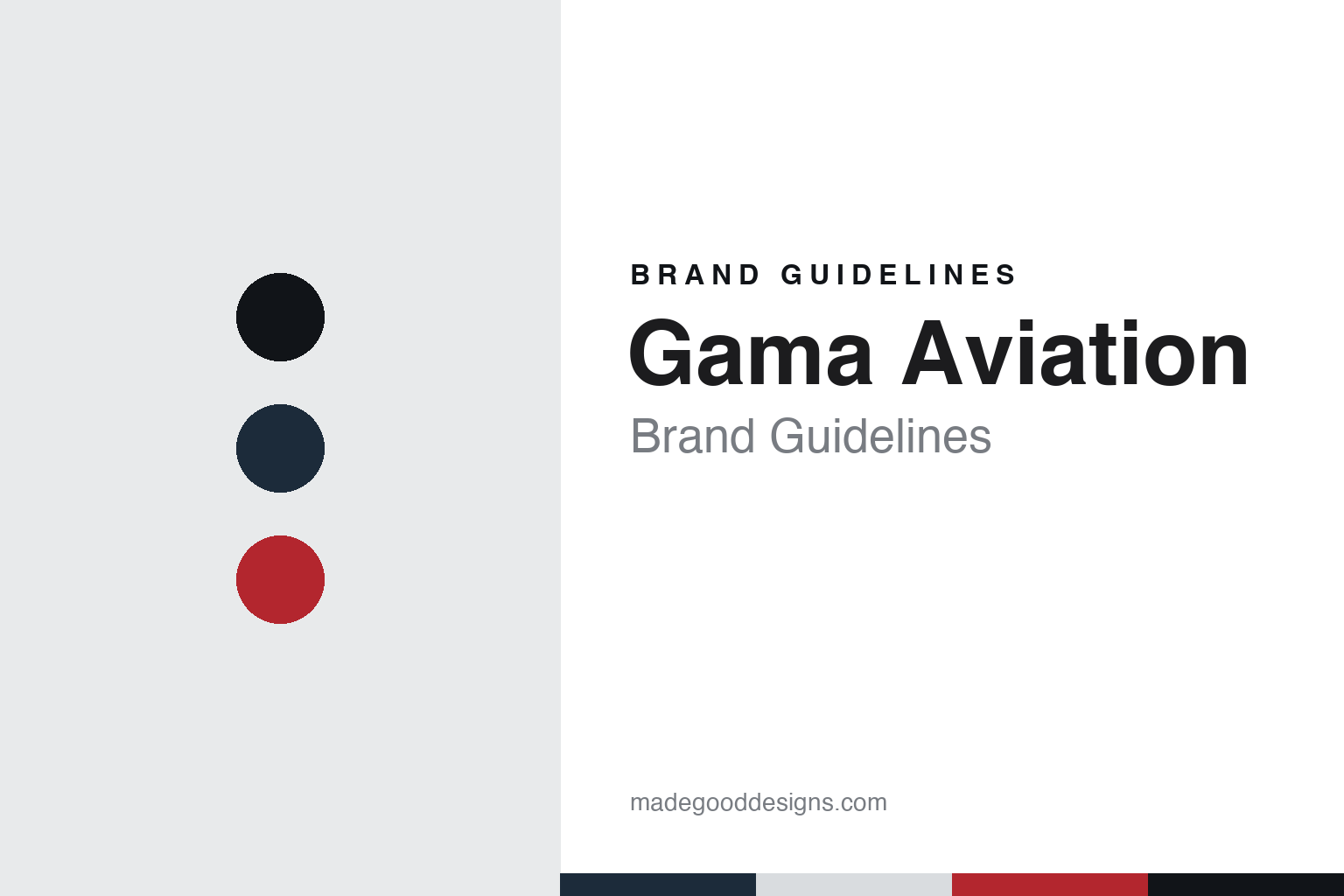
Gama Aviation Brand Guidelines
A Farnborough aviation group that shows itself through places and people.
Aa
Two constants: a hangar deep blue, thread red and apron grey palette and a plain aviation sans register. Abstract homage — not a Gama Aviation asset or mark; no aircraft, livery or logo is reproduced.
Farnborough
Two founders, 1983, and a group built by acquisition.
Gama Aviation was founded in 1983 by Marwan Khalek and Stephen Wright, according to the company’s board page and a May 2025 profile in FlightGlobal. Khalek is chief executive and Wright chief compliance officer, the company says. The group is headquartered at Farnborough in Hampshire, in an office building beside Farnborough Airport that it describes as the main hub for all three of its business units, with corporate functions on the first floor.
Growth came through acquisitions as well as new bases. English Wikipedia records a reverse takeover involving the listed company Hangar 8, which took Gama onto the London market, and the addition of FlyerTech, an aviation engineering business. In February 2016 Corporate Jet Investor reported that the Jersey Competition Authority had approved Gama’s purchase of Aviation Beauport, a deal first announced that January; it added four light jets and what the magazine called the island’s only FBO. The same report noted approval for a new business aviation facility at Sharjah International Airport in the United Arab Emirates.
The United States was a large part of the story for a time. In May 2014 Aviation International News described Gama Charters, the US subsidiary of the Farnborough group, as the exclusive operator of the Beechcraft King Air 350i turboprops ordered by the membership club Wheels Up, and reported that it had hired 100 pilots for the work and planned to recruit more. English Wikipedia also records a later merger of Gama’s US air business with the aircraft management business of BBA Aviation. FlightGlobal reported in 2025 that Gama divested its other US interests in 2020, bought a large US maintenance business in 2021 and sold it again in 2023.
Colour
Three units, three FBOs, one checklist.
Today Gama presents itself as three strategic business units: Business Aviation, Special Mission and Technology & Outsourcing. The structure followed a strategy review the company says began in May 2020, and segment reporting in that shape started with the 2021 annual report. Business aviation covers charter, aircraft management, maintenance and an FBO network; Technology & Outsourcing includes the myairops.com software and FlyerTech, the company’s website shows.
The FBO network, as the company presents it, is small and specific: Glasgow in Scotland, Jersey in the Channel Islands and Sharjah in the UAE. Glasgow is a two-hangar facility at the international airport, combining FBO and maintenance work, with hangarage, secure storage, crew rest rooms, operations support and fuel from the company’s own bowser. The Jersey page lists a VIP passenger lounge, crew rest rooms, hangarage and a conference room suitable for board meetings. The Sharjah page leads with its access to Dubai, describing the drive downtown as under 30 minutes, and publishes its handling and maintenance charges as downloads.
The charter pages are written in plain service language. The company sets out its promises — privacy, service, agility, expertise — as a list of ticked items, and names aircraft rather than describing cabins: the Gulfstream G550 and Bombardier Global 5000 at the large end, the Citation XLS and Citation Mustang for shorter trips, with audited outside operators used when its own aircraft are busy. For aircraft management it says it has 45 managed aircraft, from turboprops and helicopters to airliners, and that its longest continuous management contract has run for more than 30 years.
The clearest recent identity project is on the ground. In September 2026 Gama announced a bespoke FBO uniform across its network, with garments in different styles, fits and sizes, and a new FBO Uniform Guide. The company ties it to its Red Thread Academy, a client-experience programme named for the aim of “a continuous thread of experience” linking every client touchpoint. Gama says a recognisable identity across the FBO network was one of the project’s goals, but without asking every colleague to look or feel the same.
Typography
Ramps, cabins and lounges.
Business aviation companies sell something most visitors will never see in person, so their websites lean on photography and lists. Operators show cabins and aircraft on the ramp, as the companies themselves choose to publish them, and they tend to organise fleet pages by aircraft type — a turboprop, a super-midsize jet, a large-cabin Gulfstream or Bombardier — rather than by destination. Gama Aviation’s charter pages, for example, name individual types from the Citation Mustang to the Gulfstream G550.
FBO networks, the private terminals and hangars that serve business aircraft at airports, present themselves through places. Their websites carry location maps and airport pages that list lounges, crew rest rooms, hangarage, fuel and meeting rooms, often with airport codes and opening hours. Hangars appear as much as aircraft do, because the building is the product: Gama, for one, publishes separate pages for its facilities at Glasgow, Jersey and Sharjah.
Membership and charter programmes are a third strand. Operators describe jet cards, memberships and fixed-rate schemes in their own terms — deposit levels, guaranteed availability, capped hourly rates — and trade titles such as Private Jet Card Comparisons track and compare them. VistaJet, XO and, before its sale in 2022, Jet Edge all built consumer offers around such programmes, and Jet Edge ran branded lounges at Van Nuys and Teterboro.
Ownership changes often. Investment firms, listed groups and larger operators buy and merge these businesses, and a brand can disappear into its parent’s name, as Jet Edge’s operators did when Vista formed Vista America in 2023. This guide records who founded each company, who owns it and how it presents itself, and marks clearly what rests only on the company’s own word.
Aa
A plain aviation sans for a group that names places, not slogans. (Specimen set in Manrope, a sans STAND-IN; NOT the Gama Aviation logo.)
Gama Aviation
A decade on AIM, then private again.
Gama spent about a decade as a public company. On 29 April 2024 it told the London Stock Exchange it intended to cancel its listing on AIM, the junior market, after a share buyback, ch-aviation reported; the board cited the cost of a listing, thin trading and the concentration of shares with its two principal shareholders, one of them the founder. Aviation International News reported that the delisting was expected on 30 May 2024, after a shareholder vote at the annual meeting that month, and FlightGlobal wrote in May 2025 that Gama had left the stock market the previous year.
The buyback followed the sale of the US maintenance business, Jet East, to West Star Aviation in late 2023, which ch-aviation said had left the company unexpectedly liquid. Private again, Gama has kept buying: on 10 June 2025 it completed the purchase of Capital Air Ambulance from Centreline, moving that medical repatriation team into its Special Mission unit, Aviation International News reported.
For a design guide, Gama Aviation shows how a mixed aviation group can give its business-aviation side a face through places and people rather than slogans: named FBOs, plain checklists of service promises, and now a uniform with its own guide. Compare Wheels Up, whose King Air fleet Gama Charters flew from 2014, and Signature Aviation, the FBO network formerly known as BBA Aviation. For this guide we use hangar deep blue, a thread red and apron grey with a sans, an unofficial interpretation; no product or logo is reproduced.
Explore & save
Keep Gama Aviation’s identity on hand — save it to a board in the Made Good inspiration library.
Gama Aviation identity set
Pin the Gama Aviation hangar deep blue, thread red and apron grey palette and the plain aviation sans register to your own board.