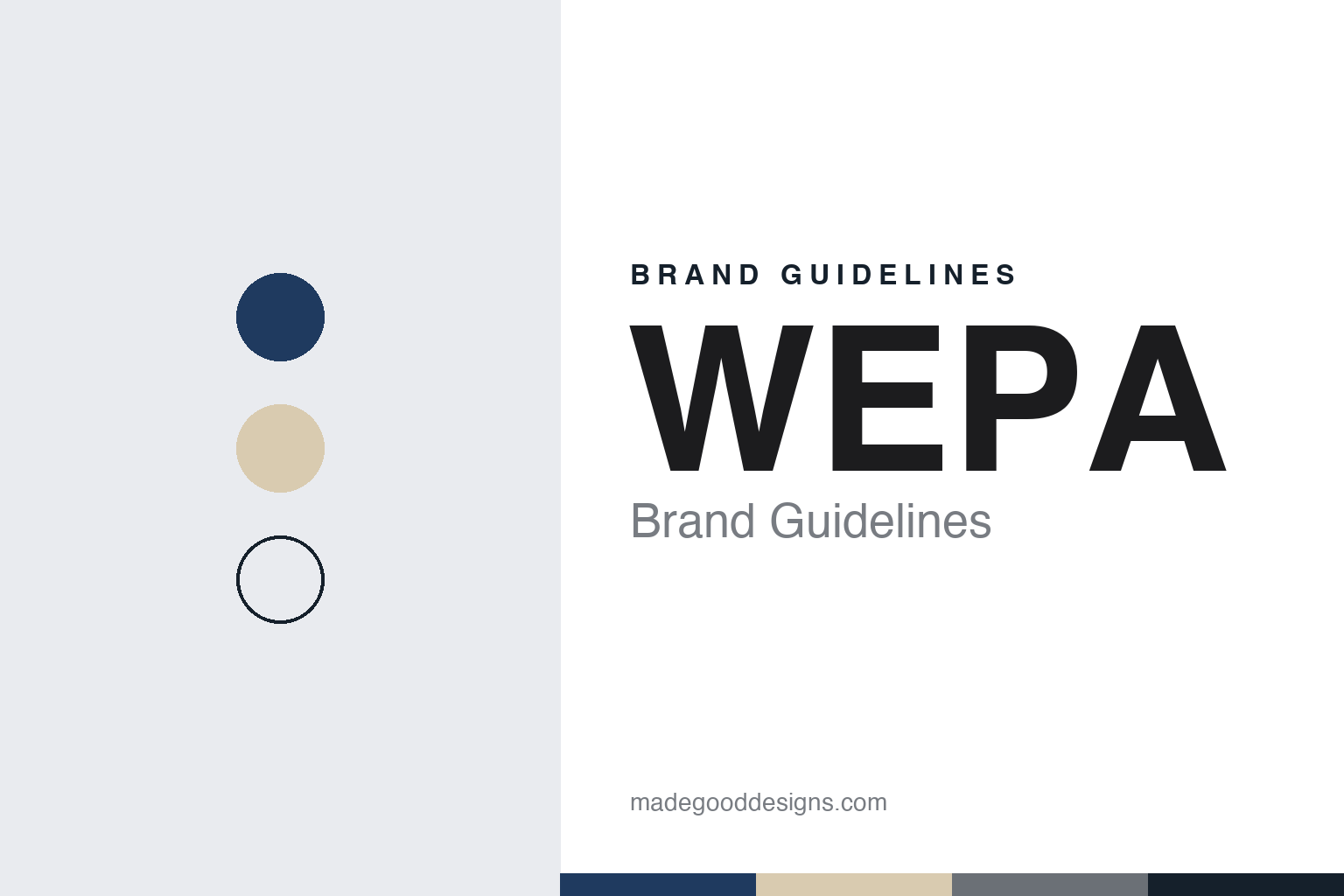
WEPA Brand Guidelines
A 1948 Arnsberg paper wholesaler turned private-label tissue group.
Aa
Two constants: a blue, beige and grey palette and an industrial sans register. Abstract homage — not a WEPA product or mark; no pack, logo or roll design is reproduced.
Westfälische Papierfabrik
A Sauerland wholesaler that became a mill.
WEPA began in 1948 in Arnsberg, in the Sauerland region of North Rhine-Westphalia. English Wikipedia says the name stands for Westfälische Papierfabrik, and that Paul Krengel founded the business as a wholesaler of lining, wrapping and gift-wrap paper rather than as a mill. Converting of hygiene papers followed in 1953, and in 1958 the company began making its own paper, on a first machine for crepe paper at Müschede, the Arnsberg district that is still its headquarters.
Growth in the 1960s stayed within the region at first: a plant at Marsberg-Giershagen, opened in 1963, took on further processing of the paper the company made. In 1980, English Wikipedia says, WEPA developed its first private-label products — goods sold under retailers’ own names — and that line of work has been central to the company ever since. Over the 1970s and 1980s the founder’s four sons, Paul Jr., Wolfgang, Joachim and Martin Krengel, joined the business and took over its management.
The company remains in the family. The group’s parent is WEPA SE, with around twenty subsidiaries in Germany and abroad, and the business is owned by the Krengel family, according to English Wikipedia. In February 2021, the business magazine Unternehmeredition reported, the family set up the WEPA Stiftung, a foundation based in Arnsberg for projects in hygiene, ecological and social sustainability, lifelong learning and family business; Andreas Krengel, a member of the group board and spokesman for the family, joined its board alongside Ingmar Lohmann. The group’s motto, quoted in the same report, is “Together for a better life.”
Colour
Mills close to the shelves they fill.
Toilet paper takes up a lot of room in a lorry for what it is worth, so WEPA set up mills across Europe to keep delivery distances short, English Wikipedia says. In 2001 it took over Kriepa at Kriebethal in Saxony, where it had run a joint venture with the paper maker Kübler & Niethammer since 1990; the site is now WEPA Saxony. From 2004 came a joint venture at Ejea de los Caballeros in Spain, a majority of the Polish maker Fabryka Papieru Piechowice and Kimberly-Clark’s mill in Mainz. From 2008 the sites of the insolvent Italian group Kartogroup — at Lucca and Cassino in Italy, Leuna in Germany and Lille in France — joined the group. A tie-up with the investment firm Pamplona Capital in 2010 ended soon after over differing views on governance, according to the same article.
Later moves filled in the map. WEPA sold its Spanish joint-venture stake in 2015 and bought a site at Troyes in France; in 2017 it took over the family business Van Houtem at Swalmen in the Netherlands, a site for away-from-home products; in 2018 it took full ownership of UK Northwood & WEPA at Bridgend in Wales, founded in 2014; and in 2023 the WEPA Professional unit bought Star Tissue UK of Blackburn, Lancashire.
The French deal of 2019 shows the raw-material side of the business. On 29 March 2019 the commercial court in Nanterre awarded WEPA the business of the Arjowiggins Greenfield plant at Château-Thierry, the regional daily Westfalenpost reported. Greenfield, which had filed for insolvency that January, does not make tissue: it cleans recovered paper of printing ink, with a capacity of about 130,000 tonnes a year, and passes the de-inked pulp to other WEPA mills or sells it on, the newspaper said. The same report described WEPA as the third-largest hygiene-paper maker in Europe.
The newest step is again French. In January 2026 the trade paper Lebensmittel Zeitung reported WEPA’s plan to take over MPH1865, and on 9 April 2026 Lebensmittelpraxis reported that WEPA had acquired a majority stake. MPH1865, founded in 1865 and based in the Ardèche and Drôme, makes hygiene paper and soap for commercial customers and now trades as WEPA Professional France; its 260 staff joined a group that then counted more than 4,500 employees at fifteen European sites, the magazine said.
Typography
How tissue makers present themselves.
Tissue and hygiene-paper makers mostly sell under names that are not their own. The corporate group is often a holding name, and shoppers meet it through a portfolio of consumer brands: Essity’s brands page lists TENA, Tork, Libero, Lotus and Zewa, each with a short category label and a link to its own website, while Sofidel puts Regina first and runs separate Regina sites for seven European countries alongside national names such as Sopalin, Le Trèfle and Hakle.
Consumer pack design follows those brand families rather than the parent. Brand names travel across toilet paper, kitchen towels and handkerchiefs, and some identify themselves by a physical detail: Sofidel says its KittenSoft tissue is recognisable by a heart-shaped embossing. Many brands came to their current owners through acquisitions, so a group’s portfolio often mixes a home-grown house brand with bought national names that keep their local identities.
The away-from-home side looks different again. Here the product is often a system for washrooms and other busy places, pairing paper with dispensers. Essity describes Tork as tissue and dispenser systems for professional and high-traffic environments and says more than 30 million Tork dispensers are refilled regularly; Sofidel lists away-from-home products as one of four business lines, next to its consumer brands, private label goods for retailers and parent reels, the large semi-finished reels sold to other converters.
The corporate websites then speak to a different audience: investors, job seekers, suppliers and journalists. Their pages typically set out the brands, the mills and the owners. Sofidel tells its story decade by decade from its first facility in 1966, and Essity explains its business areas and its 2017 origin as a spin-off from SCA. Sustainability sections on forests, water and plastics sit alongside those histories, written in each company’s own words.
Aa
An industrial sans for a mill group. (Specimen set in Barlow, a sans STAND-IN; NOT the WEPA logo.)
WEPA
Other people’s names on the roll.
Most of what WEPA makes never carries its name. The company’s website presents it as a specialist in hygiene paper for retailers’ private labels, “from idea to shelf,” and English Wikipedia says private labels for European grocery chains are its main consumer business. The range runs from toilet paper and tissues to kitchen towels, napkins and industrial rolls.
The brands it does own are few. For German shoppers, English Wikipedia lists mach m!t, Snyce and Satino by Wepa. For washrooms in offices, factories and public buildings, the WEPA Professional unit sells under Satino: paper, dispenser systems, soaps and services such as collecting used paper hand towels so they can be made into new ones. After the 2026 French deal, Andreas Krengel, the group’s chief commercial officer, said the aim was to build up the Satino brand in the European away-from-home market, Lebensmittelpraxis reported. A third business sells fibre materials to industry, including recycled pulp under the name Premium Recycled Pulp and the plant-based raw material lignin, the company says.
Recycled fibre is the theme WEPA puts at the front of its identity. In July 2024 the trade site fibers-in-process reported a nationwide German campaign by WEPA for beige hygiene paper made from recycled cardboard, and the company’s website now offers beige tissue products made from 100 per cent recycled cardboard fibres. English Wikipedia lists the Bundespreis Ecodesign in 2023 and the German Sustainability Award in 2024 among the company’s prizes.
For a design guide, WEPA shows how a maker that mostly prints other companies’ names can still build a corporate identity around its mills, its family ownership and a single professional brand. Compare Lucart, a family paper group from the Lucca district, where WEPA also runs a mill, and Essity. For this guide we use a deep blue, a recycled beige and a mill grey with a sans, an unofficial interpretation; no product or logo is reproduced.
Explore & save
Keep WEPA’s identity on hand — save it to a board in the Made Good inspiration library.
WEPA identity set
Pin the WEPA blue, recycled beige and mill grey palette and the industrial sans register to your own board.