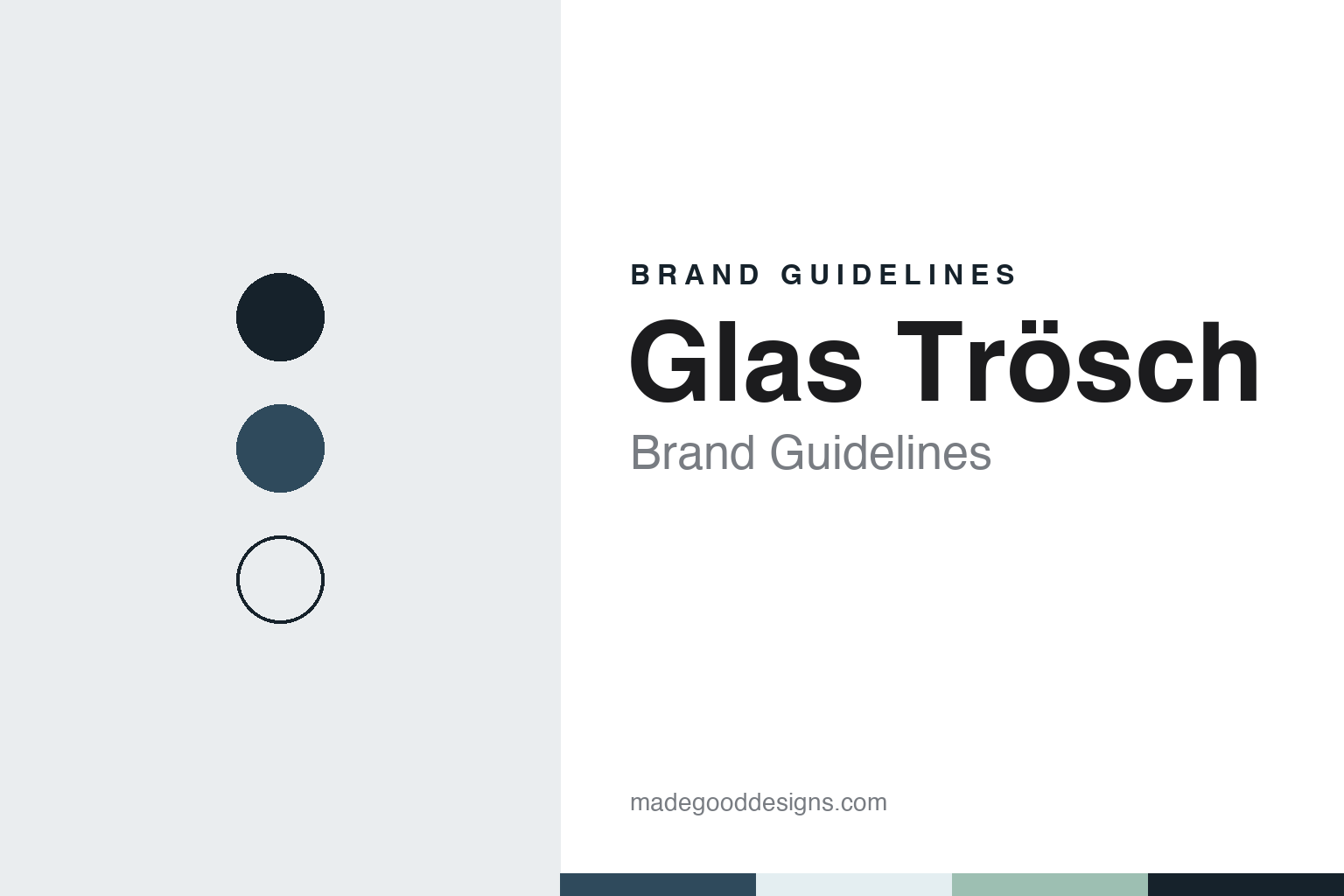
Glas Trösch Brand Guidelines
A 1905 Bützberg workshop that learned to make its own float glass.
Aa
Two constants: a slate, mist and float-edge green palette and a Swiss sans register. Abstract homage — not a Glas Trösch product or mark; no glass product, logo or nameplate is reproduced.
A Bützberg workshop
Images on glass, then mirrors, then insulating units.
Glas Trösch dates itself to 1905, when Johann Friedrich Trösch made his name as a glass specialist in Bützberg, in the Oberaargau district of the canton of Bern. The company says he had developed a method for transferring images onto glass and porcelain, and that the business began as a single workshop serving its local area. German Wikipedia gives the same founding story and names the parent company as the Glas Trösch Holding AG, also called the Glas Trösch Gruppe.
The second generation turned the workshop into an industrial firm. In 1938 the founder’s son Rudolf Friedrich Trösch converted the business into a joint-stock company, the company history says, and built a glass-cutting workshop and a mirror plant, which it describes as the foundation of its industrial growth. Switzerland remained neutral during the Second World War; the next step in the company history came in 1956, when his sons Heinz and Erwin Trösch took over the management of the company. Their era was built on multi-pane insulating glass. German Wikipedia says Heinz Trösch joined the family firm in Bützberg in 1951, began making the Heglas insulating units in 1958 and Kulmerglas in 1966, and chaired the board from 1960 to 2002.
From the late 1970s the range moved into vehicles and coatings. The company says its Swisslamex windscreen came to market in 1977, followed a year later by Swissdurex toughened single-pane glass and soon after by Swisslamex laminated glass. In 1986 it began large-scale vacuum coating and launched the Silverstar range of insulating glass, later joined by Sunstop solar-control coatings and Luxar anti-reflective glass. In 2002 Heinz Trösch handed the board chair to his son Erich Trösch; at that point, German Wikipedia says, the group had 43 processing plants, two float plants and 2,573 employees.
Colour
Making its own float glass.
The fourth generation took Glas Trösch upstream into making the base glass itself. Under Erich Trösch the group built the Euroglas float glass works at Hombourg in Alsace, which opened in 1995; a second float plant followed at Haldensleben, near Magdeburg, in 1997, and a third Euroglas site at Osterweddingen in 2006, the company says. A fourth opened at Ujazd in Poland in 2009. Writing in October 2010, the Swiss business magazine Bilanz described the Ujazd works as the largest of the group’s four float plants, supplying its processing plants further east.
That 2010 Bilanz portrait gives a snapshot of the group at mid-year: 4,317 employees across 59 plants in six countries, with Switzerland just ahead of Germany as the largest market, and Ukraine, where nine processing plants had opened in two years, newly in third place, alongside a first site in Moldova. It described a firm that sells to fabricators and builders rather than to consumers, with architects and engineers visiting its showroom in Bützberg, and listed windscreens for the Bugatti Veyron and the front screen of the Velaro high-speed train among its work.
Acquisitions widened the range. In 2001 the group bought the plants of Schwabenglas GmbH in Germany; in 2007 it opened Eurolamex laminating sites in Osterweddingen and Bützberg; in 2013 it integrated EuropTec of Oftringen, a specialist in technical glass and polymers; and in 2021 it bought the technical glass business of the Berliner Glas group, the company says. In March 2020 it announced a plan to buy Scheuten International of the Netherlands from the investor Value Enhancement Partners, subject to competition approval, glassonweb reported; the company now lists the deal as completed in 2020 and Scheuten Glass as one of its divisions.
Product work continued alongside the deals. German Wikipedia says that in 2011 the company brought out a balcony glass in Switzerland that is bonded directly to its supporting profile, with no visible fixings, and that in 2019 it worked with the Lucerne University of Applied Sciences on a ceramic digital printing process for colouring the front glass of solar modules.
Typography
Design and documentation.
Glass makers sell mainly to builders, carmakers and bottlers rather than to shoppers, and their brand pages are written for those buyers. The material does much of the visual work. Many of the large producers fill their websites and annual reports with photographs of their own float lines, furnaces and forming machines, shot and published the way each company chooses, next to close-ups of finished sheets, windscreens and bottles.
Product pages tend to follow the three big markets. Architectural ranges cover clear and tinted float glass, coated glass for solar control and insulation, laminated glass and mirrors, each usually with a range name and a technical data sheet. Automotive pages describe windscreens, side and roof glass, and glass with heating, acoustic layers or head-up-display areas. Container makers show bottles and jars by capacity, colour and finish, often with catalogue pages of standard shapes for wine, beer, spirits and food.
Colour belongs to the catalogue as much as to the logo. Flat-glass makers publish swatches for body tints and reflective coatings, and packaging makers name their glass colours, such as flint, amber and green, and show the same bottle shape in each. Corporate pages carry a second kind of identity: maps of plants, lists of countries, ownership histories and stock-market listings, which matter in an industry where many groups have grown by buying or merging with other glassworks.
The guides in this group read those public materials: founding records, owners, plants and product families, as the companies and independent sources describe them. The colours and type samples shown here are our own interpretation, not official brand assets, and no product or mark is reproduced.
Aa
A clean Swiss sans for a fourth-generation family group. (Specimen set in Manrope, a sans STAND-IN; NOT the Glas Trösch logo.)
Glas Trösch
Four generations, seven divisions.
The group remains in the family. In December 2017 USGlass Magazine reported that Erich Trösch, chief executive for 16 years, would become chairman from 1 January 2018, handing the chief executive role to Fabian Zwick, a physicist who had held several management posts in the group since joining in 2002. German Wikipedia gives the operating headquarters as Buochs, in the canton of Nidwalden, while Bützberg remains a production site. The company describes itself as Europe’s biggest family-run glass manufacturer and processor, with about 6,000 employees at 70 locations in 16 countries.
Its website groups the business into divisions for architecture, glass production under the Euroglas name, technical glass under EuropTec, rail glazing, automotive and aviation, Scheuten Glass and OKALUX, a maker of insulating glass with inserts between the panes for daylight design. German Wikipedia adds that the group is a member and licensor of the Sanco alliance of more than 50 mid-sized insulating-glass makers. In June 2023 the Belgian broadcaster VRT reported plans for a new flat glass plant on a former Philips site in Lommel, in the province of Limburg, with about 300 jobs; Glass International said it would make glass mainly for insulating windows and solar panels, and in May 2024 Brussels Morning reported that the Flemish environment minister had granted the permit.
For a design guide, Glas Trösch shows how a family glass group can carry product brands such as Silverstar and Swisslamex under one Swiss name. Compare Vetropack, another Swiss glass maker, and Saint-Gobain, a European flat glass group. For this guide we use a cool slate, a pale mist and a float-edge green with a sans, an unofficial interpretation; no product or logo is reproduced.
Explore & save
Keep Glas Trösch’s identity on hand — save it to a board in the Made Good inspiration library.
Glas Trösch identity set
Pin the Glas Trösch slate, mist and float-edge green palette and the Swiss sans register to your own board.